Project Pele progress: BWXT delivers fuel to INL
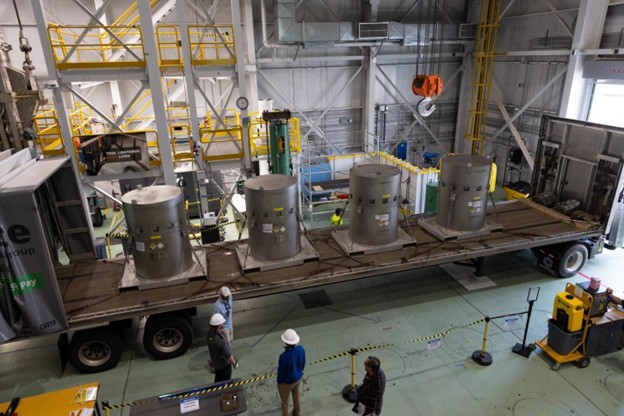
This week, BWX Technologies, alongside Idaho National Laboratory and the Department of Defense’s Strategic Capabilities Office, announced the arrival of a full core of TRISO fuel at INL’s Transient Reactor Test Facility.
This fuel will be used for the Project Pele microreactor being developed through a collaboration among the three parties (alongside the Department of Energy) and represents a major milestone for the project. As Jeff Waksman, Principal Deputy Assistant Secretary of the Army for Installations, Energy and Environment, put it, “This is real nuclear microreactor fuel delivered at its final destination, rather than some letter or memorandum promising to make fuel at a later date.”
More details: According to INL—and despite announcements coming out this week—the 40,000 fuel compacts that made up the shipment were delivered on November 5 (a video of the delivery is available here). BWXT manufactured and shipped the fuel from its facilities in Lynchburg, Va., where the company is also constructing the prototype reactor.
BWXT plans to begin formal system testing as early as 2027 and begin producing electricity at INL as soon as 2028.
While the SCO is leading Project Pele, INL director John Wagner highlighted how instrumental the DOE network has been in facilitating this project, saying, “This milestone reflects years of dedicated effort by the Office of Nuclear Energy’s Advanced Gas Reactor TRISO Fuel Qualification Program to fabricate and qualify TRISO fuel using world-class capabilities at INL’s Advanced Test Reactor and Materials and Fuels Complex, and Oak Ridge National Laboratory—capabilities that exist nowhere else in the world.”
Pele background: In May 2019, the Nuclear Regulatory Commission, DOE, and SCO signed a preliminary MOU on microreactor research laying the groundwork for Project Pele. The original goal of the project was to develop a transportable 1–5 MWe advanced microreactor.
In March 2020, the DOD awarded contracts for three projects under Pele: one to BWXT, one to Westinghouse, and one to X-energy. BWXT emerged as the frontrunner in the project with its 1.5-MWe high-temperature, gas-cooled reactor.
In August 2023 (in a webinar organized by the American Nuclear Society), Waksman said that if all went according to plan, the reactor would be turned on at INL before the end of calendar year 2025. The new operational date of 2028 represents a three-year delay in prior plans but still aims to meet a September 30, 2028, deadline set by President Trump’s Executive Order 14299.
In September 2024, the DOD announced that it had broken ground at INL’s Critical Infrastructure Test Range Complex, where the reactor is set to be tested. In July 2025, BWXT announced that it had started fabrication on the Pele reactor core.
Janus tie-in: Project Pele—of course— is not the only nuclear power–related undertaking of the DOD or the broader federal government. Most directly related is the recently announced Janus Program, which seeks to deploy an operational demonstration microreactor power plant on a U.S. military installation by 2030. The DOD has stated that Janus will build on lessons learned from Pele and that the “laboratory teams which partnered on the technical, legal, and policy aspects of Project Pele will also be working closely on the Janus Program.”
Waksman reiterated this most recently in BWXT's announcement, saying, “the army’s Janus Program will follow on to deliver affordable, reliable, commercial nuclear power to ensure that our critical infrastructure has power, even if the electric grid is disrupted.” In November, nine sites were selected for possible deployment as part of the program.
Don’t forget ANPI: Project Pele and the Janus Program are running parallel to the DOD’s separate Advanced Nuclear Power for Installations (ANPI) program, which was launched in 2024 to deploy microreactor systems at military sites. At the launch of the program, the DOD aimed to have two microreactors operational on military bases by 2030. In April of this year, the DOD announced eight companies that are eligible to receive Other Transaction Awards for the project.
At this year’s annual conference of the Association of the U.S. Army, Waksman reportedly said that Janus will differ from ANPI by virtue of having different technical requirements, reflecting recent changes in the nuclear power market, including new companies that have emerged since last year.



 2x1.jpg)