
Copper melting behavior at extreme temperatures could inform fusion materials
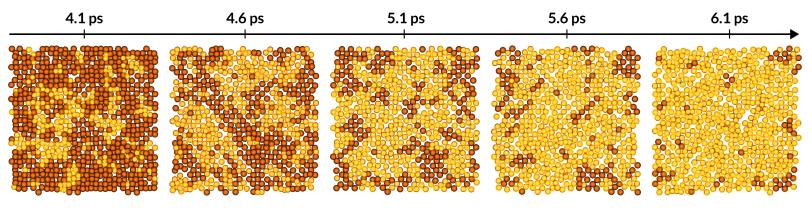
Using SLAC’s electron camera, researchers recorded timestamps of solid copper atoms (orange) as they melted (yellow) after being blasted with laser heat. This graphic shows how copper atoms changed over a period of several femtoseconds (millionths of a billionth of a second), notated here as fractions of a picosecond. Instead of the predicted collapse, the researchers saw a gradual melting. (Image: Greg Stewart/SLAC National Accelerator Laboratory)
The SLAC National Accelerator Laboratory has announced researchers have conducted experiments testing how copper melts under extreme conditions, such as those it might be exposed to in a fusion machine. The results, published in Nature Communications, found that a copper thin film was more resilient to melting than models had predicted, uncovering molecular dynamics that had been missing from calculations.
“These results greatly improve the simulations we use to predict which materials have the best shot at surviving the extreme conditions of future fusion reaction chambers,” said Mianzhen Mo, the SLAC staff scientist who led the research.