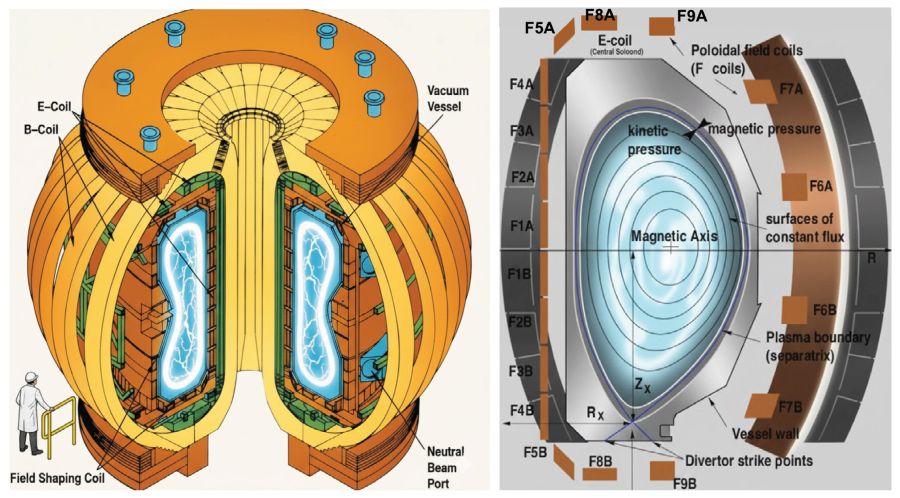
The approach: Along with researchers from the University of Houston, General Atomics, and Pacific Northwest National Laboratory, scientists from Jefferson Lab built a digital twin of DIII-D’s toroidal field coil system. According to the paper, “ML typically operates under the assumption that training data is independent and identically distributed with test or inference datasets. However, this premise often falters in environments characterized by streaming or non-stationary data, such as fusion experiments, where data distributions can change over time.”
The team wanted to find a way to predict the movement of the toroidal field coils down the line, as they shifted from the pressure of several experiments, or shots, done back to back.
“There’s a lot of drift in the TF coil data shot to shot because the behavior of the plasma is always changing,” said Jefferson Lab’s Kishan Rajput, the study’s lead author. “If you only train a model on historical data and try to use it without any updates, it would likely not be reliable.”
The framework the team created uses deep neural networks and an ML approach that continuously adapts to data as they come in. This study is, according to Jefferson Lab, the first of its kind on drifting data streams in fusion science.
The applications: “The technique that we have developed would help fusion researchers find issues before they actually happen on the physical machine,” Rajput said. “This takes us one step closer to putting AI in operations for fusion diagnostics.”
This novel online learning approach reduced prediction error by 80 percent, compared with static ML models. The new models also incorporate uncertainty quantification to aid downstream decision-making and further reducing error by another 10 percent.
Up next, Rajput hopes to train the framework on years’ worth of data to improve uncertainty quantification. “From all the aspects we consider—the uncertainty quantification, the adaptive mechanism to make sure the drifts are accommodated, the constraint with respect to time—this all indicates that it’s usable in actual operations,” he said. “That’s new for the field of fusion.”
Until then, it’s ready for use on DIII-D and is adaptable to other fusion machines, as well.