NRC cooperating with Coast Guard, Marine Minerals Administration
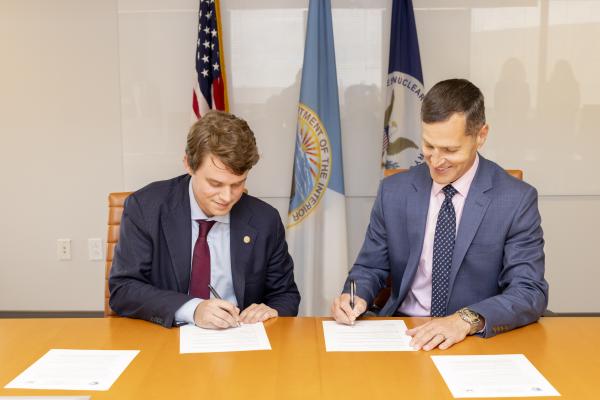
Within the past month, the Nuclear Regulatory Commission has signed memorandums of understanding to increase its cooperation with two U.S. maritime organizations. In late June, the NRC signed an MOU with the U.S. Coast Guard to strengthen coordination on civilian maritime nuclear projects, including floating nuclear power plants and civilian nuclear propulsion. On July 21, the NRC signed an MOU with the newly formed Marine Minerals Administration (MMA) to improve cooperation regarding potential future nuclear projects on the Outer Continental Shelf.
New agency, new agreement: The MOU between the NRC and the MMA—an agency that was formally established July 10 by combining the Bureau of Ocean Energy Management with the Bureau of Safety and Environmental Enforcement—is meant to “clarify jurisdiction regarding any nuclear energy projects that are authorized on the U.S. Outer Continental Shelf (OCS), in order to develop a streamlined process that would minimize the duplication of effort and aid the Participating Agencies in the successful completion of their missions and assigned responsibilities.”
Matt Giacona, acting director of the MMA, said that “submerged reactor systems have been safely deployed in naval applications for decades, demonstrating their potential as a reliable source of energy in demanding marine environments. While no commercial deployment on the Outer Continental Shelf is planned or approved at this time, it could greatly strengthen America's energy security in the future.”
He also called the MOU “an important step toward building the technical expertise, regulatory clarity, and interagency coordination needed to assess whether and how this technology could be responsibly implemented in the years ahead.”
MOU details: According to the MOU, the MMA “has authority under 43 U.S.C. 1337(p)(l)(C) to grant a lease, easement, or right-of-way for activities on the OCS that produce or support the production, transportation, storage, or transmission of energy from sources other than oil and gas,” while the NRC “has authority over licensing, permitting, construction, operation, inspection, and decommissioning of civilian nuclear projects under the jurisdiction of the United States, including on the OCS.”
The agreement adds that both the MMA and the NRC “agree to notify each other and coordinate in advance of issuing any license or permit to an applicant for an OCS civilian nuclear project. Notification and coordination should occur as early as possible in the licensing and permitting process, such as during the preapplication stage.”
Jeremy Bowen, director of the NRC’s Office of Advanced Reactors, said that th3 agreement “creates a clear framework for how our agencies will work together and ensures our processes remain efficient, transparent, and technically robust. By combining expertise, we can provide clarity and confidence to potential future applicants and enable the safe, secure, and efficient deployment of emerging nuclear technologies.”
Coast Guard cooperation: The MOU between the NRC and the Coast Guard establishes a framework for the coordination and implementation of requirements governing the design, construction, operation, and oversight of civilian nuclear reactors on marine vessels or facilities that fall under Coast Guard jurisdiction.
This new agreement was one of the topics covered in a workshop that was held in Washington, D.C., on June 23 by the USCG Maritime Nuclear Policy Division in collaboration with the United States Center for Maritime Innovation on “the future of nuclear power in commercial maritime operations.” The new MOU, which is to remain in effect for 10 years, replaces one from 1973 between the USCG and NRC’s predecessor organization, the Atomic Energy Commission, and modernizes how the agencies will work together to oversee maritime nuclear systems.
Civilian maritime nuclear projects: According to the new MOU, “Civilian owners and operators are developing new commercial nuclear technologies for use in the marine transportation system, including nuclear propelled vessels, floating nuclear power plants, and other maritime nuclear power technologies.” This is why greater coordination is needed between regulatory authorities and the various civilian maritime nuclear projects (CMNPs), which are defined as “civilian commercial, industrial, testing, or research activities involving nuclear reactors.”
Improved coordination is expected to facilitate “the reliable and efficient licensing and regulation of CMNPs” in five main areas: fostering communication and cooperation between the agencies; clarifying agency roles and responsibilities; coordinating schedules, key milestones, and joint technical reviews; coordinating safety, security, and environmental protection efforts; and promoting consistent requirements to ensure adequate public health and safety for CMNPs.
Division and coordination of authority: “The NRC and USCG will coordinate their inspections, reviews, examinations, approvals, and related compliance activities through the appropriate offices, while each retains and exercises its independent authorities,” the MOU states.
It also stipulates that when either the NRC or USCG “receives a preapplication or application for a CMNP, it will promptly notify the other and jointly develop a coordinated review schedule and milestones.” The agencies can then “incorporate review and inspection schedules into their respective project plans, invite each other to relevant coordination meetings, and promptly inform one another of any anticipated inability to meet agreed schedules or milestones and the reasons for any delay.”