-3 2x1.jpg)
DOE Nuclear Energy Launch Pad “extends and expands” pilot programs
The Department of Energy is set to expand on its Reactor Pilot Program and Fuel Line Pilot Program by introducing the Nuclear Energy Launch Pad, a DOE-led program to integrate the authorization, testing, and operation of reactors and fuel facilities from private nuclear developers. Furthermore, it will include two pathways—Launch Pad INL and Launch Pad USA—with options to access Idaho National Laboratory land or other sites around the nation.
The DOE plans to transition future pilot program applicants to the new Launch Pad model. Application requirements and review criteria will mirror those used in the reactor and fuel line pilot programs, and projects already in those programs will transition to Launch Pad with no need to reapply.
Broader fuel cycle eligibility: Importantly, while the Fuel Line Pilot Program was developed specifically to support fuel fabrication for reactors being developed under the Reactor Pilot Program, the Launch Pad is open to developers of fuel enrichment and reprocessing technologies as well.
Launch Pad is an initiative of the National Reactor Innovation Center. According to NRIC, the program “supports developers working across a range of nuclear technologies, including advanced reactors, fuel fabrication, fuel enrichment, fuel reprocessing, and other related innovations for different energy applications.”
Beyond authorization? According to the DOE, the Launch Pad builds on the pilot programs by expanding “beyond authorization to include the testing and operation necessary to scale first-of-a-kind technologies toward wide-scale commercial deployment.”
In fact, the Reactor Pilot Program included construction, operation, and decommissioning of test reactors in addition to authorization. According to the Reactor Pilot Program request for applications (RFA) released in June 2025, “The purpose of constructing and operating these reactors is to establish fundamental technological viability under DOE’s authority to foster research and development in nuclear reactors and not to demonstrate the reactors’ commercial suitability. Therefore, these reactors fall under the jurisdiction of DOE.” The RFA also stated that under the Reactor Pilot Program, reactors “will serve research, development, and demonstration purposes, and will not provide commercial power or services.”
While testing and operation of pilot reactors was included in the Reactor Pilot Program, the Launch Pad program appears to extend that plan. Its approach “ensures continuity from initial pilot authorization through extended operational validation, reducing the risk and timelines for advanced reactors and other advanced nuclear facility commercialization,” according to the DOE.
Launch Pad rollout: The DOE and NRIC made the Launch Pad announcement on March 5.
"The Launch Pad initiative will empower developers by providing the resources and support necessary to advance the deployment of innovative nuclear technologies and contribute to a sustainable and secure energy future for our nation,” said Rian Bahran, the DOE deputy assistant secretary for nuclear reactors. "Through this initiative, developers can access infrastructure, expertise, and services essential for the siting, construction, and operation of their nuclear facilities.”
According to the announcement, NRIC will accept and evaluate applications for the Launch Pad annually, with the initial RFA expected in the next few months.
More information on the Nuclear Energy Launch Pad can be found at nric.inl.gov. An Industry Day will be announced at a later date in conjunction with the release of the RFA for nuclear energy developers.
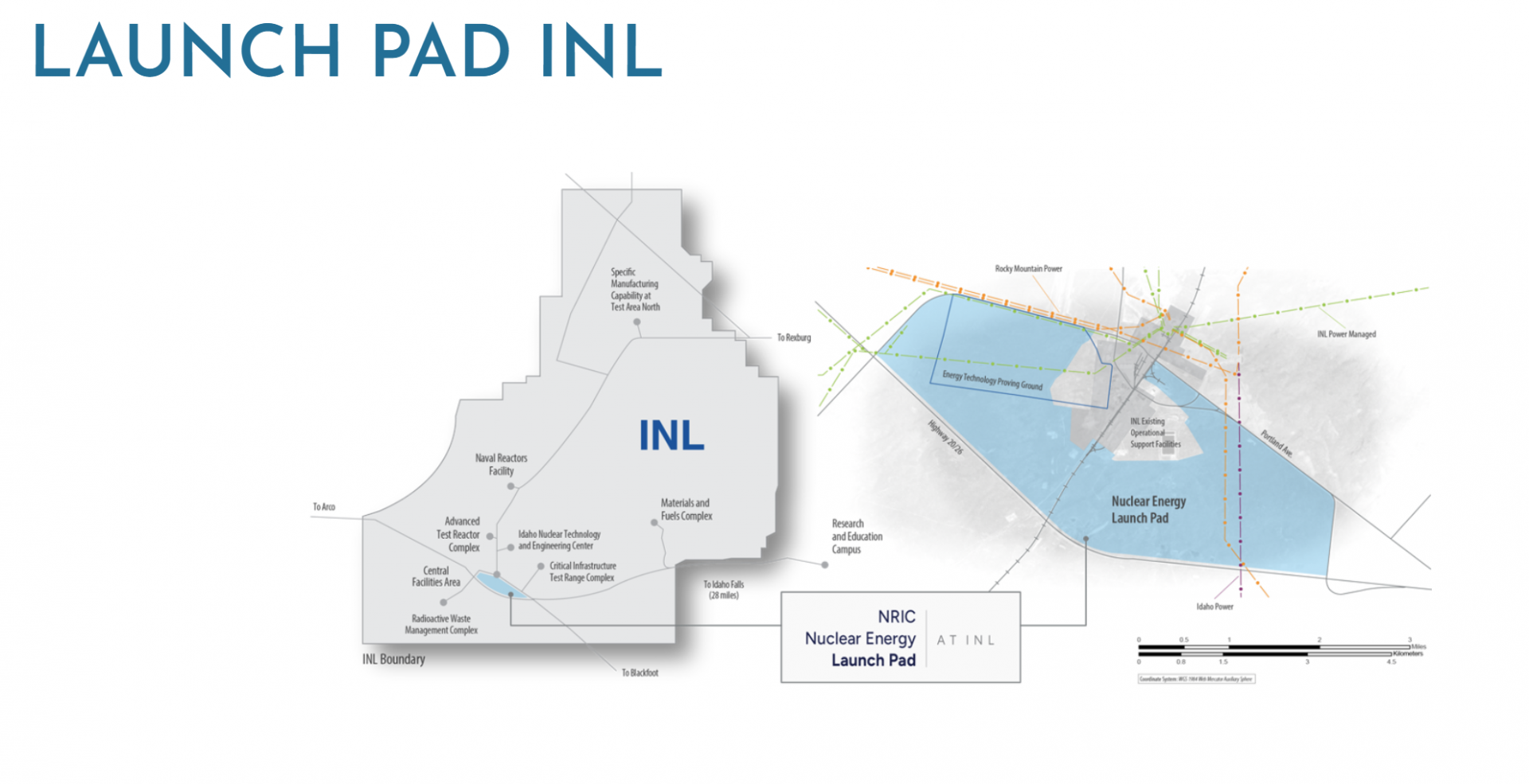
INL involvement: Among other notable components of the Launch Pad is a pathway for private developers to have access to land, infrastructure, and resources at INL.
According to NRIC, private developers selected for Launch Pad INL will receive an allotted parcel of land within more than 2,000 acres on the vast INL site that have been designated for the program. The acreage of allotted parcels will depend upon each developer’s scope of work and will be sized to house a developer’s facilities and required standoffs.
The parcels will be sited near INL’s central facilities and have a noncommercial transport route to the lab’s Materials and Fuels Complex. They will also have access to electrical interconnect, potable water, and fiber lines.
Developers must cover the costs of connecting to electrical, water, and fiber infrastructure, as allowed by applicable laws and regulations. Developers will also be responsible for all local infrastructure development required for their facility to function, such as buildings and parking lots.
“The Nuclear Energy Launch Pad represents a significant evolution in the ecosystem for advancing nuclear technologies from concept to deployment," said INL director John Wagner. “Launch Pad INL offers nuclear developers something unprecedented: an 890-square-mile federal site with more than 75 years of reactor testing experience, existing infrastructure, direct access to national nuclear expertise and streamlined regulatory pathways—all enabling developers to move from demonstration to deployment at the pace America's energy security demands.”
According to the announcement, the Launch Pad INL provides benefits like the following:
- Access to land suitable for different nuclear applications and regulatory deployment.
- Accelerated identification, allocation, and assessment of sites.
- Access to INL utilities and services.
- Direct access to specialized nuclear expertise, as needed.
- Assistance navigating nuclear regulations for DOE authorization or Nuclear Regulatory Commission licensing.
- A flexible contract framework with the DOE and INL.
Another path: The initiative’s second pathway, Launch Pad USA, provides developers with access to other DOE sites, national laboratories, and nonfederal sites.
According to the DOE and NRIC, the following are benefits of this option:
- Remote or project-specific access to specialized nuclear expertise at INL or other national laboratories, as needed.
- Assistance in navigating nuclear regulations for DOE authorization.
- A flexible contract framework with the DOE.
- High flexibility to leverage unique regional or project-specific advantages.
Pilot program basics: Both the Reactor Pilot Program and the Fuel Line Pilot Program were launched in 2025, with RFAs in June and July, respectively. The DOE has accepted 11 projects into the Reactor Pilot Program. The original plan was for at least three reactors to achieve criticality by July 4, 2026, and the 10 selected companies are quickly making progress. At ANS’s 2025 Winter Conference and Expo, Energy Secretary Chris Wright said the DOE is committed to getting at least one or two critical by Independence Day.
The Fuel Line Pilot Program, meanwhile, is to establish a domestic nuclear fuel supply chain for those testing new reactors and support the reactor pilot participants. Five companies were selected within the first few months of the program’s start. According to the DOE’s March 5 announcement, nine projects have been accepted into the Fuel Line Pilot Program.

 2x1.jpg)