Imaginary Energies allows users to design futuristic fission and fusion power plants
The University of Michigan’s Fastest Path to Zero Initiative has launched Imaginary Energies, an interactive, generative visualization tool meant to encourage members of the public to imagine future designs for fission and fusion energy power plants. Including a waste management facility on site is as easy as checking a box, and the tool also allows users to add wind, solar, hydro, and other clean-energy facilities. The AI tool was inspired by a design workshop that the university held in 2023.
As Department of Nuclear Engineering and Radiological Sciences assistant professor Aditi Verma, a Fastest Path
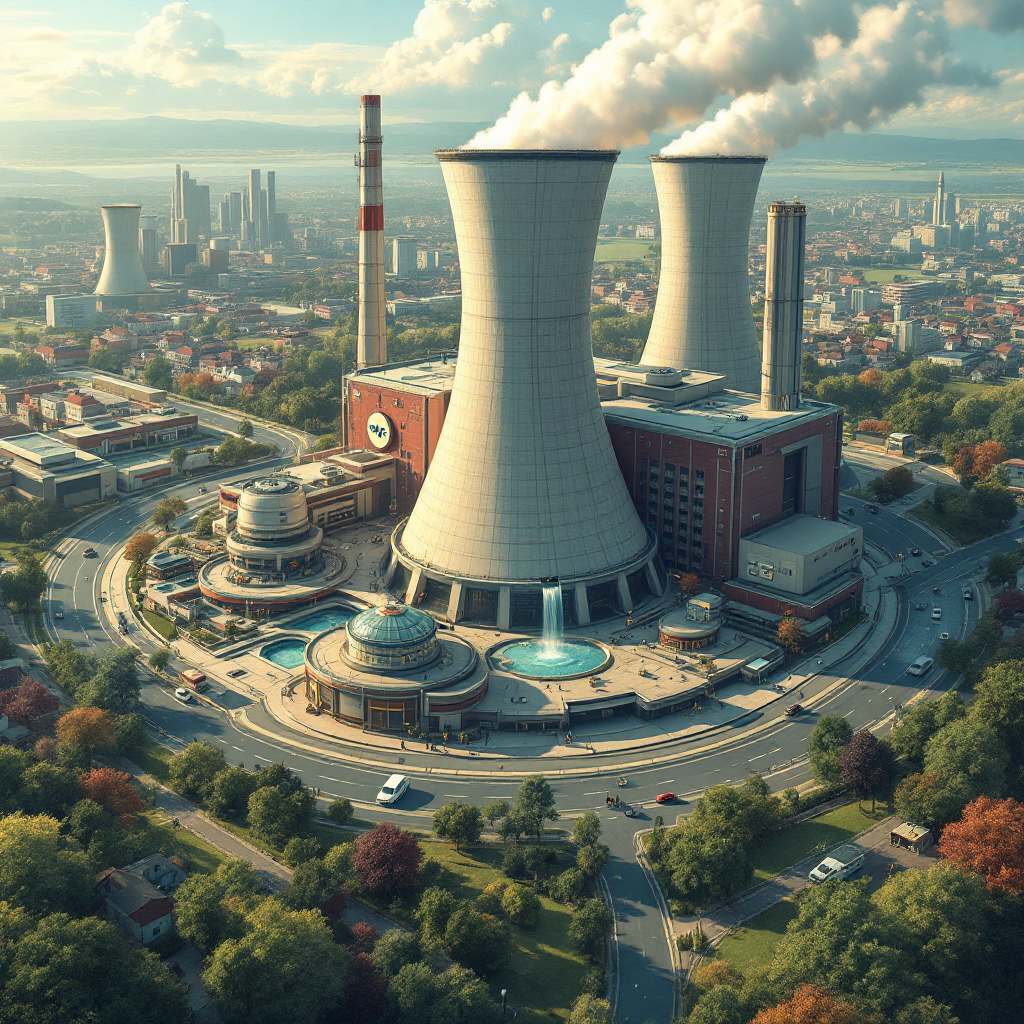
A user-generated depiction of a power plant is described as "a small, intimate fission energy facility in a . . . retrofuturistic future . . . . The community center, a big waterfall and [ring] road are around the reactor." (Image: Imagine Energies)
team member and Imaginary Energies cocreator, said, “We saw vividly how intrigued and delighted people were to have a say in designing local energy facilities. That experience demonstrated how powerful participatory design could be and sparked the desire to scale the approach beyond a single workshop and reach the broader public.”
How it works: Imaginary Energies guides users through a series of nontechnical inputs. Users first select their cultural or community values and then move on to variables like energy type, location, facility size, visual style, surroundings, and special features. They can choose to place their facilities in an urban or rural setting, can experiment with different scales, and can incorporate other elements into their designs like public plazas, educational facilities, public art, and gardens.
Based on the user’s specific choices, Imaginary Energies then generates an AI image of the resulting energy facility. It can generate images of power facilities using only one type of energy technology or facilities using a combination of technologies.
Idea bank: Users can also choose to geolocate their designs on a Mapbox-powered interactive globe, where the image can then be seen by anyone exploring the map.
Fastest Path intends for the various submissions to eventually grow into a community-sourced idea bank, which can be analyzed to gain insights into how people envision energy infrastructure.
Imaginary Energies is not meant to evaluate the feasibility or performance of energy facilities, the University of Michigan stresses. Rather, the tool “asks a different question: What should a future energy facility look and feel like, and how might it reflect the values of the people it serves?”
Try it online: Imaginary Energies has already been used by a number of students and instructors at the university. Anyone who is interested in experimenting with the AI tool can find it online. The site also features a gallery of fascinating images that have been created using Imaginary Energies.
About Fastest Path: The Fastest Path to Zero Initiative was launched by the University of Michigan in 2019 to support the institution’s commitment to accelerating the deployment of carbon-free energy solutions to combat climate change. The initiative has “a mission to empower communities and policymakers with the tools, knowledge, and resources needed to achieve fair and sustainable energy transformations..”
In addition to Imaginary Energies, other programs launched by Fastest Path include the Global Fusion Forum, which educates and gathers public input regarding fusion energy; PEANuT, a data-driven tool for assessing the global readiness for U.S. nuclear technology exports; PLANET, which focuses on understanding local attitudes toward nuclear energy; and STAND, a siting tool that helps identify communities willing to host advanced nuclear facilities.