-3 2x1.jpg)
NASA’s radioisotope-powered science will persevere on Mars
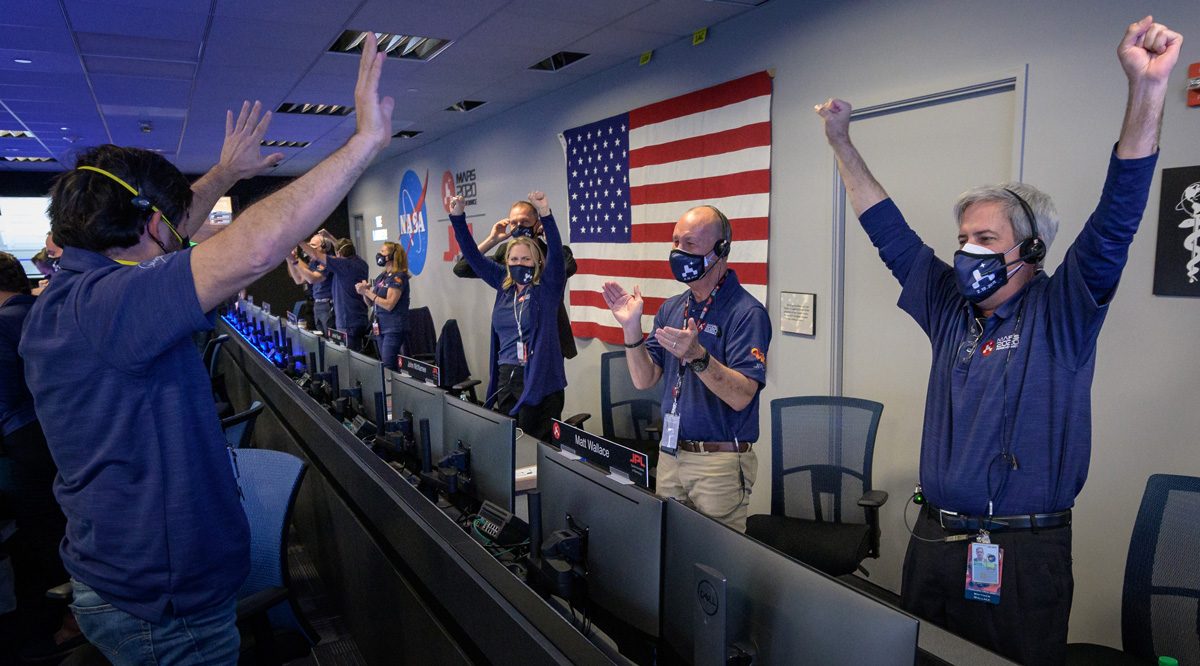
Members of the Perseverance rover team in Mission Control at NASA’s Jet Propulsion Laboratory react after receiving confirmation of a successful landing. Photo: NASA/Bill Ingalls
NASA mission control and space science fans around the world celebrated the safe landing of the Mars 2020 Perseverance rover on February 18 after a journey of 203 days and 293 million miles. Landing on Mars is difficult—only about 50 percent of all previous Mars landing attempts have succeeded—and a successful landing for Perseverance, the fifth rover that NASA has sent to Mars, was not assured. Confirmation of the successful touchdown was announced at NASA’s Jet Propulsion Laboratory in Pasadena, Calif., at 3:55 p.m. EST.
“This landing is one of those pivotal moments for NASA, the United States, and space exploration globally—when we know we are on the cusp of discovery and sharpening our pencils, so to speak, to rewrite the textbooks,” said acting NASA administrator Steve Jurczyk. “The Mars 2020 Perseverance mission embodies our nation’s spirit of persevering even in the most challenging of situations, inspiring, and advancing science and exploration. The mission itself personifies the human ideal of persevering toward the future and will help us prepare for human exploration of the Red Planet.”
Only radioisotope thermoelectric generators (RTG) can provide the long-lasting, compact power source that Perseverance needs to carry out its long-term exploratory mission. Perseverance carries an RTG powered by the radioactive decay of plutonium-238 that was supplied by the Department of Energy. ANS president Mary Lou Dunzik-Gougar and CEO and executive director Craig Piercy congratulated NASA after the successful landing, acknowledging the critical contributions of the DOE’s Idaho National Laboratory, Oak Ridge National Laboratory, and Los Alamos National Laboratory.


 2x1.jpg)