
Center for Used Fuel Research: Building confidence in storage and transport
Used nuclear fuel storage and transportation have reached a critical juncture.
Dozens of utilities need reliable data on how used nuclear fuel performs in dry storage casks and canisters to extend regulatory licenses at sites across the United States. Likewise, the Department of Energy expects to take ownership of the used nuclear fuel—termed “spent nuclear fuel” in the laws and regulations governing its stewardship—and transfer it to one or more federal staging facilities for management and disposition.
Meanwhile, dozens of reactor companies are testing prototypes of advanced reactors and advanced reactor fuels. Eventually, regulators and industry must also verify the safety and security of storage methods for these advanced fuel types.
To help address these challenges, the DOE established the Center for Used Fuel Research (CUFR) in January 2026 for work related to the long-term storage and transport of used nuclear fuel.
The CUFR, based at Idaho National Laboratory, coordinates research efforts and capabilities across several national laboratories and other sites to develop innovative technologies and solutions, to conduct applied research that helps support and maintain regulatory compliance, and to enable public confidence in storing and transporting commercial and DOE-managed used nuclear fuel.
It’s the job of Gordon Petersen, director of the CUFR, to ensure the applied research and development activities remain focused on work of mutual benefit to the DOE’s mission and the nuclear industry. Additionally, he will receive guidance from an executive technical council consisting of national laboratory leadership and representatives from the Nuclear Energy Institute, the Electric Power Research Institute (EPRI), the Shoshone-Bannock Tribes, and the Office of the Governor of Idaho. The CUFR will also manage relationships with domestic and international collaborators.
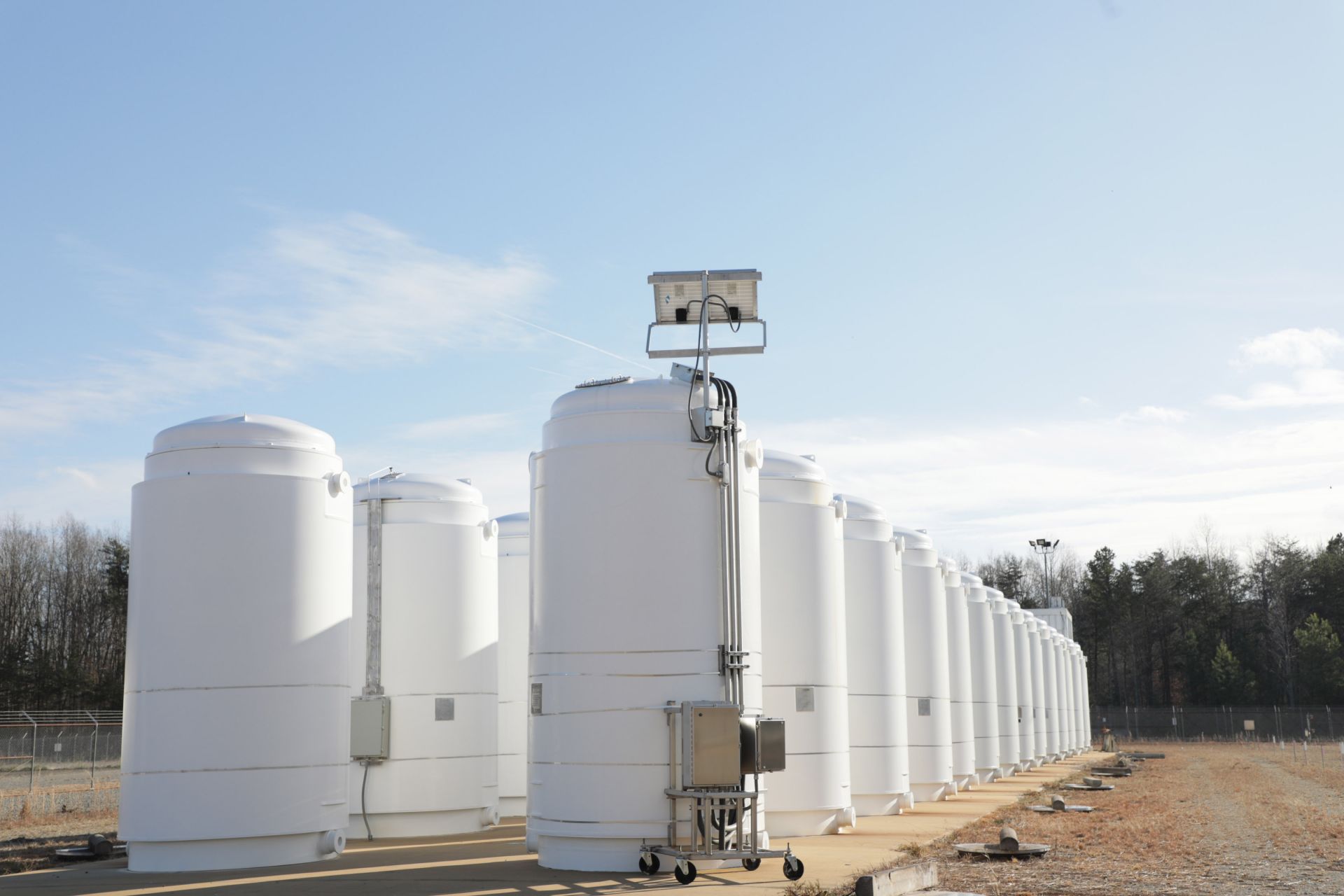
The DOE’s High-Burnup Research Cask (center), shown at Dominion Energy’s North Anna site, is moving to INL in 2027. (Photo: DOE)
Current research projects
The CUFR’s formation comes as INL prepares to receive a high-burnup research cask of used nuclear fuel from Dominion Energy’s North Anna power plant in Virginia.
The cask is one of several long-term research projects conducted through the CUFR that will provide data about conventional used nuclear fuel storage for industry and regulators. The CUFR’s research is structured into three categories: used nuclear fuel performance, canister performance and aging management, and innovations. Innovations research includes demonstrating inspection technology, canister designs for DOE-managed fuel, and support for the federal staging facilities.
“The center itself has a broad purview,” Petersen said. “With DOE moving the High-Burnup Research Cask from Virginia to INL, the Office of Nuclear Energy wanted to create a center that would coordinate and manage specific research and development for the fuel in the cask and other activities, capable of integrating the interests of many domestic, industry, and international partners.”
The High-Burnup Research Cask Project
The High-Burnup Research Cask, scheduled for transport to INL in 2027, contains high-burnup used nuclear fuel that was irradiated at North Anna between 1989 and 2010. High-burnup fuel spends extra time in the reactor core undergoing additional neutron irradiation, ultimately allowing more energy extraction from a given fuel assembly and extending the time between refueling outages.
The cask is heavily instrumented to monitor temperature and pressure over time, providing real-world data on fuel and cladding behavior during extended storage. The 32 fuel assemblies in the cask are divided into four different kinds of cladding currently used by industry: Zircaloy-4 assemblies, low-tin Zircaloy-4 assemblies, and Zirlo assemblies, all designed by Westinghouse; and M5 assemblies designed by Framatome. All the assemblies were removed in different outages, depending on the cladding type.
The project provides data to support aging management at nuclear power plants and license renewal with the Nuclear Regulatory Commission. The project also increases confidence in used nuclear fuel storage by validating models and addressing uncertainties associated with high-burnup used nuclear fuel storage and transportation.
The data generated from the decades-long project is anticipated to confirm models that show no degradation of high-burnup used nuclear fuel in dry storage. The CUFR’s researchers estimate that a minimum of 50 nuclear power plants will benefit from the data generated from the High-Burnup Research Cask Project.
“Much of the industry is planning to use high-burnup fuel,” said Jon Carmack, the CUFR’s initial interim acting director. “The industry is looking for new and better ways to be more efficient, and high-burnup fuel is a way to increase revenue streams and profit margins. We need to certify that the containers are capable of storing high-burnup fuel for its life cycle.”
Using sensors installed in the cask, EPRI has continuously collected temperature data since the cask was loaded in 2017. Prior to shipment to INL, personnel will collect a gas sample to analyze hydrogen content, the amount of water vapor in the cask, and whether any fission gas is detectable, which could indicate failed cladding.
At INL, researchers will remove the fuel rods from the cask and examine them to determine factors such as cladding creep, hydrogen uptake, hydrogen reorientation, and mechanical properties of the cladding. Testing on the used nuclear fuel from the High-Burnup Research Cask will be completed by 2038 to provide industry data to support storage system licensing and certificate of compliance extensions.
Argonne, Pacific Northwest, and Oak Ridge National Laboratories have all conducted postirradiation examinations on nearly identical used nuclear fuel pins between 2017 and 2023 to provide baseline data. Those pins were irradiated at the North Anna nuclear power plant and have similar burnup, power history, and cladding, but they were not put into dry storage.
Researchers anticipate no degradation of used nuclear fuel within the High-Burnup Research Cask and confirmation that the existing storage systems are more than adequate to store high-burnup used nuclear fuel.
“These casks are very robust and rugged,” Carmack said. “They have a large margin between what they’re designed to do and what they’re really able to withstand. They’re very capable of doing their job for many decades, but we have to prove it.”
Canister performance and aging management
The CUFR is also evaluating the likelihood of chloride-induced stress corrosion cracking as a function of distance from ocean or brackish waters because salt-bearing aerosols are more prevalent near these areas. These studies rely on standard tests used to study steel corrosion in other industries.
“We study how steel and concrete perform when exposed to the climate,” Carmack said. “Bridges in marine environments are a perfect example. The methods that we use are identical to the way you study corrosion in other areas.”
Like other studies conducted by the CUFR, these corrosion studies will help licensees and the NRC extend certificates of compliance for canister and cask storage systems.
“You need to prove to the regulator that if they extend the use lifetime of these storage systems, they can be confident that the containment structures work,” Carmack said. “It comes down to how do we keep our reactors up and operational and use these storage systems to reliably store used nuclear fuel in the decades to come. We’ve got to have a reliable, safe, and secure storage system.”
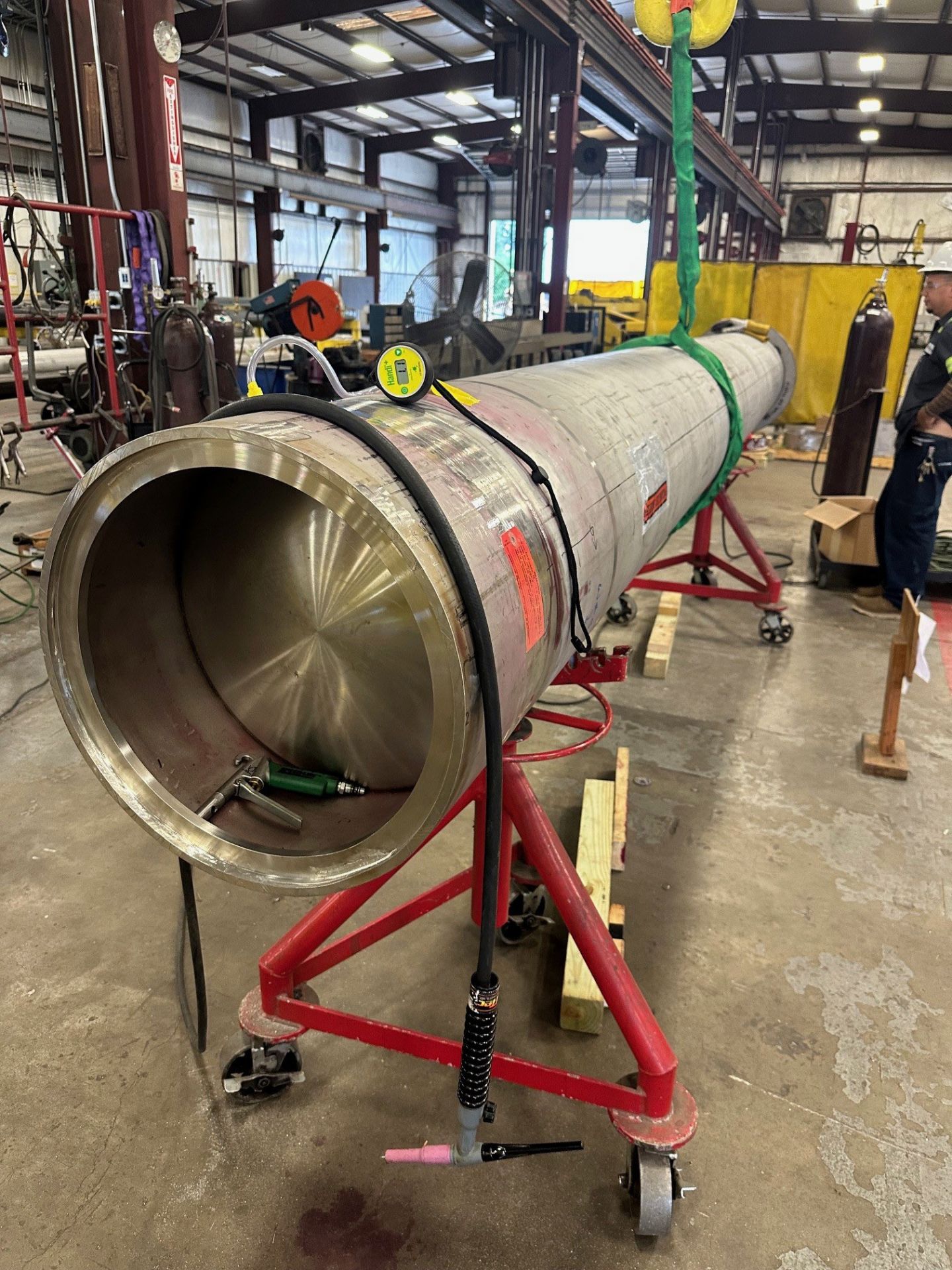
A prototype of the DOE standard canister utilized in the Road-Ready Demonstration Project undergoing a leak test at INL. (Photo: DOE)
Innovations
The Road-Ready Demonstration Project is led by the Idaho Cleanup Project and includes collaborations with DOE-NE to develop and demonstrate new technology for DOE-managed used nuclear fuel handling, transportation packaging, and container closure. The project will package a limited quantity of used nuclear fuel from Fort St. Vrain—a high-temperature gas reactor that operated commercially in Platteville, Colo., from 1979 to 1989—in a dual-purpose system for fuel storage and transportation.
To accomplish this, the CUFR designed and is testing a standard canister to hold DOE-managed used nuclear fuel; internal hardware specifically designed to load and secure Fort St. Vrain fuel; and remotely operated support systems for used nuclear fuel loading, storage conditioning, canister welding, and canister inspection. The Idaho Cleanup Project will operate these systems at the Idaho Nuclear Technology and Engineering Center, demonstrating to the state of Idaho the DOE’s capability to transport DOE-managed used nuclear fuel to a future federal staging facility or geological repository.
Advanced reactor fuel
While the CUFR’s mandate does not include testing storage methods for advanced reactor fuels, Carmack and Petersen said it may in the future.
“We’re not focused on advanced reactor waste at this time,” Carmack said. “But we acknowledge that it will occur in the future as these reactors come on line, start to generate used nuclear fuel, and need to store that fuel.” With more than 97,000 metric tons heavy metal of conventional light water reactor used nuclear fuel stored at more than 70 utility and DOE sites today, there are plenty of research topics on conventional fuel management to pursue well into the future.
Studying legacy used nuclear fuel from early reactor designs tested at INL and other DOE sites will likely provide a good template for advanced reactor fuels the United States may have to manage in the future.
A collaboration and information resource
In the end, Carmack and Petersen said they hope the CUFR will become the premier knowledge hub for information related to storing and transporting used nuclear fuel. This includes collaborating with international partners on data collection and experiments that are useful for multiple countries and organizations.
“We’re actively seeking and planning for these international collaborations so that we can leverage data that may already be available in other countries as well as generate data for people who are dealing with used nuclear fuel,” Carmack said. “We want to help them safely and securely store their fuel until they can organize a long-term repository. Collaborative experiments and access to data could assist meeting regulatory needs in their countries. We have a vested interest in having other nations safely and securely store their used nuclear fuel.”
“We also want to be a place where public institutions can come for trusted information,” he continued. “If a public institution is concerned about long-term storage of used nuclear fuel in their communities, we can provide information about the systems that are being used. We’re open to them reaching out to us as technical experts.”
Cory Hatch is a science writer for Idaho National Laboratory, which is managed by Battelle Energy Alliance for the Department of Energy’s Office of Nuclear Energy.