North American construction is back—smaller and faster—at OPG’s Darlington
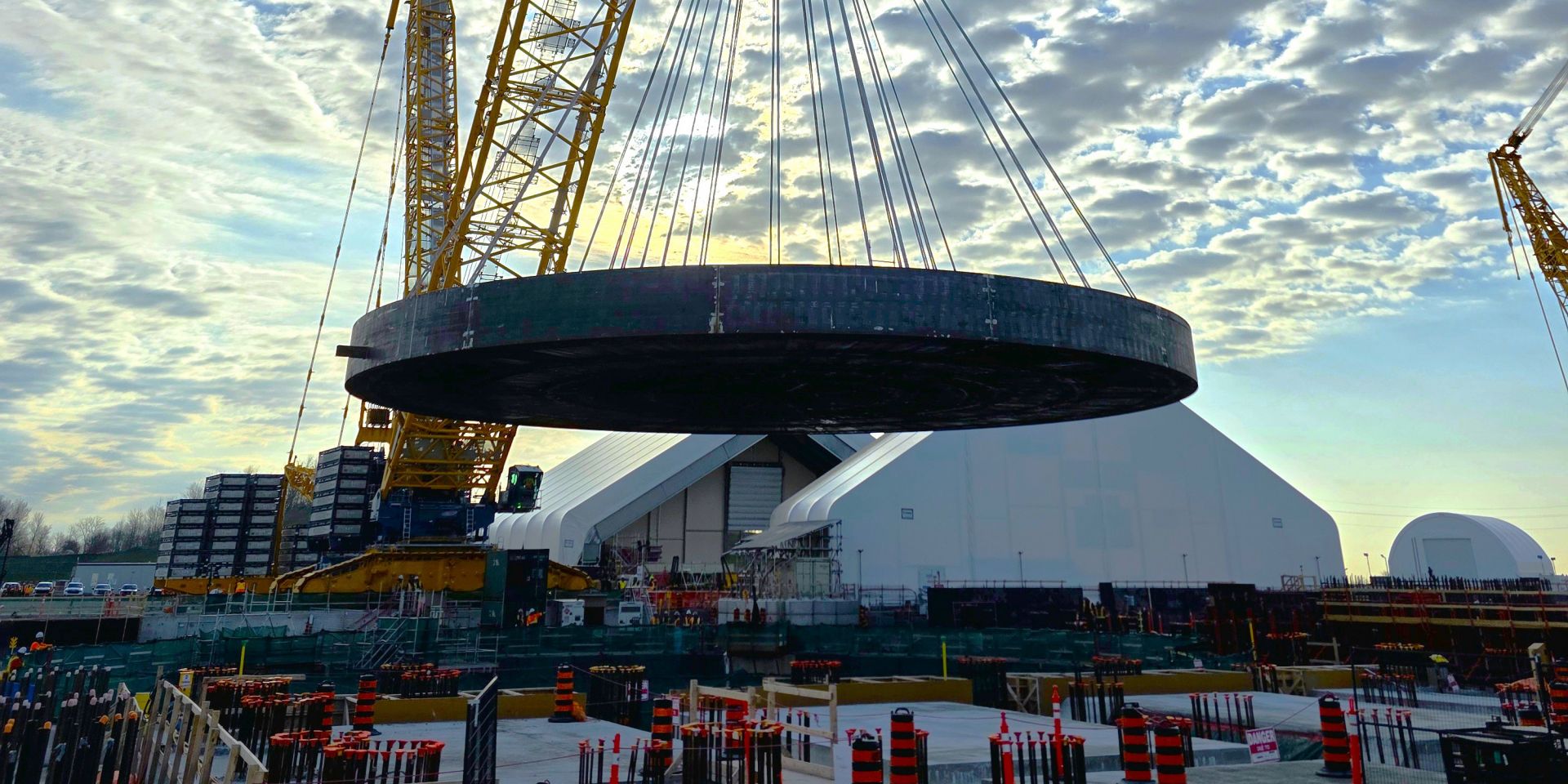
“The nuclear renaissance is real here,” said Ontario Power Generation’s Subo Sinnathamby on May 8, one year to the day after OPG secured a final investment decision to build the first of four planned BWRX-300 reactors at its Darlington nuclear power plant, and shortly after the new reactor’s foundation was lifted into place. “We got our license to construct in April and our [final investment decision] in May, and we’ve been off to the races since.”
Darlington, nearly 45 miles east of Toronto on the northern shore of Lake Ontario, has four 878-MWe pressurized heavy water reactors. The four GE Vernova Hitachi Nuclear Energy (GVH) BWRX-300 modules OPG plans to add are Canada’s first new nuclear build in more than 30 years, and the nation’s first power reactors that are not PHWRs.
Sinnathamby has been working on nuclear operations and projects at OPG for 25 years and is now chief projects officer. Prior to taking on her current role, she led work on an extensive refurbishment of Darlington’s Canadian deuterium-uranium (CANDU) reactors, extending their operating lives by 30 years. That project came in under budget and ahead of schedule.
Now, she is working on another major project, known in Ontario as the Darlington New Nuclear Project (DNNP), with OPG, GVH, and industry partners. The one 300-MWe small modular reactor under construction in Ontario now—and the three that could follow—is an important test case in Canada and the United States.
As executive vice president for advanced nuclear at GVH, Sean Sexstone is working closely with OPG and vendors to deliver the BWRX-300 at Darlington and other proposed sites. “We haven’t built new nuclear in a long time. Outside of maybe Vogtle, there has not been a significant build. And now, everyone wants to build all the time,” he said.
Sexstone was witness to work at Vogtle. He started his career with GE and later worked for CB&I when AP1000 construction was underway at Vogtle and Summer, and in China. He moved to the construction of combined-cycle gas generation before taking a role leading Aecon’s nuclear business when Aecon was participating in the Darlington refurbishment. Sexstone returned to GE in 2022. It was a “coming home,” he said, “seeing that there was a real need for new nuclear, and then from there it has just skyrocketed.”
Refurbishment sets the stage
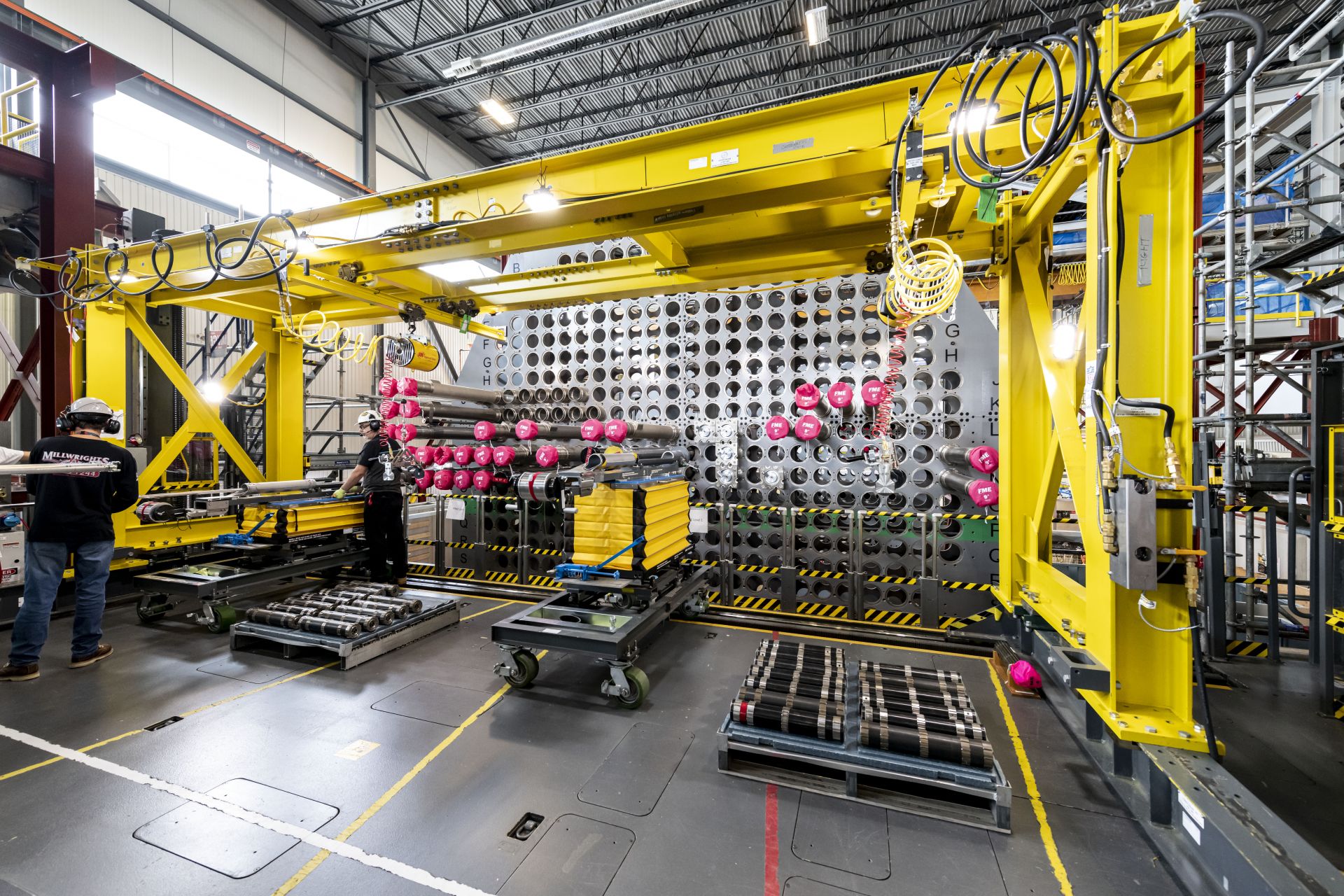
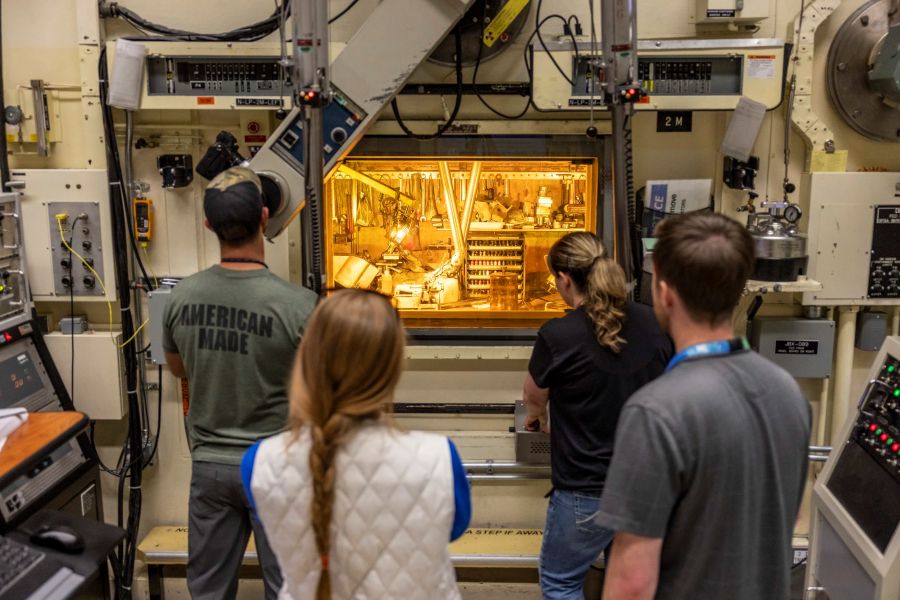
Ahead of the Darlington refurbishment, operators were trained on a full-scale CANDU reactor mock-up in a nonradiological environment. Fuel load training is shown here. (Photo: OPG)
All four units of the C$12.8 billion Darlington refurbishment were completed within a decade in what Sinnathamby said was “a tremendous experience for us. . . . I think we can claim to be probably the only organization in recent history that has had a nuclear project come in ahead of schedule and under budget.”
Sinnathamby identified key ingredients to that success: process and tools, partnering with vendors in a “one-team” culture that put the project first, building a training mock-up to ensure that workforce training was not on critical path, and upfront procurement of major components to refurbish all four units.
“The full-size mock-up paid dividends within the first unit in terms of the trades,” she said. “Not just training the trades, but also our ability to test our tooling that we use, the automated tooling, the manual tooling, full dress rehearsals like they’re working in the reactor vault.”
Getting past first-of-a-kind challenges to “rinse and repeat” for later refurbishments is a goal for the new reactor project, as well. And given that both Sexstone and Sinnathamby cited it in separate conversations, “rinse and repeat” is something of a mantra for the project team.
Building a supply chain
“We’re not new to this,” said Sexstone, noting that the “X” in BWRX-300 stands for the 10th generation and that GE has built 67 boiling water reactors.
Hitachi, GE Vernova’s partner in the nuclear business, “has built a number of ABWRs, large reactors in Japan,” Sexstone said. “They are a key partner and an owner of the GVH business. They’re very involved up front in our design, how we modularize, how we engineer, how we integrate with construction.”
Key vendors involved in the DNNP include Aecon as constructor, working with Kiewit as Aecon Kiewit Nuclear Partners; AtkinsRéalis as integration engineer; BWXT Canada as reactor pressure vessel manufacturer; and Velan Valves. In all, over 100 companies in Ontario are part of the supply chain.
“In Ontario, we’re quite fortunate that we have a very mature nuclear supply chain,” Sinnathamby said. Despite Ontario’s supply chain being focused on CANDU technology, “the quality that’s required to manufacture for nuclear was already established. What I would say is that we now have that first-mover advantage and the ability to be able to support global deployment as other countries decide to build the BWRX-300.”
While about 80 percent of the supply chain for the Darlington BWRX-300s is located in Ontario, “there are some components that we just don’t manufacture in Canada,” Sinnathamby said, naming turbines as an example. “It’s not a component that’s manufactured in Canada or in Ontario, regardless of technology.”
Canada has developed and then exported its CANDU technology and has exported its uranium as well. Now, the nation is importing light water reactor technology and the enriched fuel it requires. Canada’s operating fleet of 17 reactors uses fuel pellets manufactured in Canada from unenriched uranium.
While the fuel for Darlington’s BWRX-300s will be fabricated by GVH’s Global Nuclear Fuel, the uranium originates in the mines of Canada’s Cameco. Enrichment will be performed in the United States or in Europe. “We’ve built some diversity in our supply chain that we’re quite confident around the fuel supply risk,” Sinnathamby said.
Finding a way to integrate work between the United States and Canada is “a big thing,” Sexstone said, made easier by collaboration between the Canadian Nuclear Safety Commission (CNSC) and the Nuclear Regulatory Commission.
“Canada has done a fantastic job, and we’ve put a lot of focus on the Canadian supply chain,” Sexstone said, “but it’s also a very diverse supply chain. So we have suppliers that are in Japan or in Europe or in the U.S., and so it’s not all focused on one country. . . . We’re very confident that we can supply multiple projects across the globe.”
GVH is planning to establish a BWRX-300 engineering service center in Ontario. “That’s a big thing for us,” Sexstone said. “It’s going to be in the Durham region near the Darlington site. That’s a roughly C$70 million investment, just to provide engineering and technical services to support a fleet of X-300s. So we’re very invested in the Canadian market right now and supporting our partners.”
Workforce ready
The one-team approach that OPG built for the Darlington refurbishment and is repeating for the DNNP is something that GVH plans to carry over as an integrated project delivery approach to other BWRX-300 builds.
“OPG is a world-class operator. And what is really interesting to note is how they run their projects,” Sexstone said. As the Darlington refurbishments got underway, “one of the best strategies OPG had was seeing that the refurbishments were going to roll and then asking, ‘Where do we utilize these people?’ We utilize those people in this new unit build.”
Sinnathamby agreed. “We’re very fortunate that we have a very skilled workforce here in Ontario with the nuclear refurbishments that we’ve been doing,” she said. “With the Darlington refurbishment coming to completion, we have been able to transition some of that workforce over to the SMR project and some have been transitioned over to the Pickering refurbishment project.”
At the Canadian Nuclear Association’s 2026 conference, held in late April, Ontario Energy Minister Stephen Lecce cited 19,000 direct and indirect jobs as part of the economic impact to the province. On-site, Sinnathamby said that at peak, the DNNP’s workforce will be “probably around 2,000 as we go through the various phases of the project.”
Driving down cost and schedule
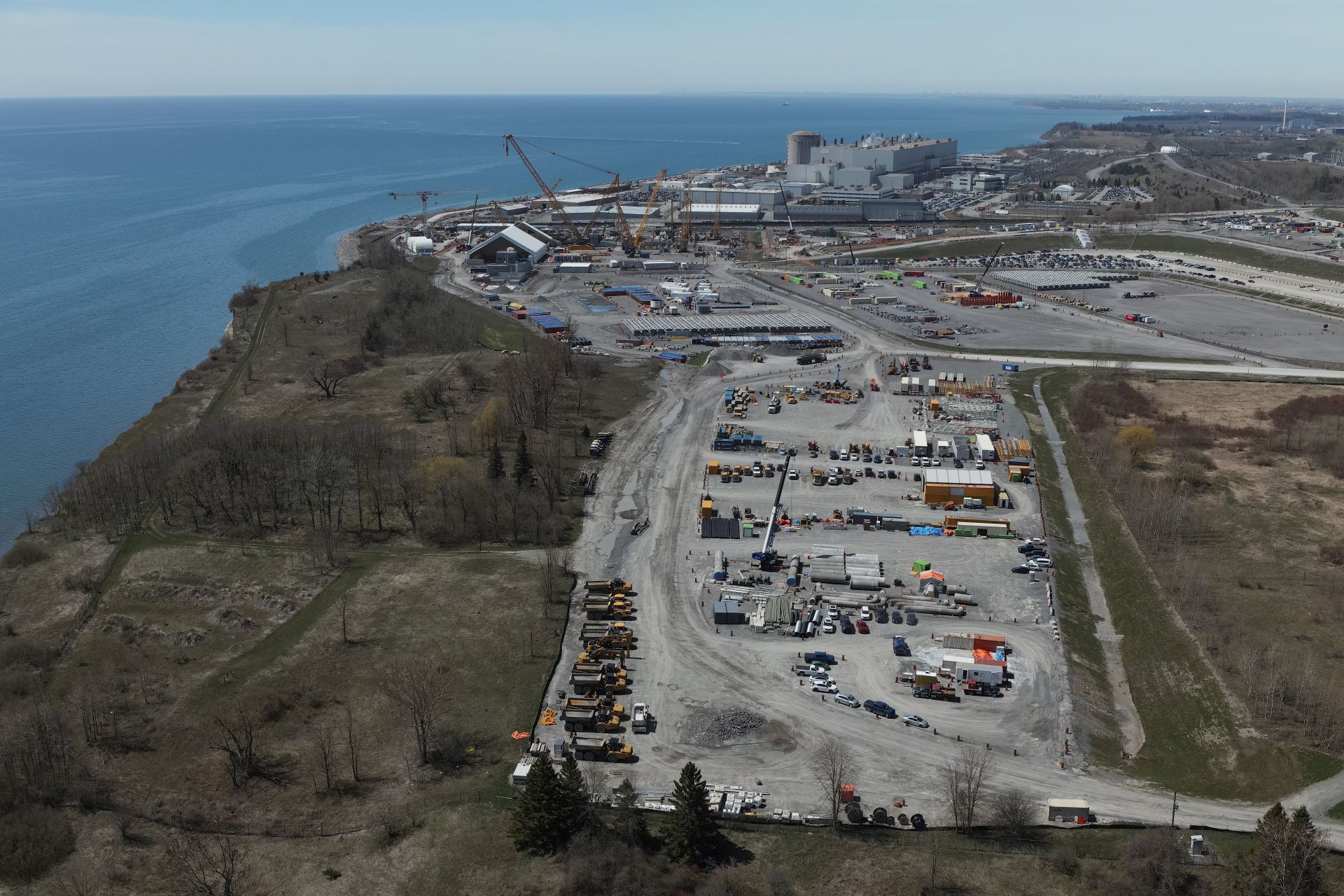
A view in April of the Darlington site, roughly 45 miles east of Toronto on the northern shore of Lake Ontario. The DNNP site is in the foreground, and Darlington’s four operating CANDU reactors are visible in the background. (Photo: OPG)
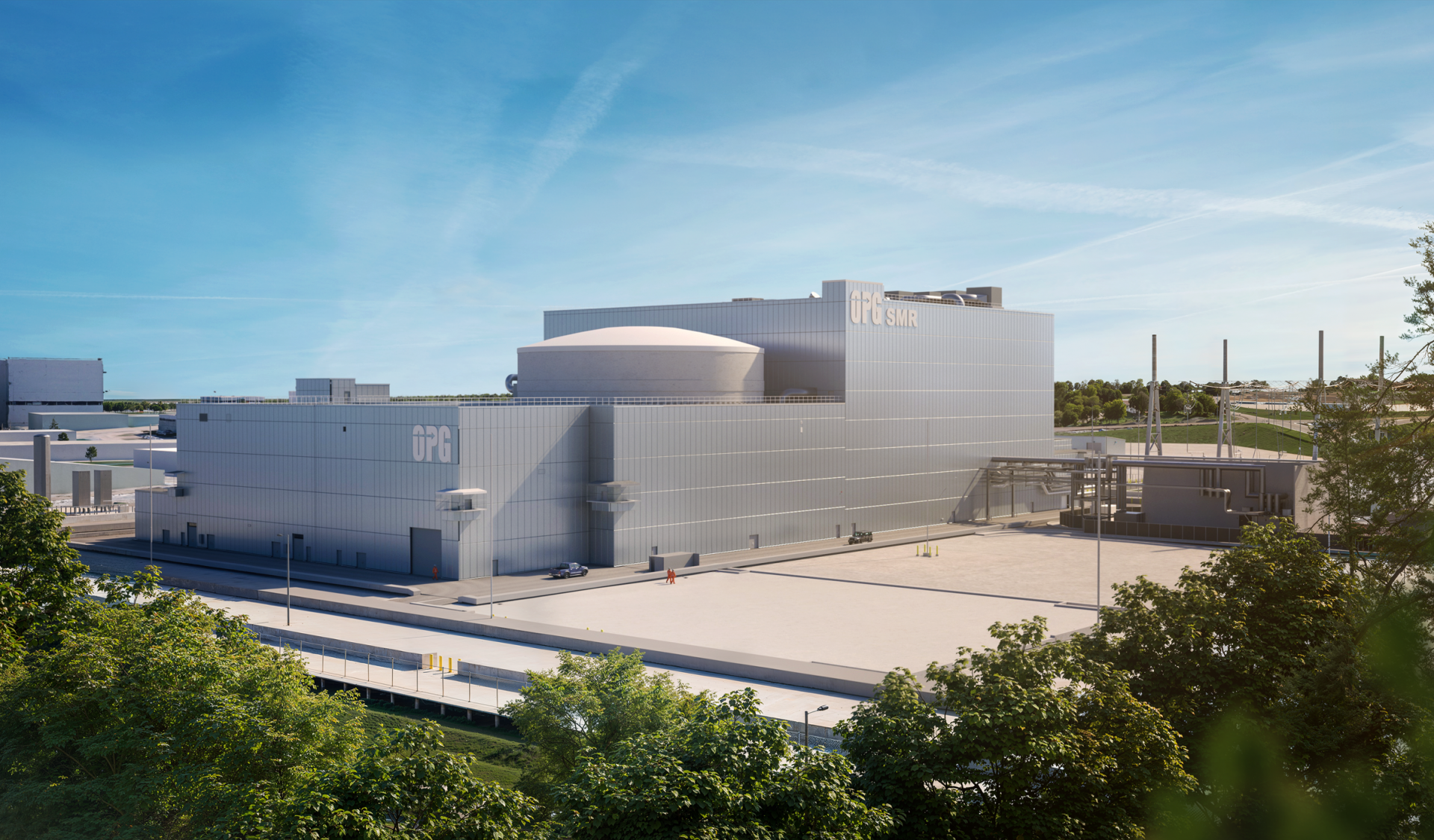
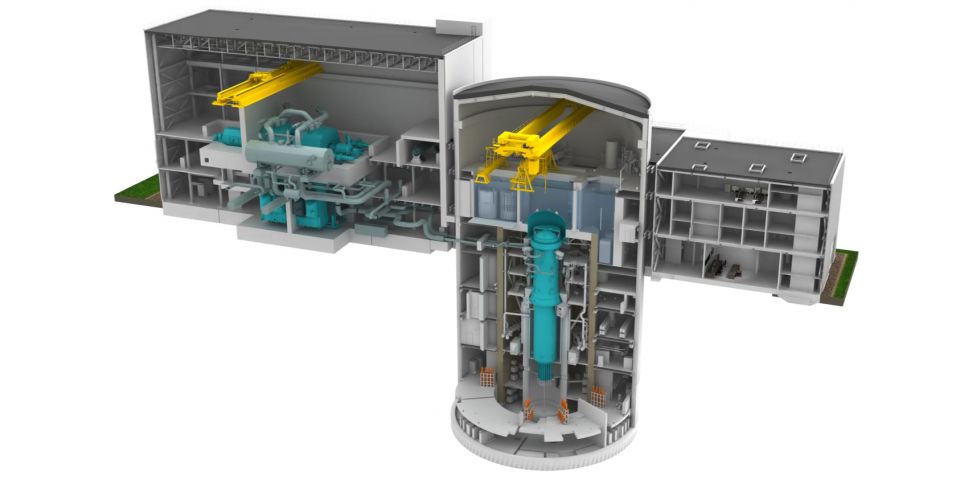
A depiction of the BWRX-300 now under construction at Darlington. (Image: OPG)
The first Darlington CANDU went off line for refurbishment in October 2016. The last of the four units returned to service in March 2026. Over nearly a decade of work, OPG improved on cost and schedule delivery.
“Our philosophy on how we executed refurb was do the first unit standalone. We knew it was going to be tough, and it was tough,” Sinnathamby said. “It was a ‘night fight’ right to the last day. But the key part of that was we had a very robust lessons-learned process. Between our first unit and the last unit, we were able to shave a year off in construction schedule and had significant cost savings.”
OPG is working with a C$20.9 billion project envelope and a similar strategy for the DNNP. “We have released $7.7 billion for what we call the common systems, common to all four units, and for the first unit,” Sinnathamby said. That includes about C$1.6 billion for common systems, including the cooling water intake system, administration building, and other common site infrastructure.
“The first unit cost is C$6.1 billion as a standalone,” she added, with the remaining units ranging from about C$5 billion down to about C$4 billion for the final unit.
“When we started construction, [the design] was at the maturity level that we needed to start construction. The beauty of doing this first unit standalone is you get the construction experience, you get the first-of-a-kind learnings behind you, the engineering is complete, all the analysis to support it is complete,” Sinnathamby said. She added that the first unit is proving to be “just as hard as the first unit on Darlington refurb was, and we’re not surprised by how hard it is. The team will figure it out. But the key is that we get the last three units done most effectively within the envelope that we have.”
Lessons learned will come into play as OPG works toward receiving approval to progress with Units 2–4. That approval milestone is expected in 2028.
“I think OPG is doing it in a very intelligent way,” Sexstone said. Instead of building one unit and then deciding whether to proceed with subsequent builds, “they’re already looking way ahead of how do we really integrate a team into this process now so that Units 2, 3, and 4 go that much faster. You’re going to have a civil team, and that civil team will do their work, excavate the hole, and they might go right next to it and do number 3 and then number 4.”
Small, but “a beauty”
The last BWRs built in the United States were under construction in the 1980s. Limerick-2 was the last to enter commercial operation, in 1990. Asked how the BWRX-300 construction site at Darlington would compare to a large BWR construction site in the United States, Sexstone replied that it’s “much smaller. You can walk the site in two minutes. So it’s a different feel than large builds, and I’ve been on a number of them.”
A typical large LWR build might have up to 6,000 people on site at peak, Sexstone said, and a project with four or five times the workforce is “not just four or five times harder . . . . It’s exponentially harder.”
“I think the other interesting thing about our technology versus a Limerick, for instance, is the amount of equipment is far less,” he added. “We’ve leveraged our partnership with Hitachi, who does a lot of our reactor internals. But outside of the reactor building itself, it’s pretty standard equipment.”
Safety-related equipment typically makes nuclear construction a lot harder than similar nonnuclear projects, Sexstone said. At the Darlington site, “it’s still a nuclear project, and we still have all the nuclear pedigree, safety, and quality, but you can build at least your secondary island—your turbine island—in more of an industrial fashion.”
Sinnathamby agreed that it’s “a very tight site. It’s a very busy site, lots of work going on. You can see it from afar, the number of cranes when the sky is clear. It is a beauty.”
To date, teams on-site have been working on three shafts: the launch shaft, which will launch a tunnel boring machine to bring in cooling water from deep in the lake; the forebay shaft, which is where cooling water will come in from the lake; and the reactor building shaft. That’s in addition to a services building, turbine building, administration building, assembly building, and warehouses.
Basemat Lift
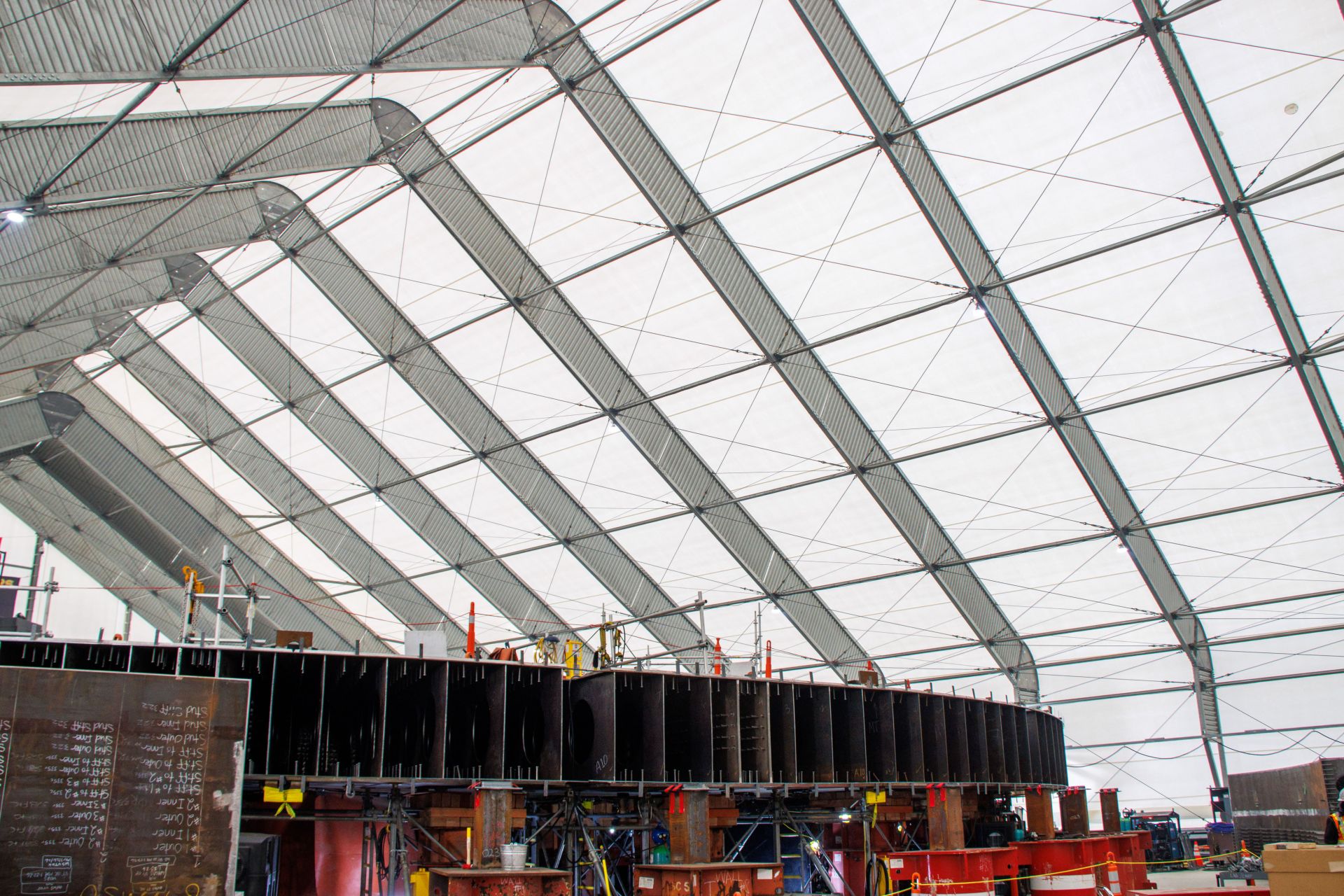
After the basemat modules were delivered to the site, additional work was carried out in an on-site fabrication facility, as shown here in February 2026. (Photo: OPG)
Basemat Lift
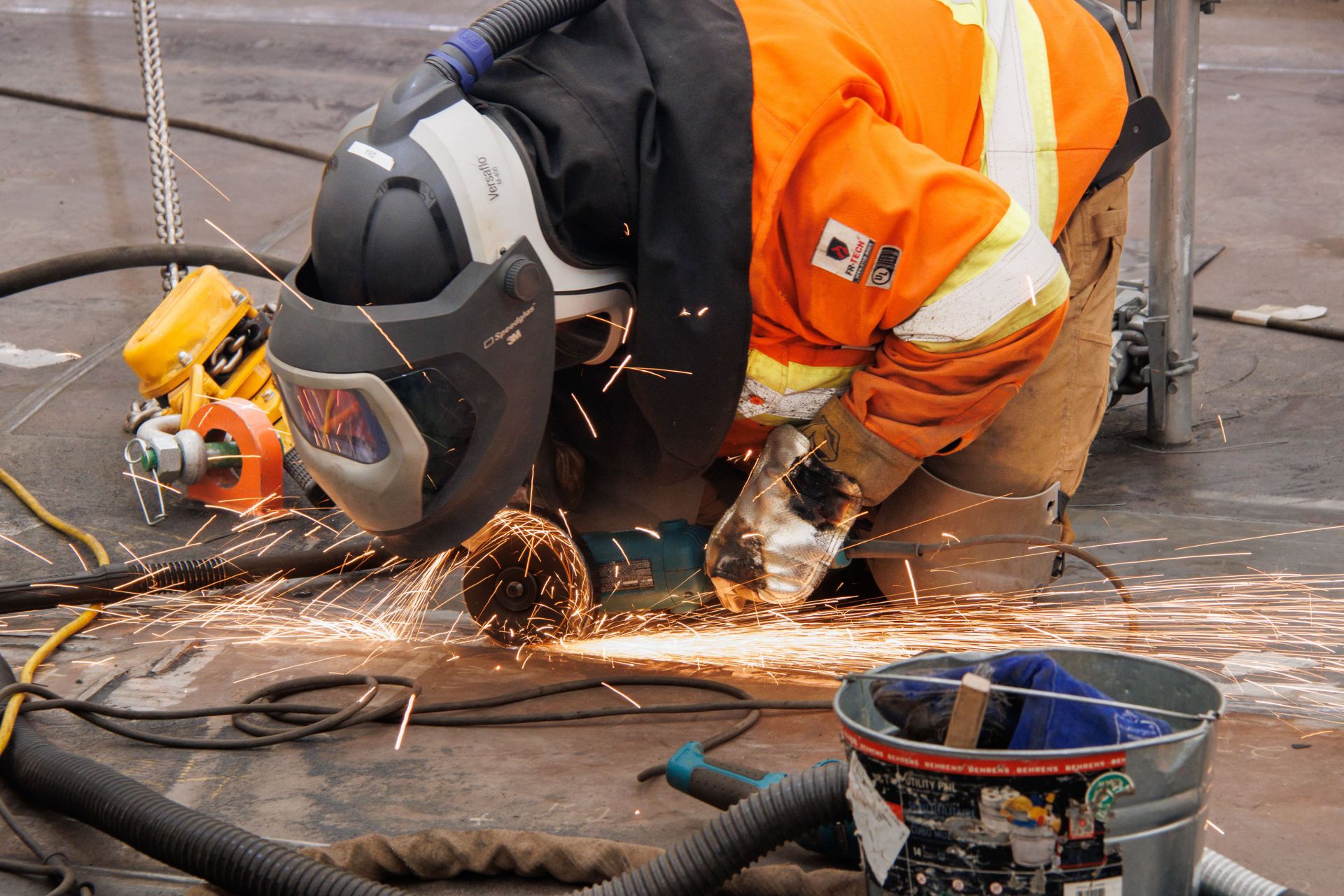
A welder at work on the basemat in the on-site fabrication facility at the DNNP. (Photo: OPG)
Basemat Lift
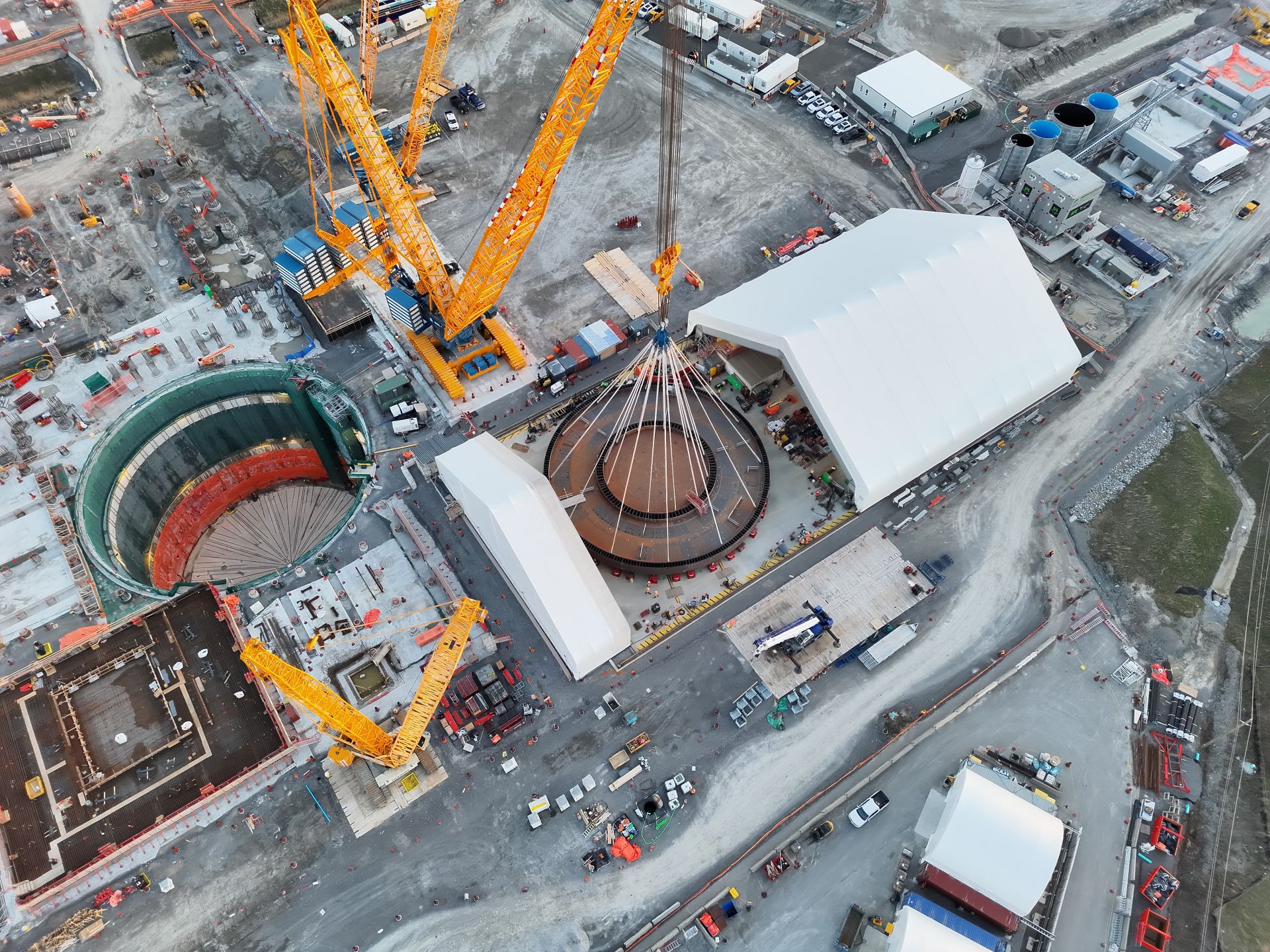
The nearly 2.1-million-pound, 37-meter-diameter basemat was lifted by crane and successfully placed in the reactor shaft on April 22. (Photo: OPG)
Basemat Lift
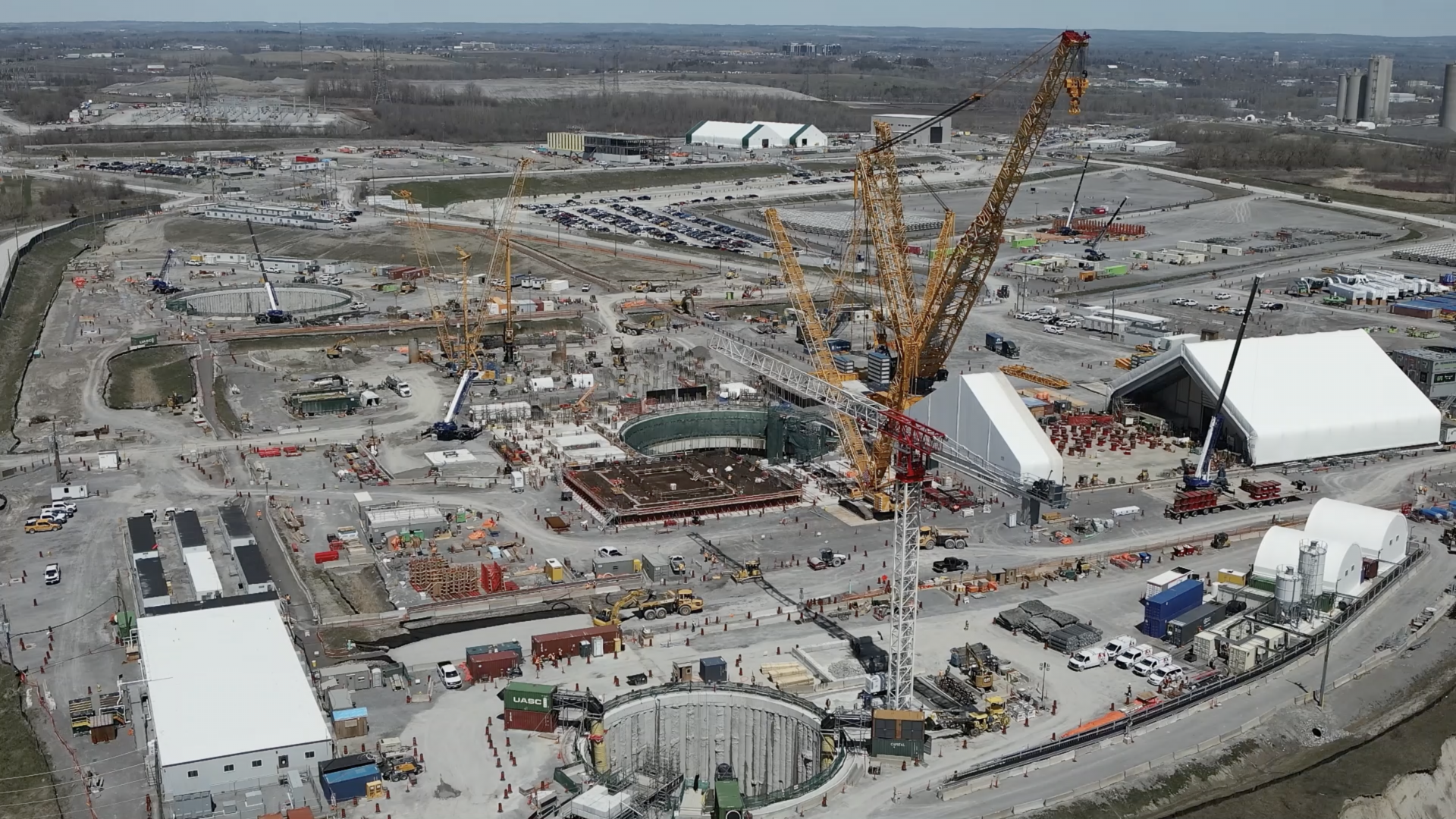
This view of the construction site was captured on April 27, after the basemat installation. (Photo: OPG)
Modular foundations
The basemat that was lifted and then lowered into position on April 22 is “essentially the foundation of the reactor building,” Sinnathamby explained. “The innovation here is really a diaphragm plate steel composite.” Now that the basemat’s steel plates are in position, she said, “we will pour concrete in between to have the strength that you need for the foundation. So it’s not reinforced concrete that typical foundations are done with, but it’s a composite.”
Steel modules for the basemat were manufactured in Ontario by Aecon Kiewit Nuclear Partners in multiple shops and were brought to the site for assembly. Now that the basemat is in position, additional annular layers will be assembled and then lowered into the reactor shaft.
“Modules will be built in pie shapes that make up a ring,” Sinnathamby explained. “You could have X number of ring modules make up a ring, with both an inner ring and an outer ring.”
Sexstone noted that the assembly of the basemat has clear lessons for future assembly work. “What we saw in the beginning versus, I would say, midway through this year’s journey, is incredible. We already improved dramatically on the production of how we would weld and put these pieces together,” he said, with obvious enthusiasm. “Usually we talk lessons learned of one project to the next, but we’re seeing it on the project itself. So that’s very encouraging to us.”
GVH already has teams working ahead on Units 2–4, going through lessons learned and what they mean for schedule and cost for the next unit: “It’s just rinse and repeat,” Sexstone said.
Next steps on-site
“Clearing the first regulatory hold point under our license to construct was what allowed us to place the basemat,” Sinnathamby said. Now, teams are building out the turbine building and building the modules for the first of eight levels of the reactor building, prior to assembly of that first level on-site. The first level of the reactor building alone will consist of more than 200 modules. The reactor building will contain about 1,200 diaphragm plate steel composite modules in total.
“For us, the main next major milestone is actually the end of this year, when we expect to have the first level of the reactor building completed,” Sinnathamby said. Once that first level is completed, “you can build X number of floors with the same design,” she continued. “Repetition becomes beneficial for us.”
Construction started at Darlington with an incomplete design. Now, Sinnathamby said, “the mechanical and civil construction design is essentially complete. What is remaining is electrical and instrumentation and controls, and that’s normal. Mechanical and civil needs to be completed before you understand where the conduit lines are going to be run, where the penetrations are going to be. And then I&C is always the last, because that’s connecting the electrical to the mechanical. So we’re in the normal stages of design, but the key was at the end of last year, essentially completing civil and mechanical design.”
OPG faces two more regulatory hold points. One must be released before the reactor pressure vessel can be installed, and the other before “fuel-out commissioning,” allowing OPG to conduct full-scale testing and commissioning of installed structures, systems, and components.
In late March, OPG submitted its application for a license to operate the unit to the CNSC. OPG’s goal is to complete construction by the end of the decade and connect to the grid by the end of 2030.
Future BWRX-300s
With Darlington construction underway and the BWRX-300 design nearing completion, the next question is, “Where next?”
When asked where the next BWRX-300s will be built, Sexstone said, “Our major focus is on Darlington, and it’s going to remain our focus, because it’s crucial that we’re successful there.” Saskatchewan’s SaskPower has also announced an intention to build the reactor. “They may be a little further out, but they are engaging with intent to make this happen,” Sexstone said. “So we’re excited about that partnership.”
As for the United States, he said, “I would say with the U.S.-Japan trade deal—the $40 billion investment in the X-300 projects in Tennessee and Alabama that was announced—I think those will be the next projects that come. There’s such momentum there that I believe that is going to be something that really changes everything in North America for us too.” He continued, “I think it’s complementary to what’s going on in Canada and the lessons learned that can go back and forth.”
In Europe, GVH is working with Poland’s Orlen Synthos Green Energy, which Sexstone said is “very focused on deploying multiple X-300s across Poland.” Declining to name dates, he added that Poland’s BWRX-300s are “coming fairly quickly.”
He added that GVH also has its eye on a planned SMR project in Sweden with Vattenfall. “We were shortlisted in that RFP, with Rolls-Royce, at their Ringhals site. And we think we’re an ideal solution for them. They are BWR operators, and so we’ll see what happens in that RFP, but that’s a big opportunity.”
As for a future for the ESBWR, the 1,520-MWe BWR that GE Hitachi Nuclear Energy marketed in the 2000s and that earned a design certification from the NRC in 2014, Sexstone said, “When customers talk to us about a gigawatt-plus solution, we say, well, let’s do four [SMRs], just like we’re doing at OPG, or like we’re going to do elsewhere. I don’t look at the X-300 as 300 megawatts. I look at it as a gigawatt solution.”
It goes back to working down the cost curve with lessons learned, he said. “It’s very hard to really drive lessons learned on—call it two megaprojects, two large plants on one site. We believe that right now in a gigawatt solution, a four-pack or a five-pack of SMRs is going to be more economical in the long run.”
Susan Gallier is editor-in-chief of Nuclear News.