NRC staff proposes ROP, security inspection overhauls
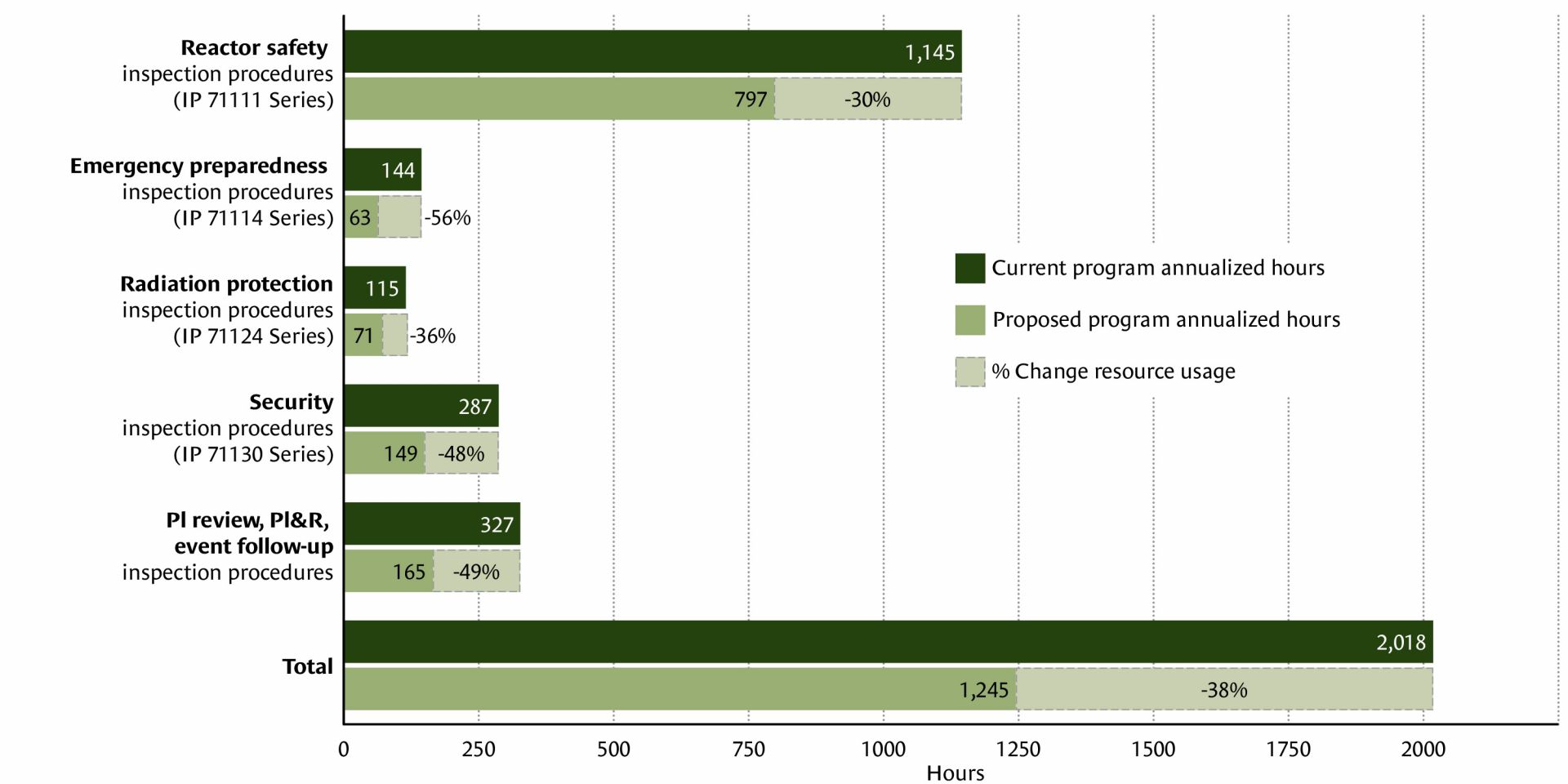
The Nuclear Regulatory Commission staff is recommending proposed changes for the Reactor Oversight Process (ROP) baseline inspection program that could reduce the number of hours spent annually on direct inspections at U.S. nuclear power plants by 38 percent.
In addition to the proposed ROP changes, NRC staff published recommendations for the baseline security program that would reduce the number of direct inspection hours necessary for this program by about 50 percent compared to current levels. This includes the Force-on-Force (FOF) inspection program.
The NRC staff and executive director of operations Michael King submitted recommendations and findings to commissioners in early February, and SECY-26-0014 and SECY-26-0015 were released to the public on February 18.
Background: In 2024, then-President Joe Biden signed into law the Accelerating Deployment of Versatile, Advanced Nuclear for Clean Energy (ADVANCE) Act, which expanded the NRC’s licensing and regulating roles to incorporate efficiency into its mission. It also required the NRC to submit a report to Congress that identified specific improvements to its nuclear reactor and materials oversight and inspections.
One year later, President Trump issued four nuclear energy executive orders (EOs), including one requiring an overhaul of the NRC’s review processes. This EO required the NRC to revise the ROP and reactor security rules and requirements.
Implemented in 2000, the ROP is based on a foundation of three strategic performance areas—reactor safety, radiation safety, and safeguards—that are split into seven cornerstones. The NRC periodically updates nuclear plant performance through summaries, reports, performance indicators, and other forms.
Meanwhile, baseline security inspection has remained largely consistent for more than a decade, comprising 11 inspection procedures (IPs) that are conducted by trained, qualified inspectors in physical security, cybersecurity, plant operations, and protection of nuclear material. The IPs are conducted on an annual, biennial, or triennial basis.
The FOF program, which falls under security inspection, conducts exercises that simulate security threats that are in accordance with any design basis threat applicable to a facility. The NRC has conducted these exercises since 1991. This program has undergone multiple revisions in the last 20 years to incorporate new inspection guidance, lessons learned, and commission direction.
ROP findings: If commissioners approve the recommended changes, NRC staff argue it would be among the most significant in the ROP’s 25-year-plus history. The 31-page SECY-26-0014 argues these changes are needed to streamline the process of inspecting and assessing a nuclear power plant’s performance while still being responsive to credible risks found during the process.
“[The recommendations] are consistent with the NRC's journey to be a more modern, risk-informed, and performance-based safety regulator,” the paper said.
NRC staff recommendations in SECY-26-0014 include the following:
- Eliminating certain baseline IPs while transferring risk-significant attributes and inspection hours to other existing IPs.
- Keeping certain IPs but reducing the sampling and associated resource hours based on risk insights, fleet-wide operational performance, and other factors.
The IPs affected by this recommendation are in the reactor safety, emergency preparedness, radiation protection, and problem identification and resolution portions of the oversight program.
According to SECY-26-0014, the proposed changes—along with changes approved last year under the ADVANCE Act—would reduce the number of annualized inspection hours from the current 2,018 hours to 1,245 hours.
The paper also included the staff’s recommended changes for the ROP’s more-than-minor (MTM) issue screening criteria. These changes would embed the screening criteria in the significance determination process and adjust the threshold for an MTM issue for a more consistent approach.
“The staff recommends that the MTM screening criteria be revised to reduce subjectivity, improve consistency, and better align enforcement actions with their actual impact to public health and safety,” the report said. “Such a change would support a more risk-informed, performance-based approach consistent with the principles of the ROP and the agency's strategic goals.”
Security and FOF findings: NRC staff, meanwhile, are seeking commission approval to retire eight of the 11 IPs in the baseline security inspection program and consolidate their risk-significant elements into two new IPs. Below are the IPs in question:
- “Access Authorization.”
- “Access Control.”
- “Equipment Performance, Testing, and Maintenance.”
- “Protective Strategy Evaluation and Performance Evaluation Program.”
- “Security Training.”
- “Fitness-for-Duty Program.”
- “Security Plan Changes.”
- “Review of Power Reactor Target Sets.”
The two new IPs would be called “Security Operations” and “Security Performance.”
“The proposed IPs would reduce inspection travel costs, balance direct inspection effort across the inspection cycle, leverage resident inspector flexibility, and maintain risk-significant inspection by physical security inspectors with subject matter expertise,” according to the 14-page SECY 26-0015.
The second major recommendation from NRC staff is to “retain and modify the periodicity of the material control and accounting procedure from triennial to ‘as-needed’ with clear criteria for implementation based on licensee performance. Additionally, enhance the cybersecurity IP based on lessons learned from initial cycle performance including shifting periodicity from biennial to triennial.”
The last recommended revisions focus on the FOF program. The recommendations propose that the FOF IP include two exercises, an update to the method for characterizing exercise outcomes, and the option to increase a licensee's role in exercise scenario development.
The FOF inspection would be modified to a single triennial inspection with two exercises. By combining the two into one inspection, NRC staff argue that the move will “improve efficiency, optimize resource use, and reduce costs while maintaining sample size consistency and enhancing opportunities to observe security program performance through multiple exercises.”
The FOF labels used to determine an exercise outcome—“effective,” “ineffective,” and “indeterminate”—would be updated under these proposed recommendations. Removing these terms comes from the idea that they instill a win-or-lose mentality to exercise outcomes.
“Removing these terms would shift the inspection emphasis to overall readiness, continuous learning, and the correction of weaknesses identified during FOF exercises, further refocusing licensee physical security programs on the identification and correction of observed deficiencies,” SECY 26-0015 said.
The NRC staff want licensees to have a greater say in FOF exercises. The final proposed change would give licensees an option to use NRC input to develop the exercise scenario, a detailed mission narrative, and the exercise controller matrix. An exercise developed by the licensee would be subject to NRC review and approval.
Under these proposed revisions, the number of annualized FOF inspection hours would drop from 287 hours to anywhere from 149 to 170 hours.