-3 2x1.jpg)
Blades-in turbine inspections at Quad Cities set new benchmark for Constellation
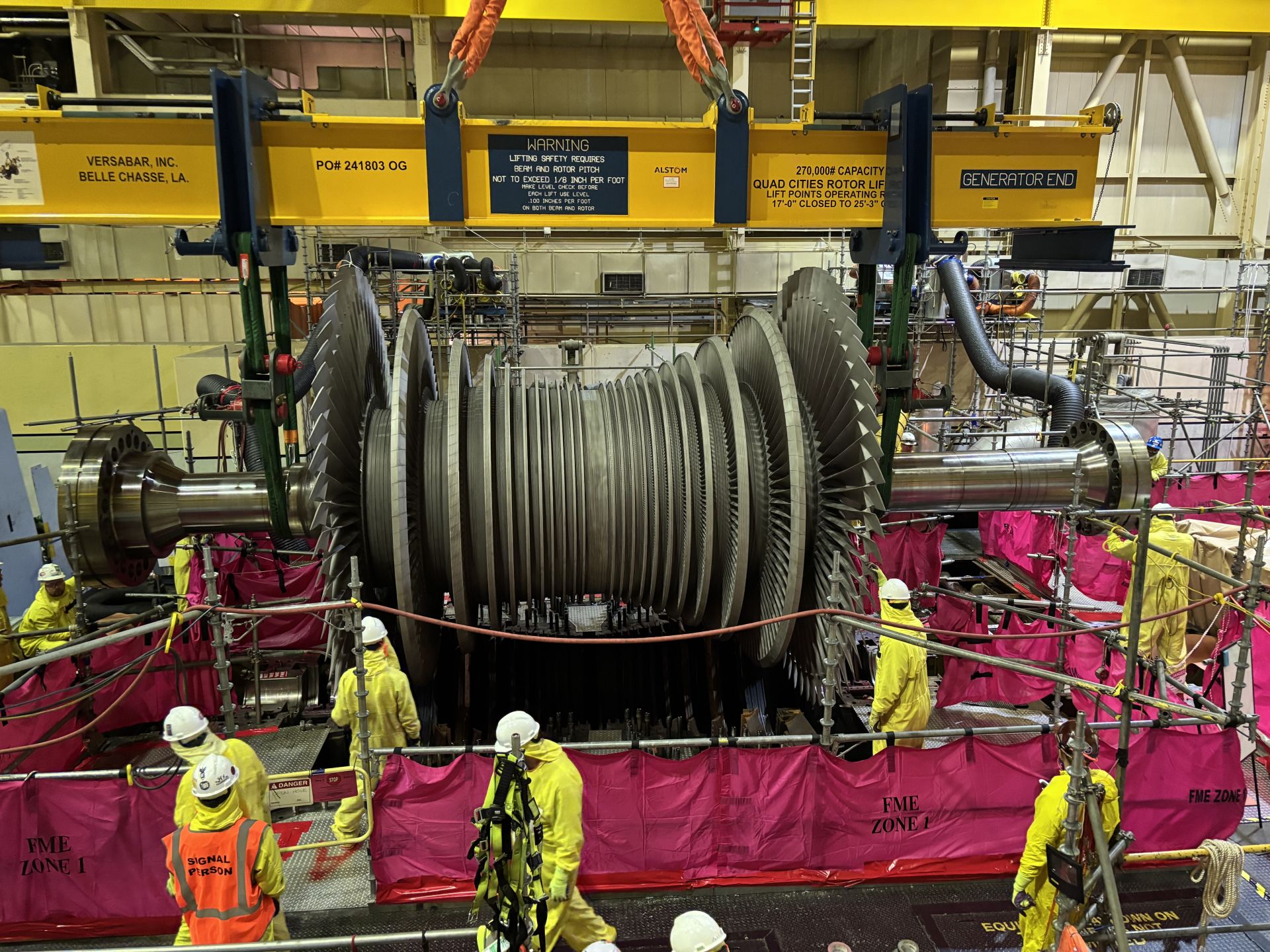
When Constellation decided to install replacement Alstom low-pressure turbines at three of its boiling water reactor plants more than 15 years ago, one benefit was knowing the new turbines should operate reliably—and without major inspections—for several years.

From left: Chris Gorka, Bill Campbell, and Steve Myers of Constellation attended the 2025 Nuclear Energy Conference & Expo, where the team was recognized with a TIP award. (Photo: ANS)
After 10–15 years of service, preventive maintenance requirements from the original equipment manufacturer called for a thorough inspection of the last-stage (L-0) blades of the turbine rotors, a task that typically means removing each blade to check for stress-corrosion cracking. Anticipating this work, Constellation benchmarked a utility that did just that: remove, inspect, and reinstall every 200-pound blade during a refueling outage.
But Constellation’s corporate turbine engineering and turbine services teams also pursued an alternative procedure first validated by the Electric Power Research Institute: phased array ultrasonic testing (PAUT). Using this method, the blades can stay in place while ultrasonic nondestructive examination (NDE) is used to scan and inspect the blades and their “root and steeple” attachment area.
Constellation decided to implement PAUT for its Alstom turbines, starting with Quad Cities-2, where three Alstom ND48 low-pressure turbines were inspected during a refueling outage in spring 2024, saving five days on the outage critical path schedule relative to a traditional turbine inspection. That initial project led the way for similar work at Quad Cities-1 in early 2025 and at Dresden-2 and Peach Bottom-3 this fall. Over a total of six outages at three plants—with only the Dresden-3 and Peach Bottom-2 inspections yet to perform—cost and labor savings could amount to over $50 million and 18 critical path days.
The Quad Cities PAUT inspections were recognized with a 2025 Top Innovative Practice award from the Nuclear Energy Institute and a 2024 Technology Transfer Award from EPRI, and proved that the PAUT technique can save time and labor while verifying low-pressure turbine integrity. Because the blades stay in place, PAUT has the added benefit of avoiding the possibility of accidental damage of the blades or rotors during handling.
Proof of concept

3D scanning of a spare turbine rotor at Pacific Gas & Electric’s Diablo Canyon nuclear power plant. (Photo: Constellation/Jeff Melvin)
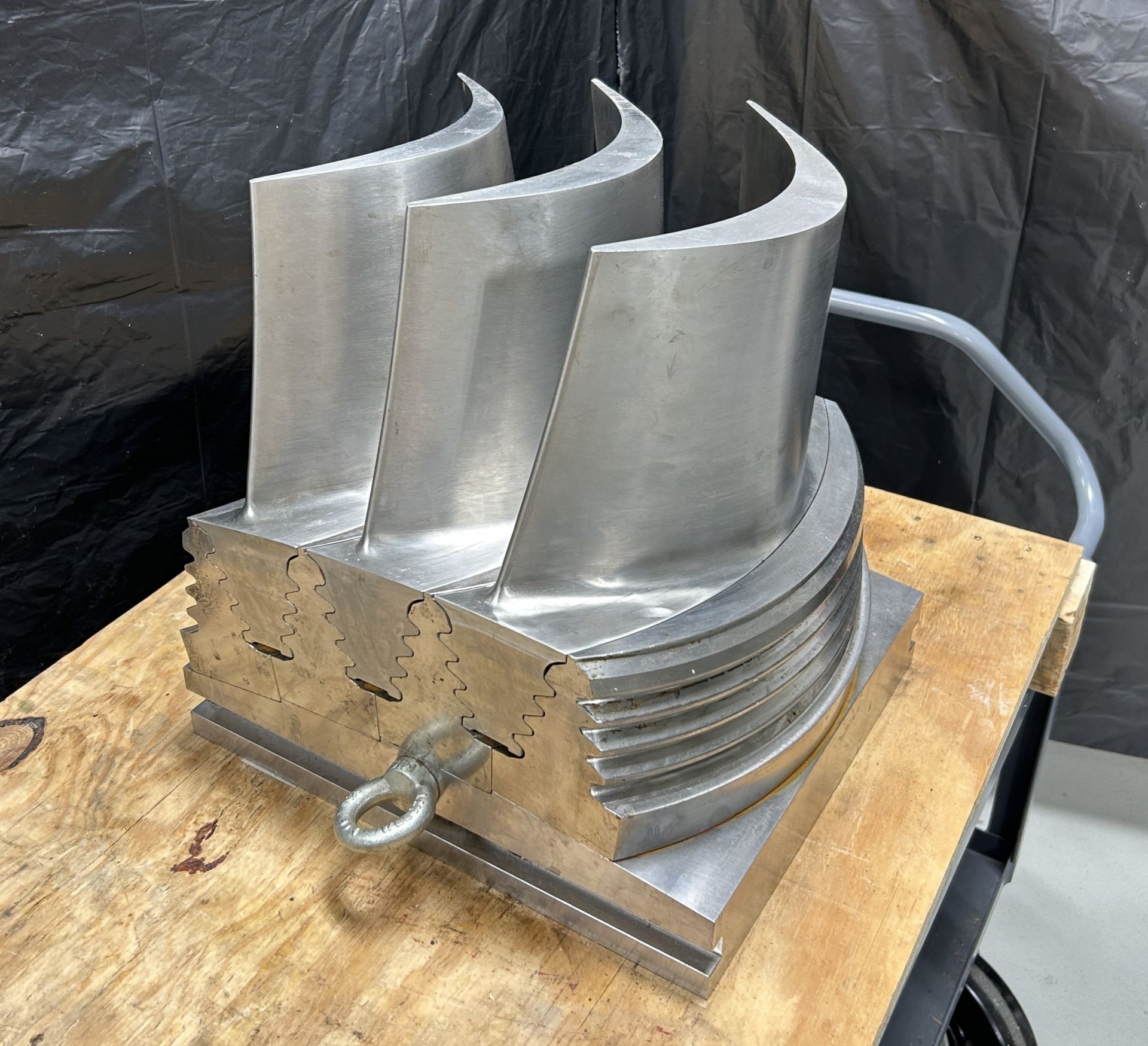
This calibration fixture, manufactured in 2018 by EPRI, was designed to validate the application of PAUT techniques on in situ last-stage blades. (Photo: EPRI)
Constellation and several other utilities joined forces with EPRI in 2018 to assess the potential for using PAUT for turbine inspections, and EPRI program manager Eric Prescott developed a technical program to evaluate the technique.
First, EPRI performed a 3D scan of a spare rotor and spare blades at Pacific Gas & Electric’s Diablo Canyon nuclear plant to develop a simulation for an ultrasonic inspection of the components. From that scan, EPRI manufactured a set of 3D replicas—or calibration blocks—of the rotor blades and blade attachment areas.
Small pits were introduced in the smooth metal of the calibration blocks using electrode discharge machining to simulate the flaws that corrosion can cause in an in-service turbine. Once the replica blades were mated to the replica rotor attachments, the flaws within the attachment areas were hidden from view.
EPRI invited several industry NDE providers to their lab to do a blind assessment to determine if the hidden flaws could be detected successfully by NDE technicians. EPRI documented the successful testing results in two reports: “Phased-Array Examination Methodology, In Situ Inspection of Alstom ND56R Blade Roots and Steeples” (2021; report ID 3002017102) and “Development of Customized UT Inspection for Axial-Entry Turbine Blade Attachments” (2021; report ID 3002022800). The end goal of the final phase of the EPRI research was to provide a methodology that could be commercialized by an NDE vendor.
Translation to Quad Cities
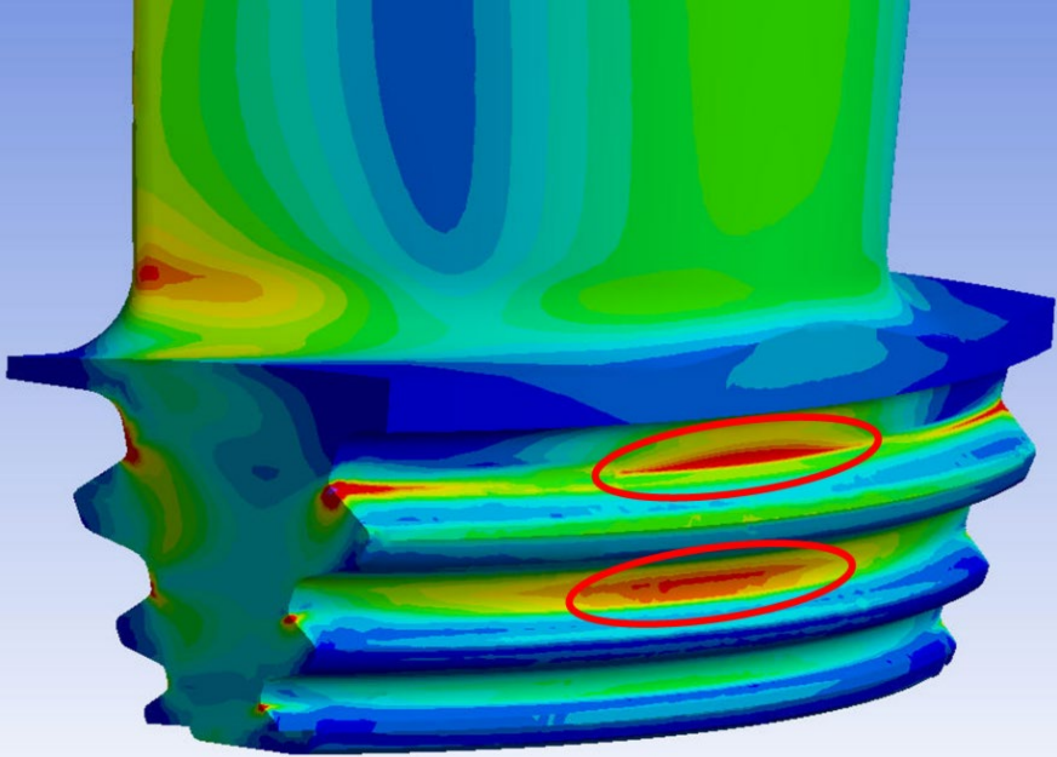
Finite element analysis of a rotor blade and blade root shows areas that are more likely to be susceptible to stress-corrosion cracking. (Image: Constellation/SIA)
Structural Integrity Associates was contracted to commercialize the EPRI methodology for Constellation’s Alstom low-pressure turbines. Mirroring the work done by EPRI, Constellation and SIA worked together to perform 3D scans of spare blades, and SIA then built a 3D model of the blade roots and interlocking rotor steeples and performed a finite element analysis of the root and steeple assembly to determine areas where stress-corrosion cracking was most likely to develop.
Next, SIA developed a computer simulation to validate a PAUT scanning route and manufactured a new set of calibration blocks, this time strategically placing flaws where they would be most likely to appear on an in-service turbine. Testing confirmed that NDE technicians were able to detect the flaws, and once the refueling outage at Quad Cities-2 was underway, the same calibration blocks were taken onto the turbine deck to allow for an on-the-spot check and calibration of the NDE equipment.
The scanning route SIA developed for inspection targeted almost 100 percent of the coverage area. Inspecting each of three turbines involved checking two sets of last-stage blades, one on each end of the turbine rotor. Scanning each end of one rotor and its blades using the PAUT probes and fixtures took about half a day, yielding a table of data containing the precise position of a scan and signals generated. That inspection is repeated six times during a single outage—on each end of three turbine rotors.
Considerable preoutage preparation and coordination, as well as support from Constellation’s Supply and Alliances organizations, were required among Constellation’s Corporate Turbine Services, NDE Services, and Corporate Mechanical Engineering organizations. The Constellation team included Chris Gorka and Tim Ernst of Corporate Turbine Services, Jeff Melvin of Corporate Mechanical Engineering, Tim Heindl of Alliances, Mike Salley of NDE Services, and Jay Akhtar of Commercial Supply.
Measures of success

Kevin Rau of Digital Reality (left) performs 3D laser image scanning of a spare blade at Diablo Canyon in 2018 as PG&E’s Martin FitzPatrick looks on. (Photo: Constellation/Jeff Melvin)
Quad Cities Turbine Services completed the first two blades-in turbine inspections—at Quad Cities-2 in the spring of 2024 and at Quad Cities-1 in the spring of 2025—without any adverse events. The dose goal for the Quad Cities-2 inspection was 18.807 rem, and the actual dose was 10.911 rem—a decrease attributable to the PAUT inspection method.
Implementing blades-in PAUT inspections also meant a significant reduction in lifting, rigging, and material handling relative to traditional inspection, as well as a reduction in required floor equipment laydown space on the turbine deck. With the blades in, the risk of injury to workers or damage to blades was reduced, as were tripping hazards.
While Quad Cities and Dresden have nearly identical Alstom low-pressure turbines with 48-inch last-stage rotor blades, the experience gained can be translated into preoutage planning, budgeting, resource requirements, and schedule efficiencies for Peach Bottom’s larger turbines, which have 56-inch last-stage rotor blades.
Part of the reason Constellation is confident the successful inspections at Quad Cities can be replicated is because a “core team” of craft labor was designated to gain rigging and mechanical skills and familiarity with the Alstom low-pressure turbines at Quad Cities and then travel to perform the same work at Dresden and Peach Bottom. While Constellation coordinated with craft labor organizations to ensure experienced craftspeople were assigned to that core team, “new to nuclear” and apprentice craftspeople were also included, with the intention of building a high return rate for large-scope, short-duration outages.
Communication is key

Close-up of the last-stage blades of a spare turbine rotor at Diablo Canyon. (Photo: Constellation/Jeff Melvin)
Lessons learned from preparation, execution, and process improvement perspectives include the importance of biweekly meetings between Constellation’s fleet turbine engineering and services organizations and SIA to drive stress analysis, PAUT modeling, calibration block manufacture, and PAUT validation milestones.
Separate biweekly meetings with Constellation’s Corporate Mechanical Engineering, Site Engineering, Turbine Services, NDE Services, and Outage Management teams kept stakeholders updated and provided a forum to coordinate handoffs between development and implementation.
Constellation was also responsible for communicating with the nuclear insurer to make them aware of the technology and Constellation’s plans to implement it. While a formal variance was not required to implement the approach, the insurer issued a professional judgment in support of implementation.
Steve Myers, corporate turbine/EHC engineer at Constellation Nuclear, is the engineering project lead for the PAUT project, and Bill Campbell, turbine services project lead at Constellation Nuclear, leads the implementation of the project.