From left, Matthew Mueller, vice president of ABS Regional Business Development; Hak-mu Shim, HD HSHI executive vice president; and Byung-hun Kwon, HD KSOE executive vice president, pose at the signing ceremony for the joint development project at the HD Hyundai Global R&D Center in Seongnam, South Korea.
The American Bureau of Shipping has joined a joint development project with the HD Hyundai divisions of Korea Shipbuilding & Offshore Engineering (HD KSOE) and HD Hyundai Samho Heavy Industries (HD HSHI) to advance the conceptual design and assess the technical feasibility of a nuclear-powered electric propulsion system for large container ships.
The project, “Conceptual Design of a Nuclear-Powered Electric Propulsion System,” will focus on developing the basic design, electrical component specifications, and arrangement plans of a nuclear propulsion system for a 16,000-TEU ship (that is, a massive vessel designed to carry 16,000 20-foot-equivalent units). It would be the first nuclear-powered commercial container vessel.
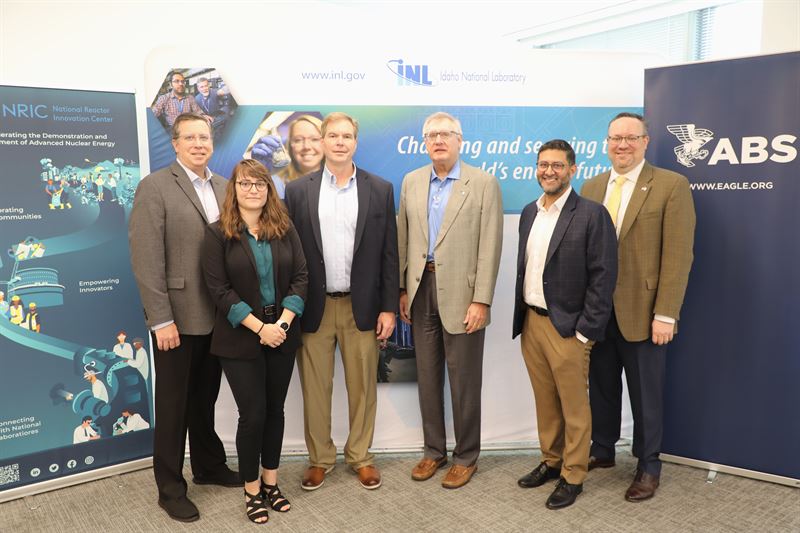
Officials of the ABS and INL gathered at a forum, where rules for floating nuclear power plants were unveiled. (Photo: INL)
A comprehensive set of rules and guidelines for floating nuclear power plants, Requirements for Nuclear Power Systems for Marine and Offshore Applications, has been released by the American Bureau of Shipping (ABS). According to the document, which, according to ABS, is the first of its kind for floating power plants, the rules and guidelines have been “developed for classification requirements specific to design, construction, and survey of vessels fitted with nuclear power systems whose generated power is transferred or distributed to onboard industrial or adjacent facilities.”
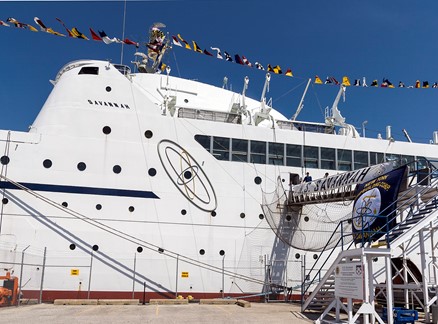
The NS Savannah—the first merchant ship powered by a nuclear reactor.
The American Bureau of Shipping (ABS) has announced the launch of a research project that will look into barriers to the adoption of advanced nuclear propulsion for commercial vessels.
The $794,000 project, awarded to ABS last year by the Department of Energy’s Office of Nuclear Energy, is now being formally contracted through the DOE’s U.S. Industry Opportunities for Advanced Nuclear Technology Development funding opportunity, according to ABS’s August 17 announcement. Support is to be provided by Idaho National Laboratory’s National Reactor Innovation Center (NRIC).