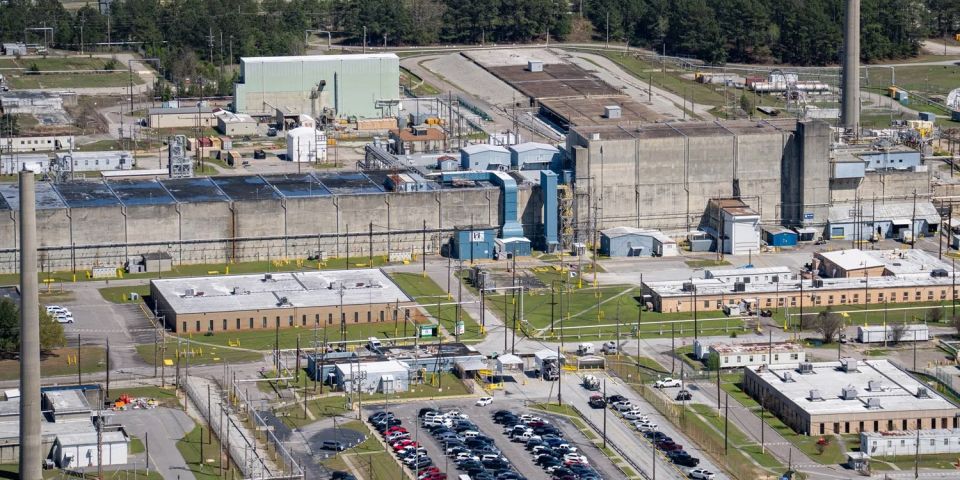
Only a few pressurized water reactors in the United States, Finland, and Japan incorporate ice condensers into their containment designs, including the TVA-operated Watts Bar, in Spring City, Tenn., and Sequoyah, in Soddy-Daisy, Tenn., the two plants where the USF technology was tested. The ice condensers act as a passive, static heat sink to rapidly absorb steam and reduce containment pressure and temperature in the event of a loss-of-coolant accident or main steam line break.
A power plant’s ice condenser system consists of thousands of “baskets” filled with borated ice. Each baskets must be individually lifted and weighed during routine inspections. However, the process used to replenish the gradually melting ice can cause neighboring baskets to freeze together, preventing their individual inspection without labor-intensive work to separate them.
TVA asked engineers at USF to develop a better way to separate the ice baskets to allow for easier inspections. Ahmad Vaselbehagh, an associate professor of mechanical and aerospace engineering, and Ty Hagan, a postdoctoral research associate and mechanical engineer, accepted the challenge.
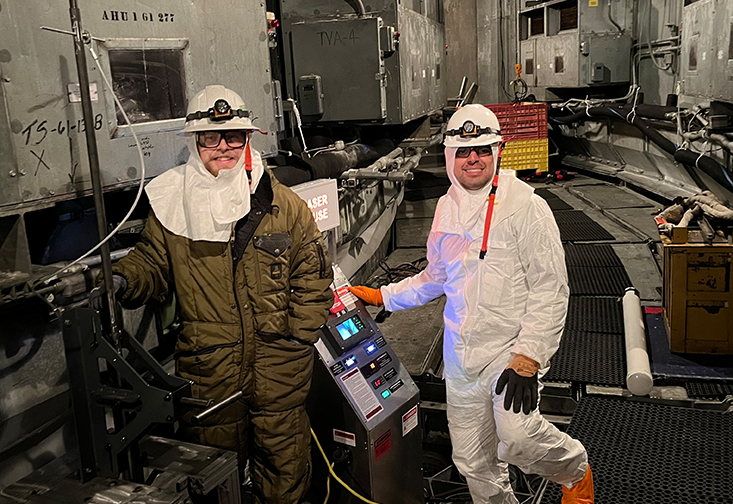
Laser deicing: Vaselbehagh, Hagan, and their multidisciplinary research team designed a laser-based deicing system to meet the needs of TVA operators. The system uses a precision laser to cut through the sheets of ice that connect adjacent baskets, allowing the baskets to be safely separated and inspected. The laser technology can function more than 40 feet below the surface in freezing conditions and in the tight spaces between the ice baskets.
The system is capable of clearing several feet of ice in minutes, substantially reducing maintenance time and allowing safety inspections to be completed more thoroughly and efficiently. The deicing system was shown to work without generating large volumes of meltwater, which would cause other problems, such as refreezing in other locations.
The USF team conducted extensive testing of their laser maintenance system in freezing environments and contamination-controlled areas. Along with TVA officials, they concluded that the testing proved that the system was fit for purpose.
The researchers also completed specialized radiation worker and laser safety certifications for the laser system and developed operating procedures, documentation, and training materials. Thus, power plant personnel should be able to use the technology and maintain it independently.
Challenging multidisciplinary effort: The development of this laser system required input from several research disciplines, including mechanical engineering, electrical engineering, optics, controls, manufacturing, and safety compliance. Vaselbehagh said, “This was one of the most challenging projects I’ve ever led because it included conceptualization, design, engineering, fabrication, testing, and production of something that had to work flawlessly in the hands of the plant's personnel without our presence to guide or support them. There is a huge difference between theoretical work and developing a system that can perform reliably in a real industrial environment.”
Hagan added, “When you're building a system that has to work in the real world, it's never just one discipline. You have to understand mechanical systems, electrical systems, controls, safety requirements, and how everything works together.”