Seven projects selected for DARPA’s Rads to Watts
The Defense Advanced Research Projects Agency (DARPA) has selected seven teams for its Rads to Watts program, setting off a competition to design radiovoltaic cells capable of providing power in extreme environments such as deep sea and space.
The teams are now working on developing a unit cell, simple demonstrations that their design ideas work. These are expected to be low power but capable of being scaled up into a higher-power array.
With mission applications that offer little to no access to maintenance, high reliability is key.
“I believe the work being done in Rads to Watts could not only create the capability to provide array-scaled radiovoltaics with kilowatts of nuclear power in a transportable form factor, but it could also lead to radiation-hardened capabilities for the broader community to include solar, nuclear, and power beaming,” said DARPA Defense Sciences Office program manager Tabitha Dodson.
The project leads are based at Arizona State University, Avalanche Energy, BWX Technologies, City Labs, Morgan State University, University of Missouri, and University of North Carolina–Chapel Hill.
Radiovoltaics: There are several ways to design nuclear batteries, but the most mature technology uses thermoelectric conversion, using radiation from a source to produce heat and then using that heat to drive a turbine and produce electricity.
Rads to Watts focuses on developing a method that skips the middle step, using a semiconductor transducer to convert energy from radioactive decay directly into electricity, which is generally much more efficient. The process is comparable to how the photovoltaics in solar panels convert photons from the sun into electricity.
While the idea isn’t new—it dates all the way back to shortly after the discovery of radioactivity—research is required to figure out how to implement it at scale. Existing nuclear battery designs require trading off between operation life and device power.
“The goal is to move beyond the very low power levels typical of many radiovoltaic devices and demonstrate practically useful power for small electronics or sensors,” said Jinsong Huang, a professor at UNC–Chapel Hill and lead of one of the selected projects. “Demonstrating a device that produces useful power under realistic radiation conditions would be an important step toward practical radiovoltaic energy harvesting.”
These seven projects focus on different aspects of radiovoltaics systems, some more focused on the source and some exploring new materials. Several projects are looking to combine many very thin devices, around the width of a human hair or even less.
Michael Spencer, a professor at Morgan State, said this can improve radiation tolerance. For example, damage to a 5-micrometer-thick device that is in a stack of 20 such devices would have less impact on the unit cell than damage to a 10-micrometer-thick device that is in a stack of 10. Both offer an overall thickness of 100 micrometers, but the stack of thinner devices isolates the radiation damage to a smaller region.
“The performers who stood out had the most innovative ideas for radiation-hardened voltaics at the device-level—not only in the charge generation region (which is typically the focus of radiation-hardening efforts for voltaics) but for multiple layers including the multilayer interfaces. Device-level solutions are essential to push performance well beyond today’s state of the art,” said Dodson. “I’ve been surprised and impressed by our performers’ creative solutions to going beyond what is typical for space or low fluence radiation hardening”
Source novelties: For both City Labs and Morgan State, key design innovations are being made at the source.
Unique among the Rads to Watts group, City Labs already has a commercial nuclear battery, and it’s looking to improve that design. The company sells batteries powered by beta particles emitted by tritium trapped in a metal hydride matrix.
For Rads to Watts, the company will be exploring a new class of tritium metal hydride materials, which it believes will be able to pack even more tritium into the matrix, stepping up the power density of their sources while maintaining a low material density through which the beta radiation can easily escape.
“Programs like this encourage teams to take on ambitious challenges that can lead to next-generation advances,” said Peter Cabauy, CEO of City Labs. “For us, that means finally pursuing a new class of materials we’ve believed in for years but can now develop with this critical institutional support.”
He also said the design could be directly applied to advanced medical devices, such as facilitating a cardiac pacemaker that could be implanted by catheter rather than open surgery.
At Morgan State, Spencer is pursuing a different beta emitter: strontium-90.
“One thing people have recognized recently that was not generally appreciated for people who, like me, are making devices, is that strontium decays to yttrium, which then has a rapid decay,” he said. “They tend to sync up, so with every strontium decay, you also get a yttrium decay because the half-life is really very short, and you get two high energy electrons.”
Spencer is working on an experiment to explore absorption of the second electron, which has roughly four times the energy of the first and therefore ends up travelling further, absorbed in a neighboring unit cell.
Materials novelties: Many semiconductors have been explored for radiovoltaics. The material must be able to absorb radiation, a process that causes damage to many materials.
Mariana Bertoni, a professor at ASU, said her project aims to challenge a long-held assumption in semiconductor materials science. Conventionally, structural disorder is associated with degraded performance, but Bertoni said she thinks it can be turned into an advantage.
“Our work instead investigates how specific forms of atomic-scale disorder can make materials more tolerant to radiation while preserving or even enhancing their electronic properties,” she said. “If successful, this would establish a fundamentally different design strategy for resilient electronic materials.”
Daniel Velázquez, physicist and materials science lead at Avalanche, said the company’s project is focused on absorption from alpha emitters. Avalanche is a fusion energy start-up that aims to use the technology developed through Rads to Watts to support direct energy conversion in their fusion machine concept, the company said.
Avalanche’s unit cell design uses a liquid-metal transducer, which Velázquez said is expected to improve carrier generation while reducing radiation damage by minimizing direct radiation interaction with the semiconductor.
Initially Avalanche will design for a polonium-210 source, which has only a 138-day half-life, but, Velázquez said, “the underlying device architecture is intended to be compatible with long-duration radioisotope power systems spanning months to years.”
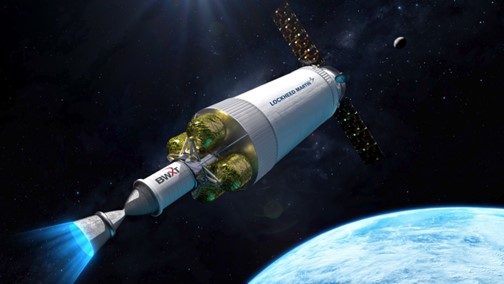
BWXT’s project is also focused on alpha emitters, with the specific goal of boosting the power extracted from plutonium-238 on deep space missions. Justin Kasper, chief of technology at BWXT and a professor at University of Michigan, said the project will test a class of highly radiation-tolerant semiconductors that were recently identified at Johns Hopkins University Applied Physics Laboratory, and the design will integrate a technique BWXT developed to deposit a thin layer of the radioisotope directly onto the semiconductor.
“As each alpha particle stops in the semiconductor, it will liberate thousands of electron-hole pairs, directly producing a current. This is expected to convert more than 20 percent of the kinetic energy of the alphas into electrical power,” he said. “The first time we apply the high-activity radioisotope to the semiconductor and make electricity is going to be really exciting.”
UNC’s Huang said a unique aspect of his project is the use of a class of materials called halide perovskites, a type of crystalline semiconductor that he said combines strong radiation absorption, efficient charge generation, long carrier transport lengths, and low-temperature device fabrication.
“These properties could allow compact, lightweight radiation-energy converters with higher specific power than conventional semiconductor approaches. These materials [have] the lowest fabrication costs among all semiconductors for this application,” he said.
John Gahl, a University of Missouri professor leading one of the projects, declined to comment for this story, but according to an announcement from University of Toledo, his collaborator, Raghav Khanna, said their team is pursuing a design that uses gallium oxide as a semiconductor, which he said has a high radiation tolerance.
Next steps for Rads to Watts: The program will run for up to 30 months, but evaluations at months 15 and 24 will inform a down-selection process that determines if a team gets to continue to a system phase, during which they would use a stacked or arrayed formation to develop a high-powered system. Performance under radiation testing will be key, with DARPA setting thresholds for the allowable amount of degradation under specific fluence levels.
.jpg)