The announcement—made on the agency’s social media pages—came just days after residents in Sakwa, in Siaya County, protested over the plans to build a power plant along Africa’s largest lake—Lake Victoria, in western Kenya. According to a news report from Mongabay, locals are concerned over radioactive waste management, losing ancestral lands, displacement, and the impact a power plant could have on the area’s fishing communities.
“As the Nuclear Power and Energy Agency, we hear and respect the voices of the residents of Siaya. Public participation is not a mere procedural formality. It is a constitutional right and a technical necessity for a successful national nuclear program,” NuPEA CEO Justus Wabuyabo said in the statement.
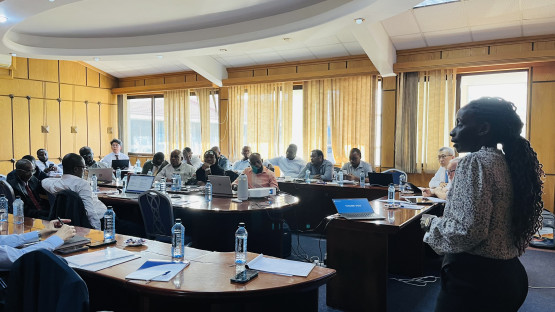
“We wish to assure the public that the stakeholder engagement process is firmly ongoing,” he continued. “We are moving from high-level institutional planning into deep, village-level, grassroots sensitization.”
The plant’s role in the country’s future: Kenya’s nuclear construction plans are among the most ambitious in Africa, where several countries have expressed interest in adding nuclear power to their energy supply. Kenyan President William Ruto opened the 2026 International Conference on Nuclear Energy (ICONE) by announcing plans for a 2,000-MW nuclear power plant in Siaya County. He expects construction to begin in 2027 and for the facility to be operational in 2034. Kenya’s current power capacity would grow from 3,300 MW to 10,000 MW in the next five to seven years, with 3,000 MW to be generated from nuclear sources, Ruto said at the conference.
“To the people of Siaya County, the site of Kenya’s first nuclear power plant, I invite you to be partners in this journey,” Ruto said in his speech. “I encourage you to seek a deeper understanding of the immense economic benefits this project will bring, from high-value jobs to infrastructure development.”
He continued, “Let me reaffirm that nuclear energy will be a true game changer for Kenya. It will sustainably and safely power our industries, accelerate our development, and propel us firmly on the path to a first-world economy.”
In a May opinion piece in Business Daily, Wabuyabo said this power plant will be the “crowning jewel of President William Ruto’s legacy.” Not only will it help Kenya keep pace with future energy needs, the multibillion-shilling project will create more than 10,000 jobs during construction and thousands more permanent jobs once it is operational. In the column, Wabuyabo also referenced Kenya Vision 2030, a road map to improve Kenyans’ way of life and create a more competitive country by 2030.
“Kenya Vision 2030 identifies energy as the key enabler of our national transformation,” he wrote. “However, our current renewable mix, while impressive, cannot meet the projected 60,000 MW demand required for full-scale industrialization. Nuclear energy will undoubtedly provide, in the medium term, the 3,000 MW baseload that hydro and solar, which are prone to weather changes, simply cannot.”