Who’s in the running for DOE Nuclear Lifecycle Innovation Campuses?
Today is the Department of Energy’s deadline for states to respond to a request for information on proposed Nuclear Lifecycle Innovation Campuses. Issued on January 28, the RFI marks the first step toward potentially establishing voluntary federal-state partnerships designed to build a coherent, end-to-end nuclear fuel cycle strategy for the country, including waste management, according to the DOE.
Who’s asking? Although the DOE indicated that it intends to move swiftly in processing responses to the RFI, the department has said it will likely be six months before it releases the results.
And while it is not known how many states have responded to the RFI, some states have already indicated interest in hosting Nuclear Lifecycle Innovation Campuses.
Utah—On March 27, Gov. Spencer Cox announced that the state of Utah and Tooele County were responding to the RFI, saying it aligns with the state’s efforts to expand nuclear energy.
“In the 1980s, Tooele welcomed the EnergySolutions facility at Clive, putting us on the map as a key player in America’s nuclear ecosystem,” Tooele County Council chair Jared Hamner said in the announcement. “We’re ready to lean in again.”
According to a March 4 report in the Salt Lake Tribune, a massive salt dome in Millard County is one potential site the state is exploring for hosting spent fuel.
Tennessee—Nashville’s National Public Radio affiliate WPLN reported on March 26 that state lawmakers passed a resolution urging Gov. Bill Lee to submit an RFI response.
According to the Tennessee General Assembly website, however, the resolution was placed on the Senate regular calendar for April 2.
South Carolina—On February 18, state Sen. Tom Davis announced that he had filed a joint resolution directing a unified state response to the RFI.
“This is not a routine federal solicitation,” Davis said in a statement. “It is one of the most significant economic and national security initiatives the federal government has launched in a generation, and South Carolina cannot afford to treat it as anything less.”
As of March 31, however, the resolution remained in committee, according to the South Carolina Legislature website.
Washington—On February 14, state lawmakers introduced a resolution requesting that Gov. Bob Ferguson direct state agencies to prepare a competitive response to the DOE RFI.
House Joint Memorial 4016, however, was still in committee as of March 31, according to the Washington State Legislature website.
Colorado—While officials from Mesa and Moffat Counties have expressed interest in the Nuclear Lifecycle Innovation Campuses, as noted here and here, it is not clear if the state was willing to submit a response to the RFI.
But what about the waste? As the back end of the nuclear fuel cycle is integral to the DOE’s Nuclear Lifecycle Innovation Campuses, the initiative is seen as a way to move the needle on waste management and ultimately find a disposal path for U.S. spent nuclear fuel.
“This RFI says if you want to have the front of the fuel cycle, if you want to be part of this conversation, you have to have an answer to the back end,” said Marla Morales, acting deputy assistant secretary for the Office of Spent Nuclear Fuel and High-level Waste Disposition within the DOE’s Office of Nuclear Energy. Morales was speaking at a session of the Waste Management Conference, held in Phoenix, Ariz., March 9–12.
While states will be able to negotiate what front-end activities they will pursue, the back end will be the “anchor,” Morales explained. Comparing it to a menu, Morales said all the front-end fuel cycle activities—uranium mining, milling, conversion, enrichment, and so forth—can be thought of as the “appetizers,” adding, “but your main course needs to be ultimate disposition.”
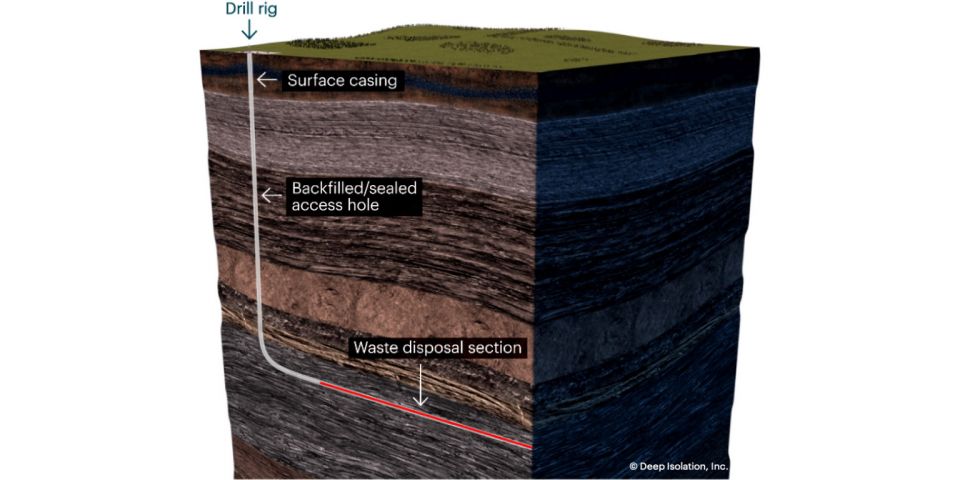
Morales explained that she uses the term “disposition” rather than “disposal,” because at this point the DOE is not looking for an exact location for a deep geologic repository. Rather, she said, states can consider other waste management options, including interim storage and recycling/reprocessing, which may include deep borehole disposal for some waste streams. States are required to evaluate geologic conditions of potential campus sites.
“We need to know that you have looked at your geology and you have some sort of option for us to continue the conversation,” Morales said.

 2x1.jpg)