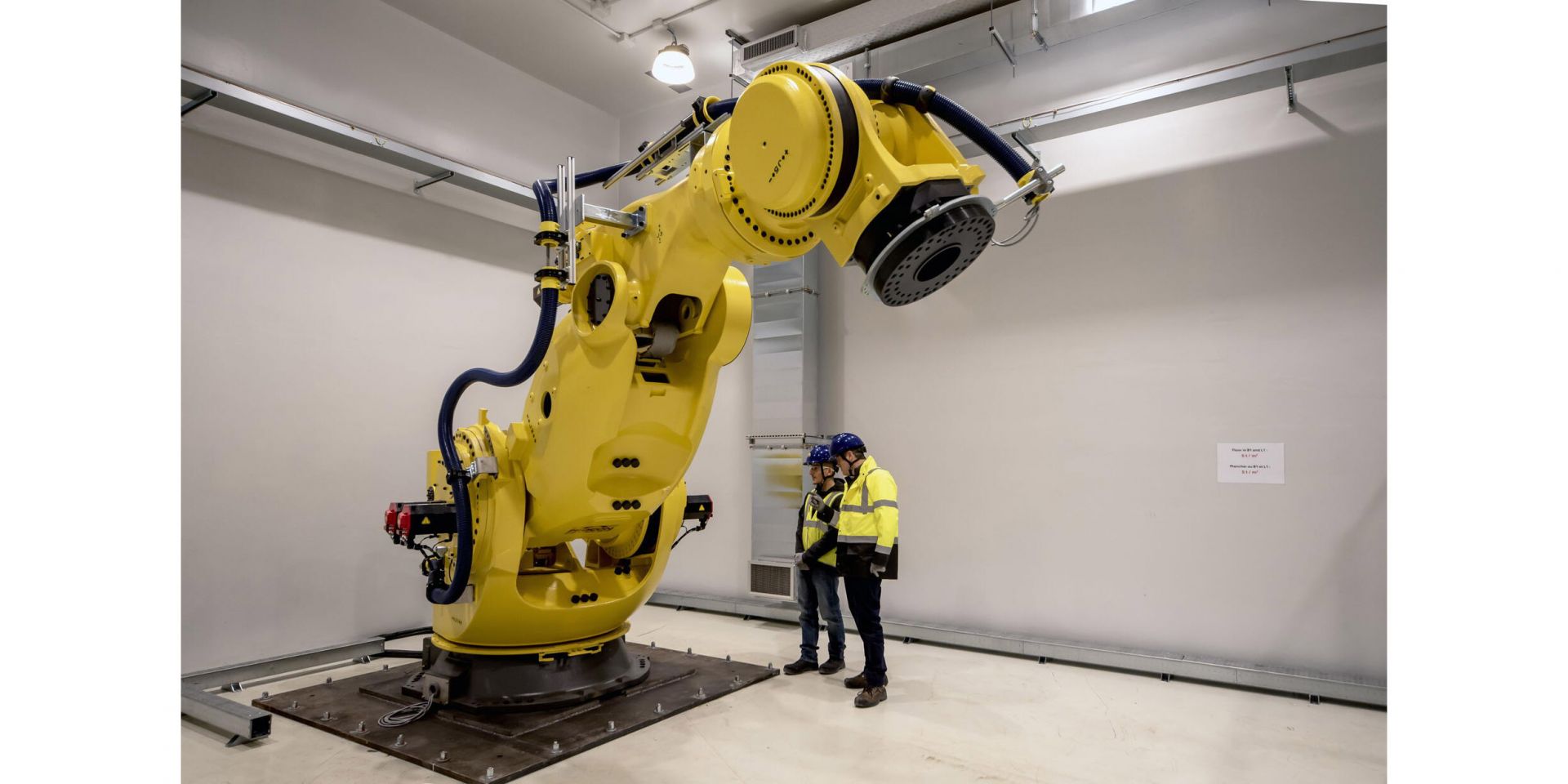
Standing about four meters tall, with an arm that extends out to five meters, this particular Godzilla is the most powerful industrial robot that has ever been made. ITER is using it as a platform to develop and integrate technologies that will be used by other robots to install 20,000 components inside the vacuum vessel, or plasma chamber, of the tokamak under assembly at the facility. ITER’s current timeline anticipates full magnetic energy in 2036 and the start of deuterium-tritium operations in 2039.
Complex assembly operations: Assembly robots will carry out the complex installation of such components as coils, manifolds, and blanket modules attached to the vessel’s inner surface; first-wall panels that face the plasma of the device; and several different layers of systems that “are superimposed like the skins of a steel onion,” in the words of ITER. These assembly operations will have to follow a “streamlined work organization based on the parallelization, rather than the succession, of tasks.”
Robotics expert Raphaël Hery explained, “Specialized teams and assembly tools will move from one part of the vacuum vessel to the next to install a specific ‘layer’ of components. As they advance, another team moves in to install the next layer.” The ITER team is using Godzilla to develop optimization strategies for carrying out and coordinating these complicated procedures.
Godzilla, which can lift and move loads as heavy as 2.3 metric tons, is testing a variety of tools and technologies for these future procedures. One such technology is described as “a partial prototype of a ‘tool changer,’ which, as its name indicates, will enable assembly robots to quickly and safely switch from one tool to another in accordance with work sequences.” This quick tool-changing capability is expected to save a lot of time, considering that more than 30 types of tools will be needed during in-vessel assembly operations.
Testing begins in March: The ITER team is planning to start using Godzilla in March to test the tools under development on mock-ups and interfaces that are representative of the in-vessel environment. After the tools and technologies are validated with the Godzilla platform, they will be transferred and integrated into the robots that will perform in-vessel assembly tasks.
One of these assembly robots is an in-vessel tower crane, produced and delivered by French industrial engineering firm CNIM Systèmes Industriels, that will be adapted and optimized based on the Godzilla test results. Another is the blanket assembly transporter, which is described as a “monster three times the size of Godzilla.” It is currently in a detailed design phase before its fabrication by Indian technology firm Larsen & Toubro.
As Godzilla is prepped to begin its work, the ITER crew continues to make progress on other aspects of the international tokamak project. On January 28–29, the 1,300-metric-ton sector module 8 was installed successfully in the tokamak pit, making it the fourth of nine to be lowered into place. Four more sector module insertions are scheduled for 2026.