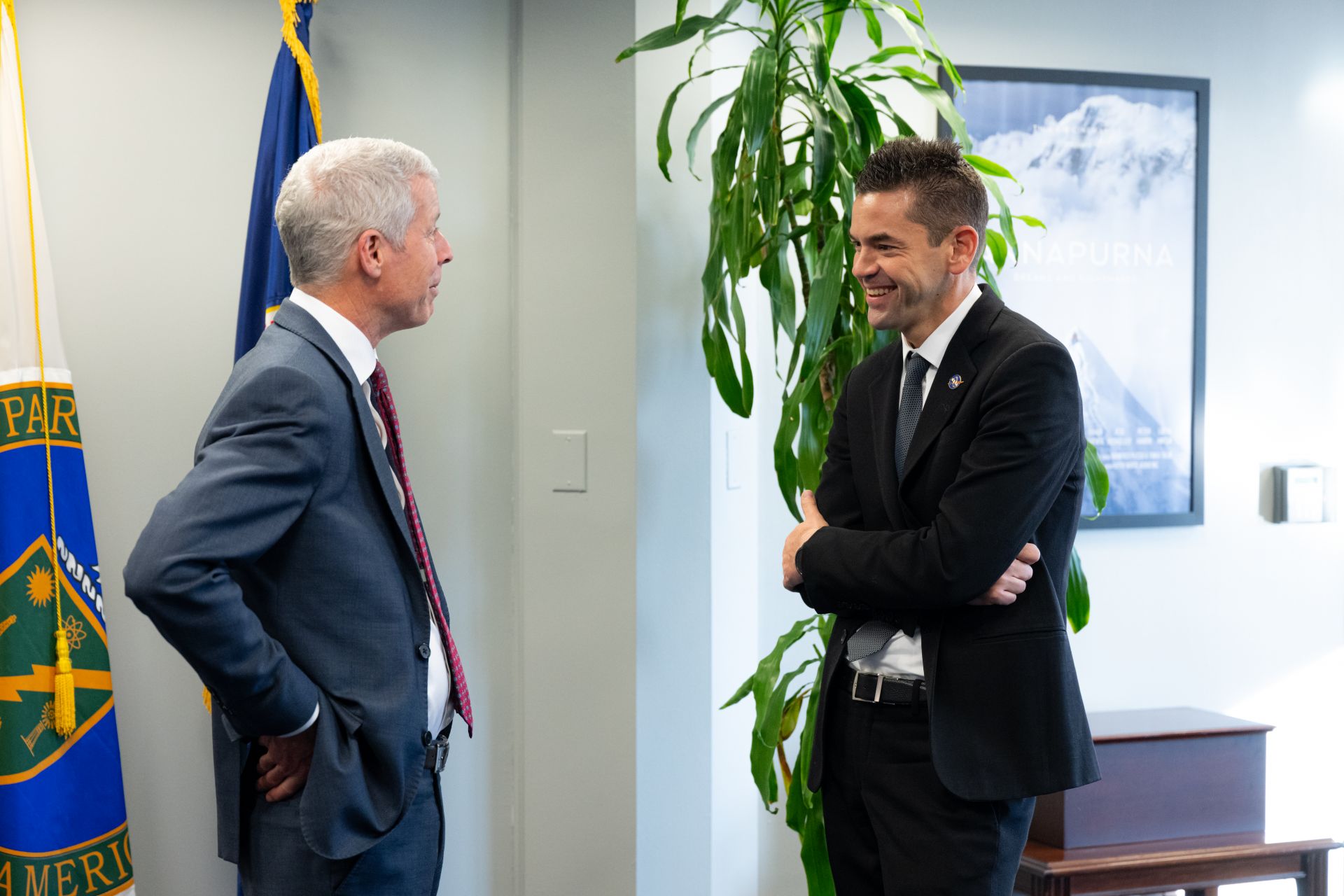
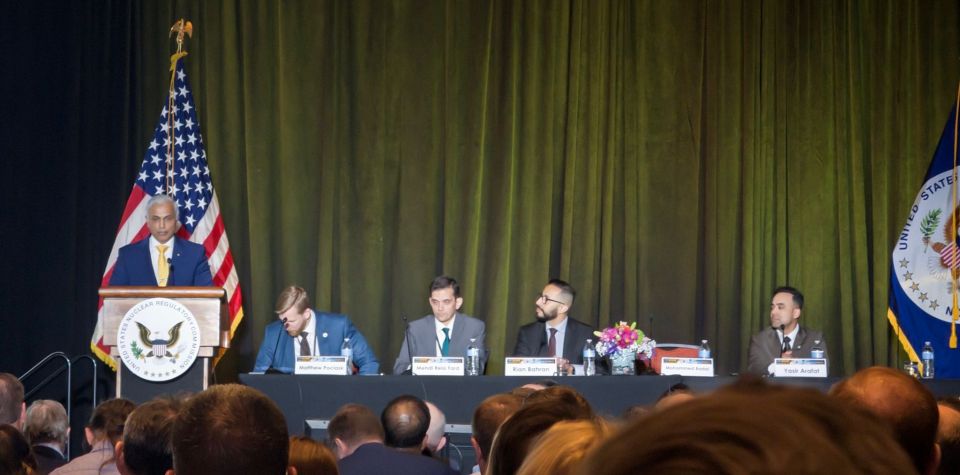
Secretary of Energy Chris Wright (left) and NASA Administrator Jared Isaacman (right) meet at DOE headquarters in Washington, D.C., on January 8. (Photo: NASA/John Kraus)
NASA and the Department of Energy have announced a “renewed commitment” to their mutual goal of supporting research and development for a nuclear fission reactor on the lunar surface to provide power for future missions. The agencies have signed a memorandum of understanding that “solidifies this collaboration and advances President Trump’s vision of American space superiority.”
Uncertainties remain: Trump released an executive order on December 18 that calls for “establishing initial elements of a permanent lunar outpost by 2030 to ensure a sustained American presence in space and enable the next steps in Mars exploration.” Among those elements would be a nuclear reactor capable of producing “safe, efficient, and plentiful electrical power that will be able to operate for years without the need to refuel.”
However, as with previous government statements about a U.S. lunar reactor, the latest DOE and NASA press releases include uncertainties. They do not state specifically whether the reactor will actually be operating on the moon by 2030, or whether it might be built by then but not yet deployed. NASA’s and the DOE’s joint ambitions for a lunar fission surface power (FSP) system have been characterized by delays and uncertainties as shifting priorities have led to changing designs and schedules.
Another “space race”: Russia and China also have plans to deploy a nuclear reactor on the lunar surface. The two nations announced their plans in March 2024 to cooperate in this endeavor, with the goal of potentially deploying a reactor on the moon sometime between 2033 and 2035.
Last August, Secretary of Transportation and then acting NASA Administrator Sean Duffy said, “We're in a race with China to the moon, and to have a base on the moon we need energy. This fission technology is critically important. . . . There’s a certain part of the moon that everyone knows is the best. We have ice there. We have sunlight there. We want to get there first and claim that for America.”
Latest specs: According to an August 2025 NASA request for information that was sent to several companies for feedback, the most recent FSP design would include the following specs:
- Reactors should be prepared to launch by the first quarter of fiscal year 2030 (the last quarter of calendar year 2029).
- Reactor designers can assume the use of a heavy-class lander that can carry up to 15 metric tons.
- The reactor must have a 100-kWe output using a closed Brayton cycle power conversion system. NASA prefers the Brayton cycle to “reduce risk and ensure extensibility to higher power systems.”
One of the greatest technical achievements: Secretary of Energy Chris Wright said of the new MOU, “History shows that when American science and innovation come together, from the Manhattan Project to the Apollo Mission, our nation leads the world to reach new frontiers once thought impossible. This agreement continues that legacy. . . . the Department is proud to work with NASA and the commercial space industry on what will be one of the greatest technical achievements in the history of nuclear energy and space exploration.”

-3 2x1.jpg)