He then welcomed this month’s speaker: Douglas Bowen, who presented “RIPB Methodology and the ANS-8 Nuclear Criticality Safety Standards.” Bowen is the director of the Nuclear Criticality Safety Program at Oak Ridge National Laboratory. He has supported the ANS-8 standards through various roles and will soon be transitioning to chair of the Nuclear Criticality Safety Consensus Committee, which is part of the broader ANS Standards Committee.
Defining criticality safety: Bowen kicked off his talk by presenting two diverging perspectives on the definition of nuclear criticality safety. While many of his colleagues at ORNL strongly feel that criticality safety is a branch of reactor physics that supports advanced reactor validation, Bowen looks at criticality safety as the prevention of unintended criticality.
In simple terms, he explained, it’s about making sure that fissile materials that are being handled cannot accidentally reach conditions (such as amount, geometry, moderation, or reflection) that would cause them to go critical (a self-sustaining fission reaction). The field’s primary purpose, in Bowen’s view, is to protect workers and the public from the unique radiological hazards that materials handled outside of a nuclear reactor can pose. That protection ensures that nuclear materials can be processed, transported, and stored without the risk of inadvertent criticality.
Criticality accidents: There have been 22 recorded criticality accidents around the world since the beginning of nuclear research. Thirteen have taken place in Russia, seven in the United States, one in the United Kingdom, and one in Japan.
These accidents are characterized by a rapid and large release of neutrons and gamma rays, and are sometimes accompanied by Cherenkov radiation, which is visible as a flash of blue light. Often, this release of radiation can be lethal to people within 15 feet of the area.
The first known accident occurred in 1953 at the former Soviet Union’s Mayak plutonium reprocessing plant. While the majority of accidents occurred in the 1950s and ’60s, the last known accident occurred in 1999 at a reprocessing facility in Tokaimura, Japan.
Of these 22 accidents, 21 involved liquids “because they are hard to control,” Bowen said. “They can leak from a geometry that we consider to be safe like a skinny tank into something larger and less favorable from a criticality safety standpoint.” One accident that happened in Russia in 1978 involved metal. In all, 18 of the accidents have occurred in manned, unshielded facilities, leading to serious exposures and nine fatalities. While each accident had multiple failures, human error—rather than equipment failure—was found to be the root cause in every case.
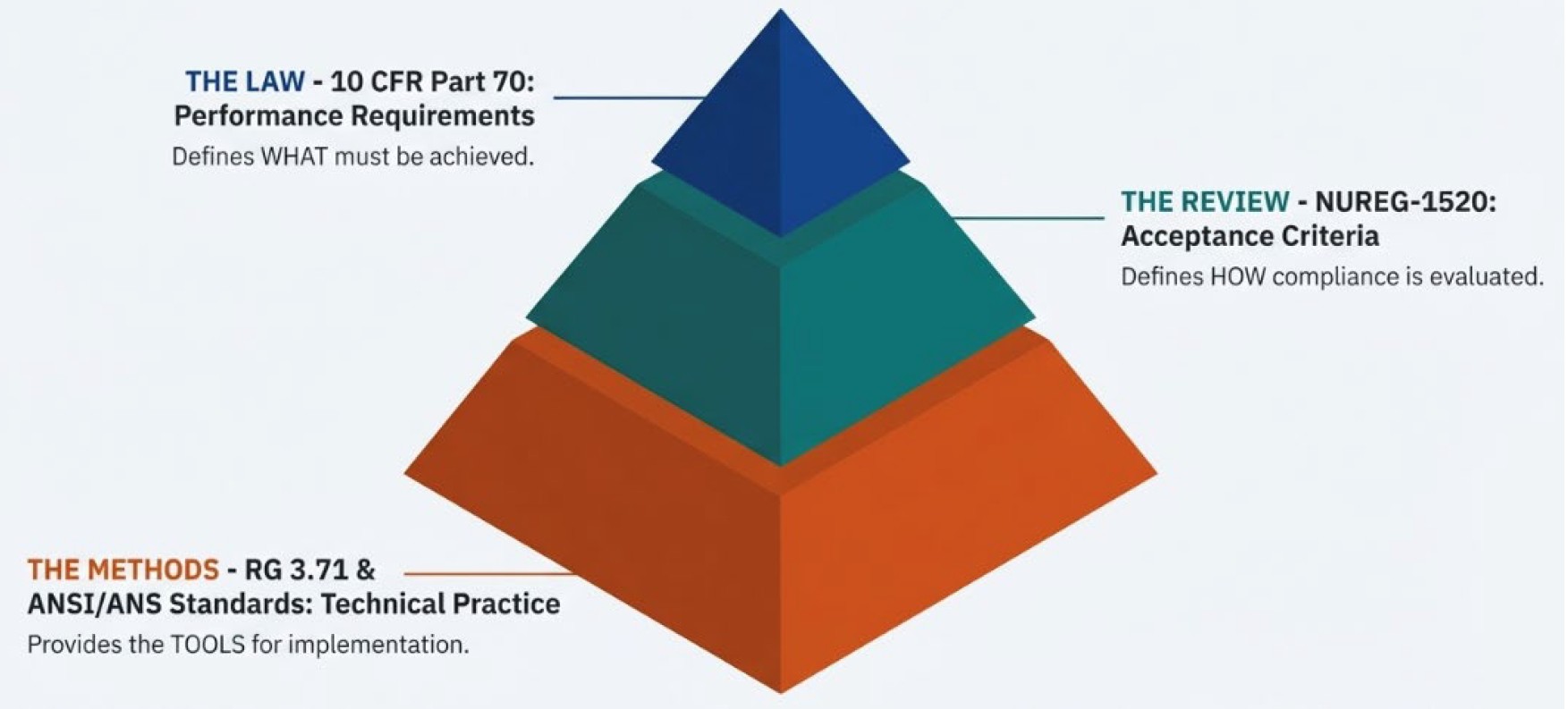
The regulatory structure: Putting roadblocks between human error and future accidents defines much of the work done by the Nuclear Criticality Safety Consensus Committee, which is in charge of the ANS-8 series of standards. Those standards are endorsed by both the Department of Energy and the Nuclear Regulatory Commission and lay the foundation for what criticality safety looks like today. To learn more about the details of those standards, view Bowen’s full presentation here.

-3 2x1.jpg)