RIC session focuses on interagency collaboration
Attendees at last week’s 2026 Regulatory Information Conference, hosted by the Nuclear Regulatory Commission, saw extensive discussion of new reactor technologies, uprates, fusion, multiunit deployments, supply chain, and much more.
With the industry in a state of rapid evolution, there was much to discuss. Connected to all these topics was one central theme: the ongoing changes at the NRC. With massively shortened timelines, the ADVANCE Act and Executive Order 14300, and new interagency collaboration and authorization pathways in mind, speakers spent much of the RIC exploring what the road ahead looks like for the NRC.
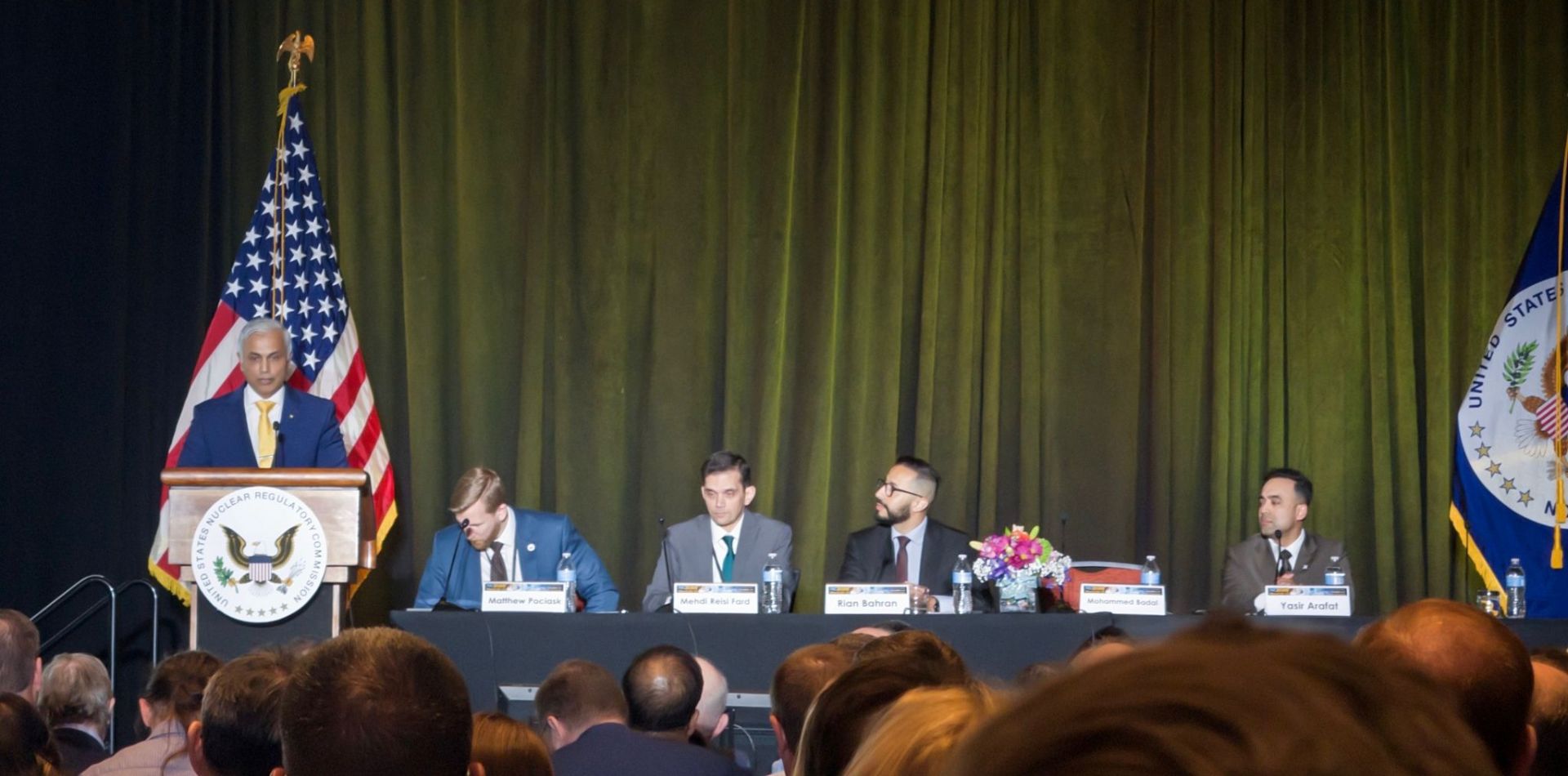
One government: On March 10, the RIC technical session “One Government, One Mission: Advancing Safe Deployment of Nuclear Energy,” featured spokespeople from the NRC, Department of Energy, Department of Defense, and Aalo Atomics, each of whom gave their insights on how each party can work together to facilitate new nuclear deployment and minimize duplicative efforts across different parts of the government.
The session started off with this poll question for the audience: “Recent executive orders envision a coordinated, whole-of-government approach to nuclear policy and regulation. How will this strategy affect deployment of safe, clean, and reliable nuclear energy?” In response, 57 percent answered “positive,” 27 percent responded “neutral,” and 16 percent responded “negative.”
Mehdi Reisi Fard, deputy director in the Division of Advanced Reactors and Non-power Production and Utilization Facilities at the NRC, was first to speak. “The pipeline of reactor applications over the next few years is unlike anything we’ve seen before in terms of the number of projects, the diversity of technologies, and the complexity of deployment models,” he said.
To respond to this unprecedented environment, Fard said the NRC must “continue learning, adapting, and improving our processes. Collaboration with our federal partners will be an important part of that effort. [Working] together while maintaining our independent regulatory roles allows us to leverage expertise and reduce unnecessary duplication. Ultimately, we all share the same objective: enabling the safe use of nuclear technologies.”
Rian Bahran, deputy assistant secretary for nuclear reactors at the DOE, echoed Fard’s optimism, saying that for years the industry has been at “a tipping point for advanced nuclear technology deployment,” and in the past year “it actually feels like we’re finally tipping.”
Bahran put a spotlight on both the Reactor and Fuel Line Pilot Programs as a key facilitator of this new surge in momentum. He added that these programs will lead to lasting change because of the DOE’s close collaboration with the NRC, referencing both the recent DOE-NRC memorandum of understanding and the NRC’s recent internal guidance document regarding authorization projects. Bahran explained that these programs have always been intended to facilitate NRC commercial license fast-tracking for projects that are able to meet DOE regulatory milestones.
Bahran also said, “I am happy to report, we are on track to turn on, for criticality, at least three reactors as directed by the president by July 4 of this year.” This was the original goal of the Reactor Pilot Program but contradicts Energy Secretary Chris Wright saying one or two reactors would reach criticality by the deadline late last year.
The DOD’s Mohammed “Mo” Badal was next to speak. He is the program manager for nuclear power in the Office of the Assistant Secretary of the Army for Installation, Energy, and Environment. Like Bahran, Badal covered the ongoing efforts at the DOD for reactor authorization, providing several updates on the Janus Program.
He said that DOD is actively engaging with vendors and is currently looking at their proposals for the program, adding that the DOD is currently finalizing MOUs and associations to solidify its collaborative framework with the NRC. Despite being in its early stages, Badal said the Janus Program already involves five national laboratories that have assisted the DOD with its project selection process.
Q&A: After each speaker gave an overview of their respective organizations’ ongoing work, the panel was asked several questions on the nature of future collaboration.
The first was, “How is the NRC ensuring that its regulatory role remains both independent and effective in this all-of-government approach?”
Fard responded that the NRC has “a distinct statutory responsibility” enshrined in the Atomic Energy Act. “At the end of the day, the NRC has to independently make a determination on whether NRC regulations are being made, so full stop there.”
Another key question concerning all the panelists was, “How important is the standardization of definitions and regulatory approaches for effective collaboration among government agencies and to achieve streamlining efficiencies?”
Fard responded that, down the road, standardization could further increase efficiency, but he hopes projects are not currently being substantially held back by varying terminology. Bahran agreed that collaboration is going well, saying that despite differing vernacular, “there are no major gaps that would stop something being authorized by DOE from getting a commercial license, fundamentally.” Bahran also said that the DOE is developing an AI tool in collaboration with private industry that will translate a DOE license to an NRC application.
The concluding question of the session was, “What does success look like to each of you for this coordinated government effort to deploy advanced nuclear technologies?”
Fard responded that success will look like innovation continuing to move forward without any compromises to safety. Clarity, he said, is critical for developers and regulators, but it is also key for the continued assurance of public confidence in nuclear. “We are public servants, and it’s important to maintain the trust that they have in the work and our licensing activity.”