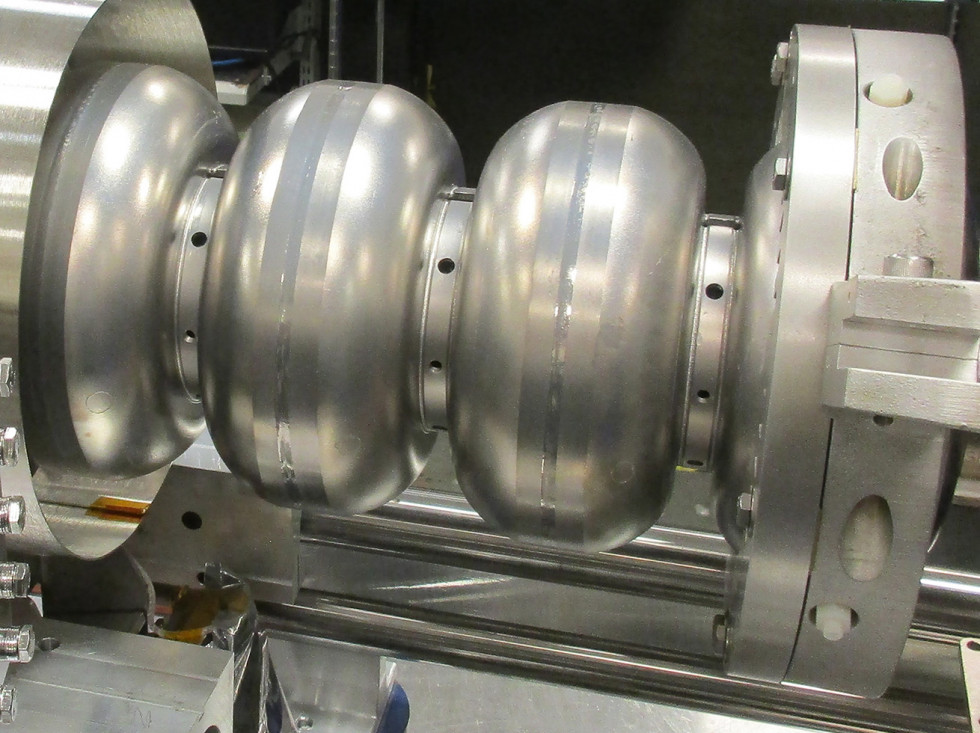
Particle accelerator technologies, such as this niobium-tin particle accelerator cavity, may lead to advancements in nuclear waste transmutation. (Photo: Jefferson Lab)
The Thomas Jefferson National Accelerator Facility is leading research supported by two Department of Energy Advanced Research Projects Agency–Energy (ARPA-E) grants aimed at developing accelerator technology to enable nuclear waste recycling, decreasing the half-life of spent nuclear fuel.
Both grants, totaling $8.17 million in combined funding, were awarded through the Nuclear Energy Waste Transmutation Optimized Now (NEWTON) program, which aims to enable the transmutation of nuclear fuels by funding novel technologies for improving the performance of particle generation systems.
The projects each focus on different components of an accelerator-driven system that uses neutron spallation to convert highly radioactive nuclear waste into material with a much shorter half-life.
“These neutrons will interact with these unwanted isotopes and convert them into more manageable isotopes that you can either try out for some beneficial use or bury underground. Instead of having a lifetime of 100,000 years in storage, for example, you can shorten the storage years down to 300,” said Rongli Geng, principal investigator on both grants and head of the SRF Science & Technology Department in Jefferson Lab’s Accelerator Operations, Research, and Development Division.
One project aims to redesign the superconducting radio frequency (SRF) cavities of the accelerator for increased efficiency, while the other aims to design magnetrons that could power the SRF cavities.
Warming up: One project, titled “Superconducting Nb3Sn Cavities for Efficient and Reliable 10 MW Proton LINACs,” will be extending work that has shown that coating the inside of niobium SRF cavities with tin allows them to operate at high enough temperatures to eliminate the need for costly cryogenic refrigeration facilities in favor of standard commercial cooling units. In collaboration with RadiaBeam Technology and Oak Ridge National Laboratory, the Jefferson Lab team will apply these findings to cavities that are specifically designed to be part of the neutron spallation process. They are also exploring a new class of cavities, called spoke cavities.
Steady power source: The second project, titled “High-Efficiency Continuous-Wave RF Sources for High-Power Particle Accelerators,” looks at the radio frequency power sources for these SRF cavities. They will be developing magnetrons, which have many common applications including radar systems and microwave ovens, but are less common in accelerator applications due to sporadic startup conditions and noisy spectra impacting operational stability. In collaboration with Stellant Systems, General Atomics Energy Group, and ORNL, the team will develop a high-powered magnetron with a proposed design that they believe will address the typical issues.



 2x1.jpg)