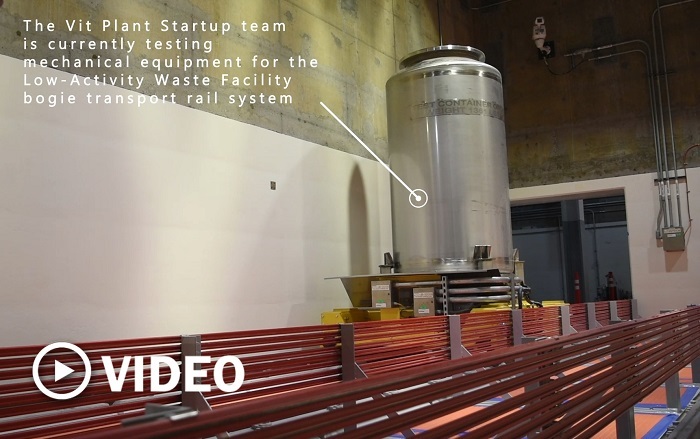
A WTP crew vitrified the first Hanford Site tank waste inside one of two melters in the Low-Activity Waste Facility. Top right, a camera inside the melter’s pour cave shows the vitrified waste being poured into a stainless steel container as well as the hot liquid inside the container. Bottom right, the first two containers filled with vitrified waste in the pour cave prior to being lidded, swabbed to verify their exteriors are free of contamination, and then moved into the export bay. (Photos: DOE)
The Department of Energy has announced that the Hanford Site’s Waste Treatment and Immobilization Plant (WTP) has reached a commissioning milestone, producing more than 20 stainless steel containers of immobilized low-activity radioactive waste.
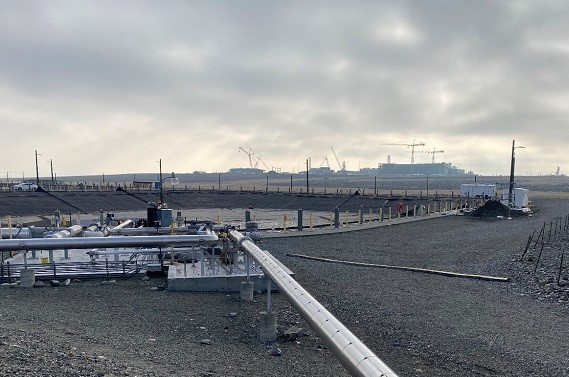
During the Hanford Site's Direct-Feed Low-Activity Waste Program treatment operations, the Waste Treatment and Immobilization Plant, background, will feed liquid waste to the Liquid Effluent Retention Facility, foreground, through a primary transfer line pictured here. (Photo: DOE)
Work crews at the Department of Energy's Hanford Site recently completed the first transfer of test water from the Waste Treatment and Immobilization Plant's Effluent Management Facility to the nearby Liquid Effluent Retention Facility (LERF). The transfer of 6,000 gallons was the first simulation of the process that will be used to treat secondary liquid waste from the plant’s Low-Activity Waste Facility during operations to treat tank waste.
“This is a tremendous accomplishment that culminates years of work by our team and alumni toward being ready for hot commissioning,” said Valerie McCain, project director and senior vice president for Bechtel National, Inc. “It’s an important step for the entire Hanford team and our collective mission of protecting the Columbia River and its shoreline communities.”
Bechtel National is a contractor of the DOE's Office of Environmental Management's Office of River Protection.

-3 2x1.jpg)