
Nuclear and the Renewable Energy Standard
October 18, 2010, 6:00AMANS Nuclear Cafe
 Now that more comprehensive climate change policies such as cap-and-trade are on indefinite hold, the U.S. Congress is considering a national Renewable Energy Standard (RES) in an effort to do something on energy issues. The RES would require that 15 percent of all U.S. electrical generation be provided by "renewable" sources by 2020. Currently, the definition of "renewable energy" does not include nuclear. Similar policies are already in place in many states, such as California.
 Clearly, our attempts to generate greater understanding of energy challenges exclude no member of the public. Young and old, Democrat and Republican, male and female-all must be the aim of public information about U.S. energy policy in general and nuclear energy in particular. Years of industry surveys, however, have quantified the large gender divide on acceptance of nuclear energy. For example, a survey last year by Ipsos Public Affairs showed that 54 percent of men support a stronger role for nuclear energy in the next few decades, while women's support was only 32 percent.
 My generation has been labeled Generation X, or maybe Y, I'm not sure. I don't even know what those labels mean. I think of us as individuals coming of age in the Information Age. We have been exposed to more information than any generation before and have been made all too aware of the problems facing our planet from a very early age.
 The
The  personal interest in the success" of the DOE's new Nuclear Energy University Programs (NEUP) initiative, according to Mary McCune, NEUP's lead program manager.
 The
The 
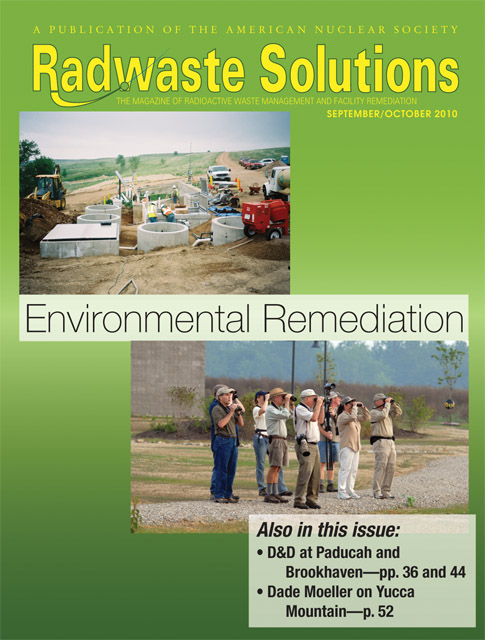 The September/October issue of Radwaste Solutions will soon be available electronically to ANS members. This issue includes the following three feature articles on environmental remediation: