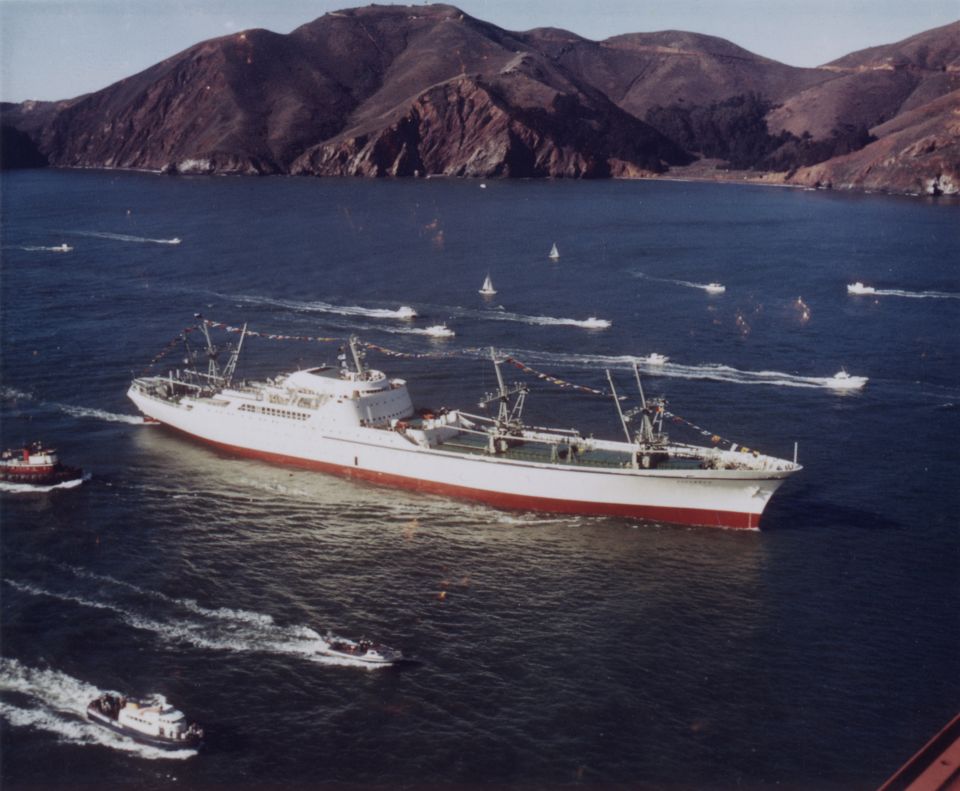
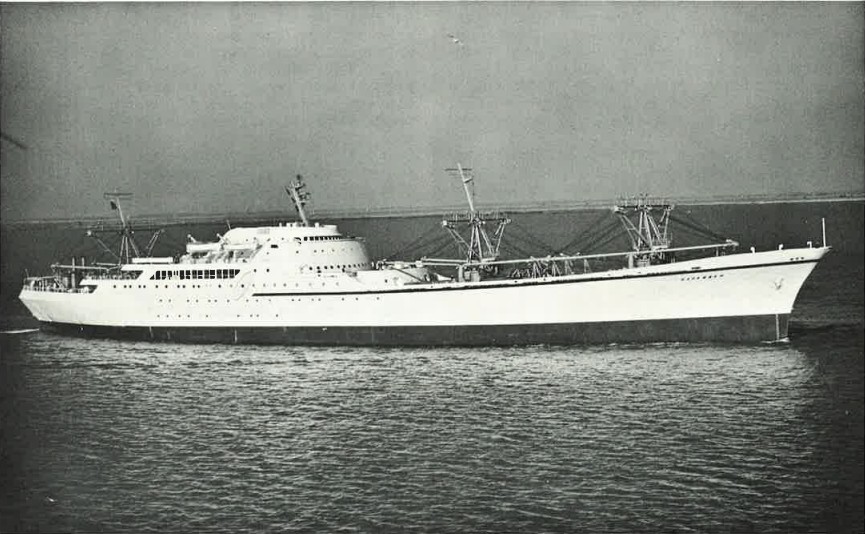
The NS Savannah, the world’s first nuclear cargo-passenger ship, en route to sea trials in Yorktown, Va. (Photo: Nuclear News, May 1962, p. 39)
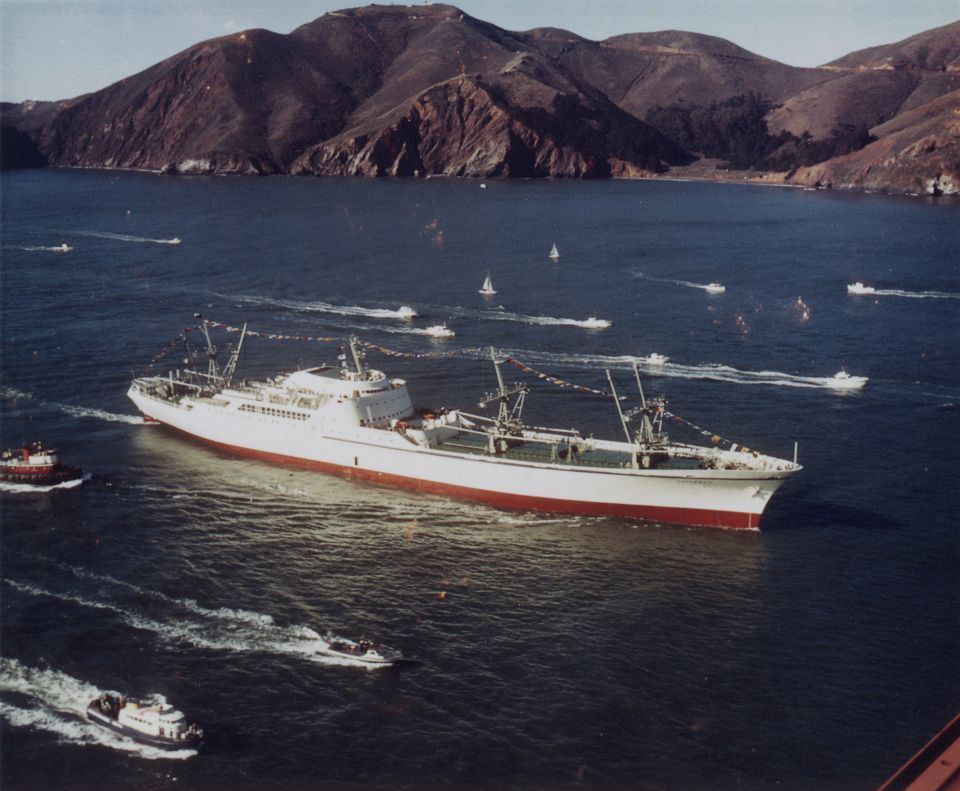
On Sunday, May 17, in Baltimore, Md., there will be an open house on the NS Savannah to commemorate National Maritime Day. The Savannah acted as a passenger and cargo ship from 1962 to 1970, serving as a floating ambassador for President Eisenhower’s Atoms for Peace program and, more broadly, for the safe and peaceful uses of nuclear power.
Tour details: The Savannah holds a unique legacy in nuclear history. One of its many distinctions is its designation as a Nuclear Historic Landmark, which the American Nuclear Society granted in 1991.
The ship will be open to the public from 10:00 a.m. to 3:00 p.m. (EDT), and a ceremony will be held at 11:30 a.m. Especially notable this year is the opportunity for visitors to tour the formerly off-limits containment vessel, which once housed the ship’s reactor—a 69-MWt (later uprated to 80 MWt) pressurized water reactor with twin steam generators and primary coolant loops.
The Savannah will be docked at Canton Marine Terminal’s Pier 13—at the same pier as the SS John Brown, one of the last operating survivors from a fleet of over 2,700 Liberty ships built during World War II. The John Brown will also be open for tours on May 17.
As its decommissioning process is coming to an end, Savannah is now looking for a new home. This year’s tour represents an opportunity to learn more about the ship’s past and future.
To learn more about the tour, click here.
Brief history: National Maritime Day commemorates the first transatlantic voyage completed by a steam-powered vessel—a milestone achieved in 1819 by the SS Savannah (the namesake of the NS Savannah).
A year and a half after his seminal “Atoms for Peace” speech, President Eisenhower announced the NS Savannah project in April 1955. It was authorized by Congress the next year and was in service six years later. In its eight years of operation, the ship visited 32 domestic and 45 international ports. Its core was shuffled in 1968, and four new fuel elements were installed. The ship traveled more than 450,000 nautical miles on cores I and Ia, consuming 163 pounds of enriched uranium—the equivalent of 28,600,000 gallons of bunker C fuel oil.

-3 2x1.jpg)
.jpg)
.jpg)