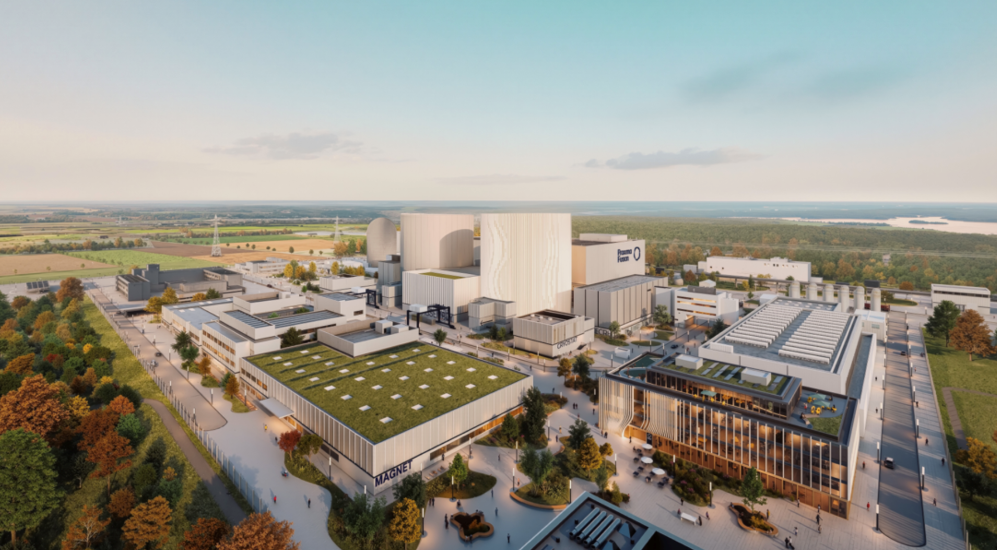
According to the partners, the MOU outlines a roadmap to Europe’s first commercial fusion power plant, beginning with the building of a demonstration stellarator near IPP in Garching, near Munich. Called Alpha, the demonstration stellarator is to become operational in the 2030s at a cost of €2 billion ($2.34 billion).
Using Alpha to test and validate key fusion technologies under real-world conditions and in shorter development cycles, Proxima and its partners will then build a stellarator fusion power plant. Called Stellaris, the demonstration plant is to be built in Bavaria at RWE’s former Gundremmingen nuclear power plant, which is currently undergoing decommissioning.
MOU details: Under the MOU, Bavaria, Proxima, RWE, and IPP will work together on site selection, permitting and regulatory processes, project structure, and financing.
IPP will lead on plasma physics and the scientific leadership of demonstration stellarator Alpha. Proxima will lead on engineering, public procurement processes, and construction. RWE will lend its experience in the construction and operation of complex power plant facilities, as well as its global industrial network.
Proxima said it intends to finance approximately 20 percent of the project’s total costs through private international investors. The company added that, subject to federal funding, Bavaria has indicated a potential state cofinancing contribution of 20 percent. RWE has also signaled its willingness to participate financially within the framework of the MOU.
By pooling their efforts, all four partners hope to maximize their chances of securing federal funding under Germany’s High-Tech Agenda, the €22.38 billion ($26.15 billion) program launched by the government last year to accelerate technological advancements.
According to Markus Söder, minister-president of Bavaria, the Bavarian government is supporting magnetic fusion research through the Bavarian High-Tech Agenda with up to €400 million ($467 million).
Quote: “With Alpha in Garching and Stellaris in Gundremmingen, we are, for the first time in Europe, connecting world-class research, privately financed and publicly supported high-tech innovation, and its industrial implementation at a single location. Bavaria is therefore evolving from a research hub into a foundational location for the fusion industry,” said Francesco Sciortino, Proxima’s cofounder and CEO.

-3 2x1.jpg)