
-3 2x1.jpg)
Opposites can solve nuclear waste problems working together

Allison Macfarlane

Lake Barrett
In these challenging times of ever-increasing political polarization and strong differing personal opinions, there is hope that diverse points of view can converge to create solutions for difficult problems if we remain focused on the common good.
For us, the common interest is a solution for the broken U.S. program to dispose of the growing inventory of spent nuclear fuel and high-level radioactive waste from commercial nuclear energy. We strongly believe this is critical to support and enable our projected continuation and expansion of safe, reliable, clean, affordable nuclear power to support the needs of our rapidly evolving national and global societies.
The U.S. needs a new approach, because federal agencies like the Department of Energy, which are constrained by two-, four-, and six-year federal election cycles, have been unable, for more than 43 years, to perform the primary Nuclear Waste Policy Act (NWPA) mandate to establish a geologic repository.
The solution is to move the responsibility for nuclear waste away from constrained federal agencies and into the hands of those who understand it best: the nuclear industry. We suggest “NuCorp,” a nuclear corporation—an independent corporation established by reactor owners and enacted by new legislation.
We arrived at this conclusion after bringing together differing viewpoints and working together toward a greater common good to create and implement nuclear waste solutions. Although there is hard work ahead, we believe we are an example of how we can achieve solutions to difficult problems if we take the time to listen to each other and work together to find mutually acceptable answers.
We come from different perspectives. One of the authors of this commentary (Lake Barrett) is a Republican engineer who spent decades working as a civil servant within the DOE to implement the NWPA within the constraints of the federal system. Barrett reported to five different energy secretaries in three different presidential administrations. He led the scientific evaluation of the suitability of the statutorily designated Yucca Mountain geologic repository site.
The other author (Allison Macfarlane) is a Democrat and a geologist who spent decades critiquing the technical and policy merits of the Yucca Mountain site. Macfarlane served on the Blue Ribbon Commission for America’s Nuclear Future and was appointed by President Obama to chair the Nuclear Regulatory Commission.
Congress has not provided funding for work on the Yucca Mountain site for the past 16 years and is unlikely to move forward in the foreseeable future. As a result, there is currently no U.S. geologic disposal program—the heart of the NWPA. This inability of the DOE to perform its basic duty violates our long-shared understanding: the U.S. needs to safely dispose of its nuclear waste in a mined geologic repository, and we, the generation that benefited from the production of the electricity that resulted in this waste, are responsible for finding a solution.
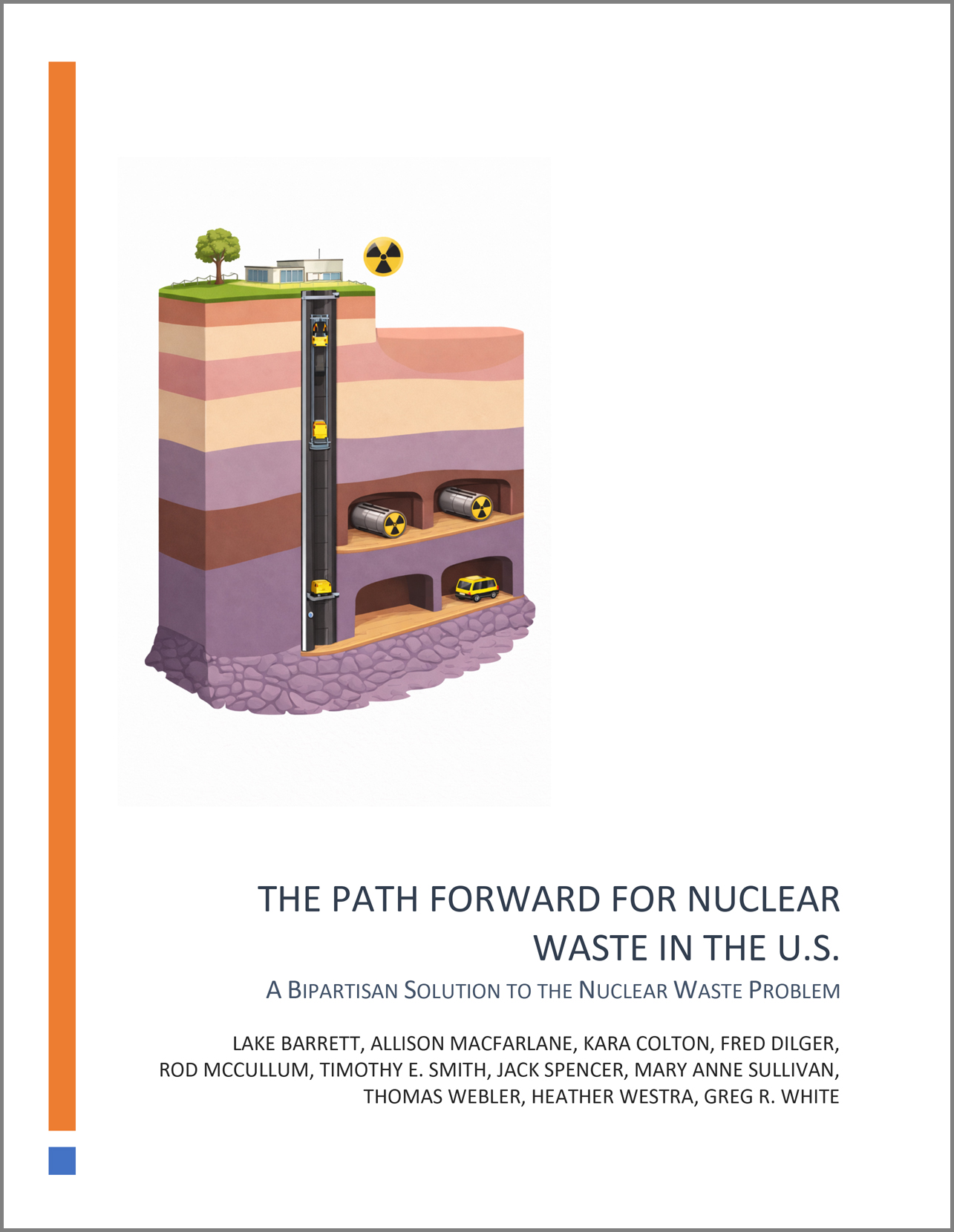 To solve this conundrum, we gathered a bipartisan group of nuclear waste experts from among the nuclear industry; federal government; public interest groups; academia; and state, local, and tribal governments. The result we agreed to is The Path Forward for Nuclear Waste in the U.S.: A Bipartisan Solution to the Nuclear Waste Problem (sppga.cms.arts.ubc.ca/wp-content/uploads/sites/5/2026/01/Path-Forward.2026.pdf).
Our report recommends that NuCorp be established for the public benefit and be governed by a corporate board of directors. It would be responsible for the management, transportation, storage, and disposal of commercial spent nuclear fuel.
NuCorp would be authorized to enter into contracts with new waste generators—any new reactors built in the U.S.—and would be required to dispose of federally owned high-level waste and spent fuel if there is a mutually agreeable contract.
To provide oversight, the law would require the establishment of an independent advisory committee containing a broad range of expertise and interests that periodically reports to Congress, the public, and NuCorp. Of course, all nuclear facilities operated by NuCorp would need to be licensed by the Nuclear Regulatory Commission.
To fund NuCorp, new legislation would allow for interest from the existing Nuclear Waste Fund (currently about $50 billion) to be made available to NuCorp, and the corpus of the fund would be transferred to an escrow account until needed. Once NuCorp is up and running, it would have to provide Congress with a mission plan, updated biannually, describing how it would develop a repository, including cost and schedule estimates.
NuCorp would be allowed to develop a limited-volume centralized storage facility as a bridge to final disposal, which would provide temporary storage of spent fuel to allow permanently shut-down reactors to repurpose their sites. Repository and storage facility siting would proceed in a collaborative manner, and voluntary hosting agreements with the identified state and local or tribal government would be required to proceed.
With the potential dawn of a new nuclear era, our nation needs a new strategy for disposing of our nuclear waste—one that will achieve success. Other countries have found success in the NuCorp model, and two are actively constructing their repositories. It’s time to try this new approach in the U.S. We can do this.
Lake Barrett is a retired DOE executive and ran the DOE’s Office of Civilian Radioactive Waste Management. Allison Macfarlane is director of and professor in the School of Public Policy and Global Affairs at the University of British Columbia.