
-3 2x1.jpg)
The spark of the Super: Teller–Ulam and the birth of the H-bomb—rivalry, credit, and legacy at 75 years
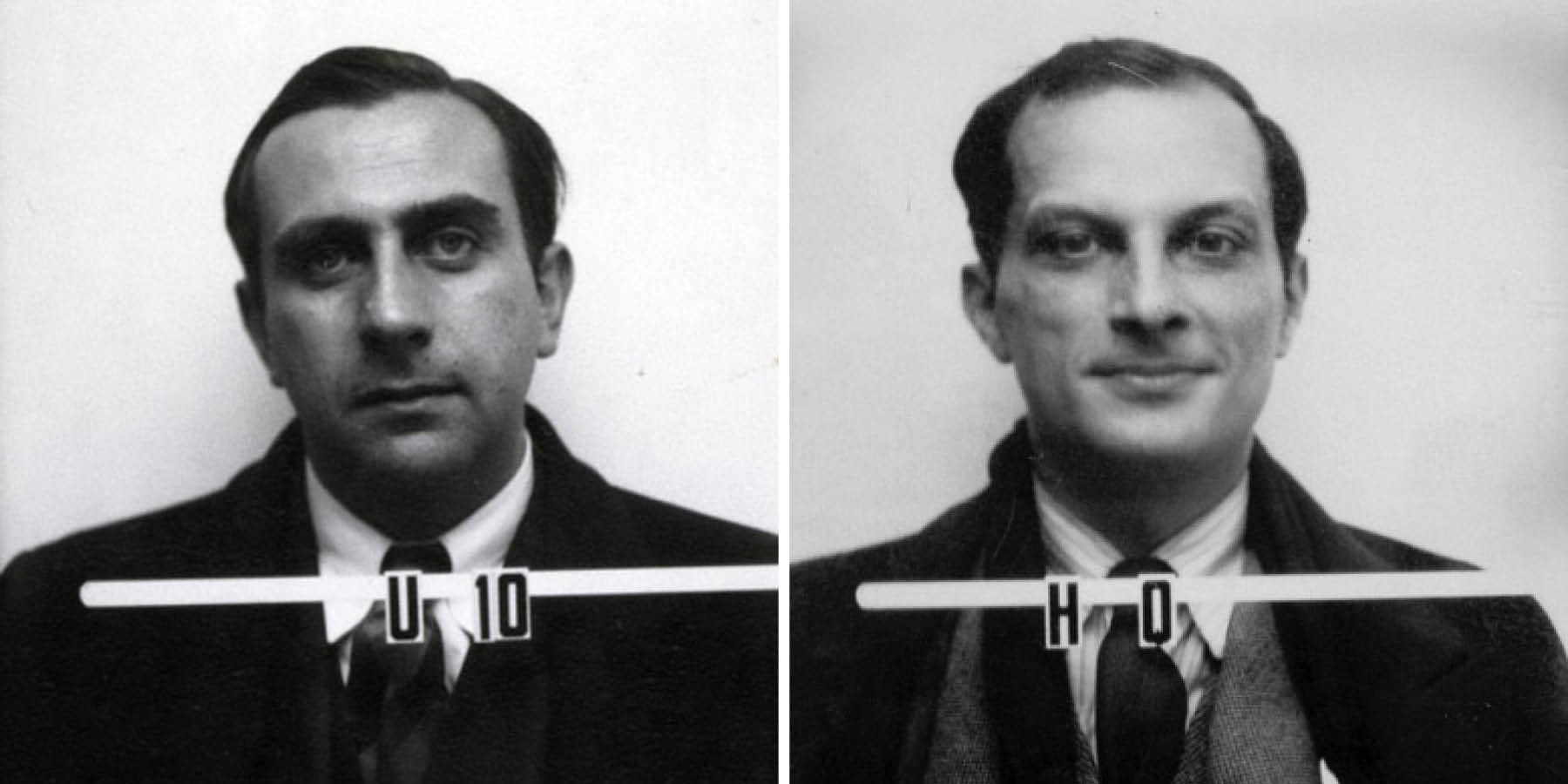
In early 1951, Los Alamos scientists Edward Teller and Stanislaw Ulam devised a breakthrough that would lead to the hydrogen bomb [1]. Their design gave the United States an initial advantage in the Cold War, though comparable progress was soon achieved independently in the Soviet Union and the United Kingdom.
The technical details of the design breakthrough remain classified. Instead of discussing the technology, here I present the story of the disputes that quickly followed its conception—particularly over who deserved credit. Teller and Ulam were brilliant, forceful, often difficult men who held little affection for each other [2,3]. Their contrasting accounts, alongside recollections from equally remarkable contemporaries, reveal how scientific breakthroughs emerge from a volatile mix of cooperation, competition, and flashes of independent insight.
Origins of the Super
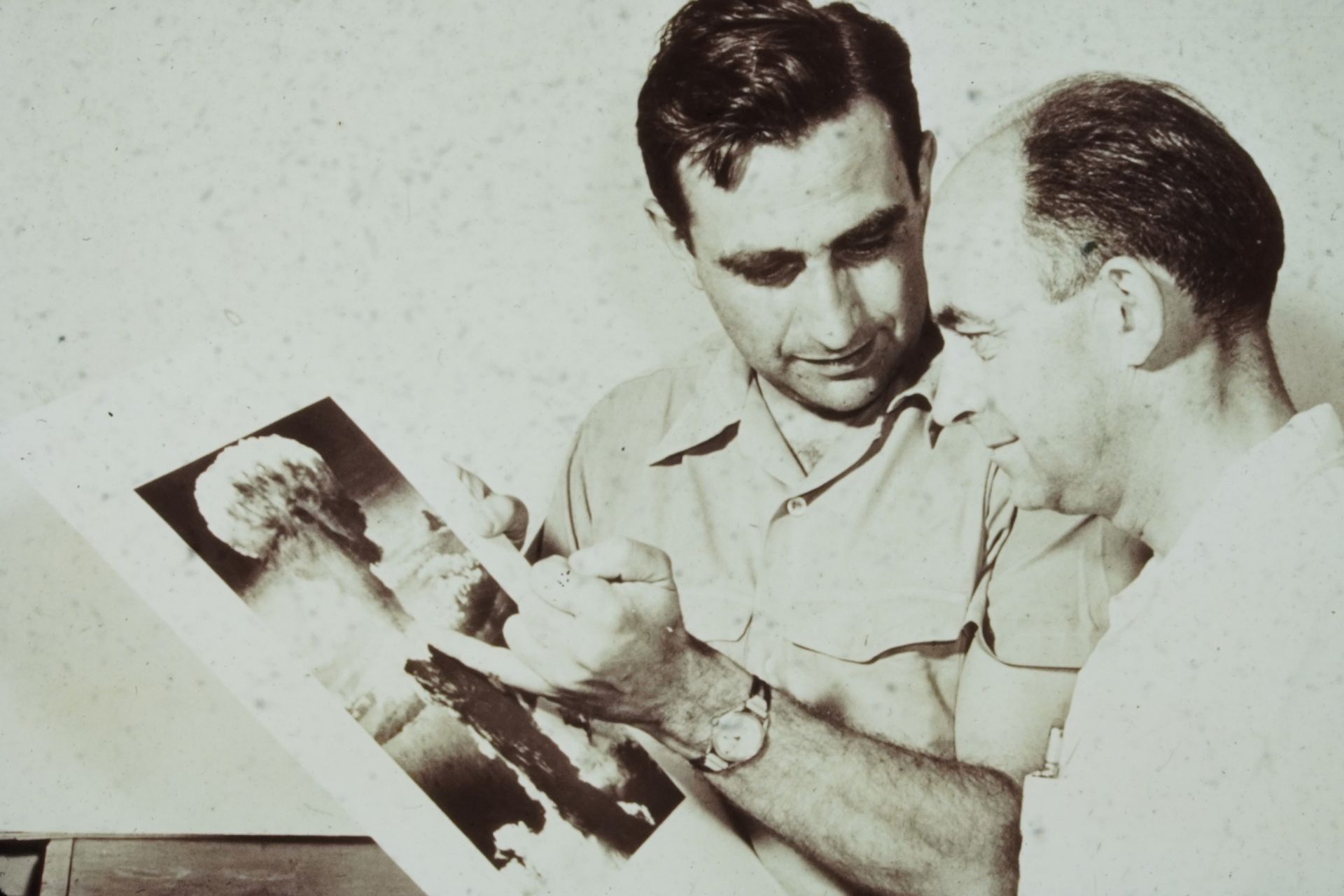
Edward Teller and Enrico Fermi.
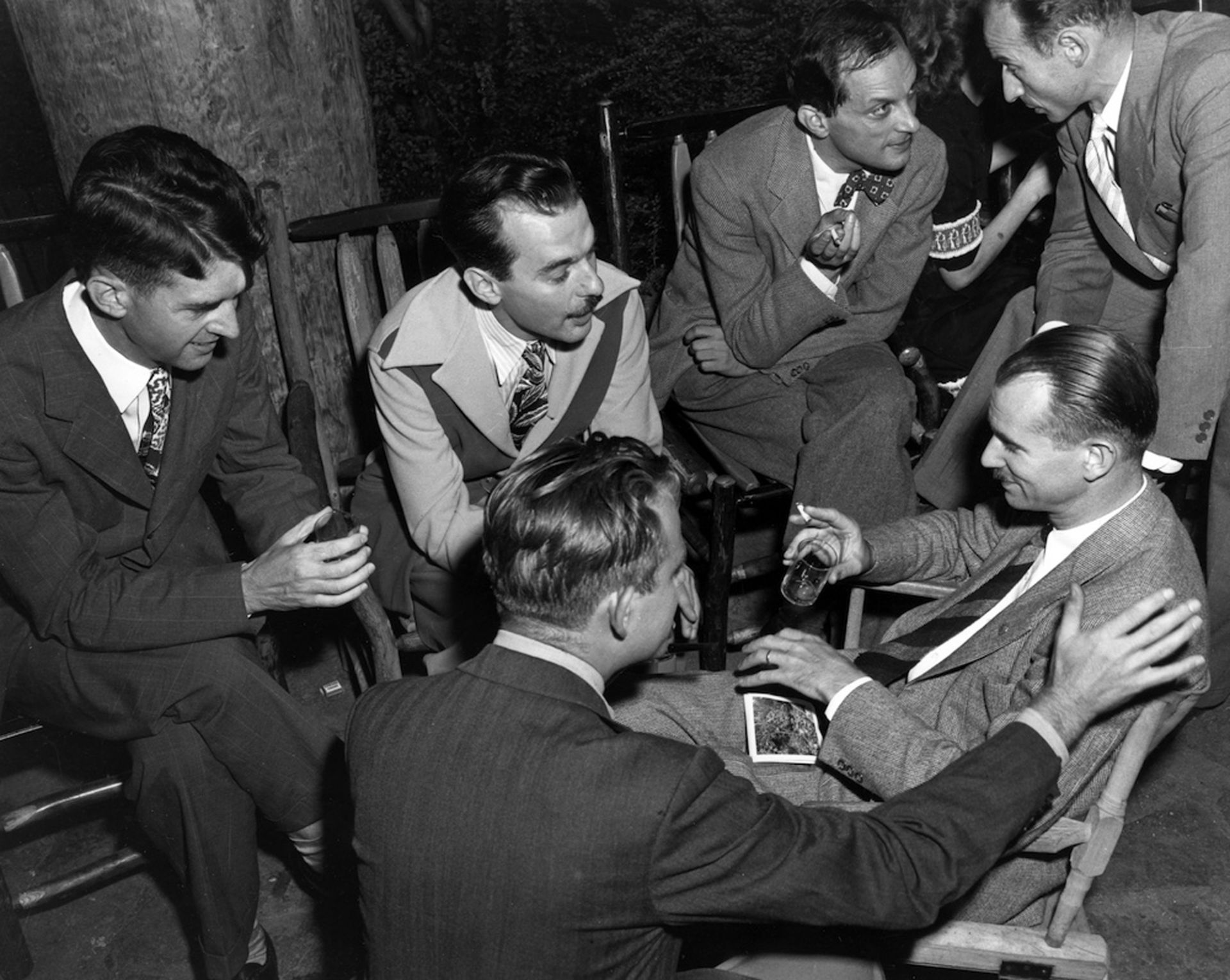
Clockwise from left: J. K. Knipp, Nick Metropolis, Stanislaw Ulam, Ray G. Herb, Edwin McMillan, and Robert R. Davis. (Photo: John “Mike” Michnovicz/acknowledgement to Toni Gibson, 1946)
These were not idle quarrels: Teller pointedly refused to cosign the hydrogen bomb patent—withholding shared recognition—and declined to attend the 1952 Ivy Mike test in the Pacific. His absence was interpreted (at least in part) as a protest stemming from Los Alamos Scientific Laboratory Director Norris Bradbury’s decision to keep Teller from directing the Mike engineering effort—an entirely justified call.a
The Teller–Ulam paper holds a place in fusion history comparable to the 1940 Frisch–Peierls memorandum for fission (as described in Cameron Reed’s excellent article in the July 2025 Nuclear News, “The Frisch-Peierls Memorandum: A Seminal Document of Nuclear History” [4–6]). The hydrogen bomb fundamentally changed the world’s geopolitics. It contained Soviet ambitions through the rapid expansion of nuclear arsenals and the military-industrial complex, underpinned strategies such as Massive Retaliation, influenced arms control agreements, and eventually helped shape a global nuclear order—embodied in the Treaty on the Non-Proliferation of Nuclear Weapons and the spread of peaceful reactor technologies. That order, however, has been under strain in recent years [7]. Beyond policy, “the bomb” cast a deep shadow across public life—in culture, society, and the collective consciousness [8].
Work on thermonuclear concepts in the U.S. dates back to 1942, running in parallel with fission research during the Manhattan Project [9,10]. One motivation was the concern that Nazi Germany might be pursuing fusion weapons (in reality, they made some attempts but failed). Enrico Fermi first suggested the general idea: the energy from a fission device could ignite fusion in a secondary fuel, with deuterium considered the most promising candidate because of its abundance. Teller had championed various versions of what became known as the “Classical Super,” but calculations—first by human “computers” and later by machines—kept showing that the design would fail. The balance between fusion energy gain and energy loss was proving unfavorable.
After the Soviet Union’s unexpected atomic test in 1949, President Truman directed the United States to prioritize thermonuclear development. A remarkable team assembled: Carson Mark, Stanislaw Ulam, Robert Richtmyer, Conrad Longmire, Marshall Rosenbluth, Dick Garwin, John Wheeler, Kenneth Ford, and Norris Bradbury worked alongside returning Manhattan Project veterans including Enrico Fermi, Edward Teller, Hans Bethe, and John von Neumann.
Yet progress remained elusive until February 1951, when Ulam proposed a two-stage “bomb in a box” design using compression. Teller added the critical insight of radiation-driven compression. Their report, “On Heterocatalytic Detonations I” (LAMS-1225; March 9, 1951), captured this first piece of the solution. Soon after, Teller, working with Frederic de Hoffmann, expanded the theory of energy gain and loss, documented in LAMS-1230 (April 1951). Together, these advances gave birth to the “New Super,” which achieved dramatic successful proof in the Ivy Mike test of November 1, 1952, at Eniwetok Atoll [11].
This article summarizes how some of the era’s leading minds—giants of American science—described these events. Their recollections were shaped not only by technical insight but also by friendships, loyalties, and the peculiarities of human nature. Assessments of “who deserves credit” inevitably depend on whether one considers both phases of the solution: (1) Ulam’s initial concept and Teller’s radiation elaboration, and (2) Teller’s working out of the energetics. Both men, in their own retellings, acknowledged the two parts. Hans Bethe, in his detailed and fascinating history, also used this “two parts” framing [12]. Ultimately, any attempt to assign percentagesb is subjective.
The timeline was astonishing: just two and a half years from Truman’s directive to a full-scale thermonuclear test. It was even more extraordinary, in some ways, than the development of the fission bomb. The physics was more intricate; the computing tools were primitive, if trailblazing (ENIAC); and opportunities for experimental validation were limited. Its success was not assured. Unlike fission weapons, there were few intermediate tests to confirm progress. An exception came in 1951 with the Greenhouse George experiment, which produced the first sustained burning deuterium-tritium fusion plasma. Fuel was easier to obtain than fissile material but still demanded new industrial capacity, particularly for liquefying deuterium [11].
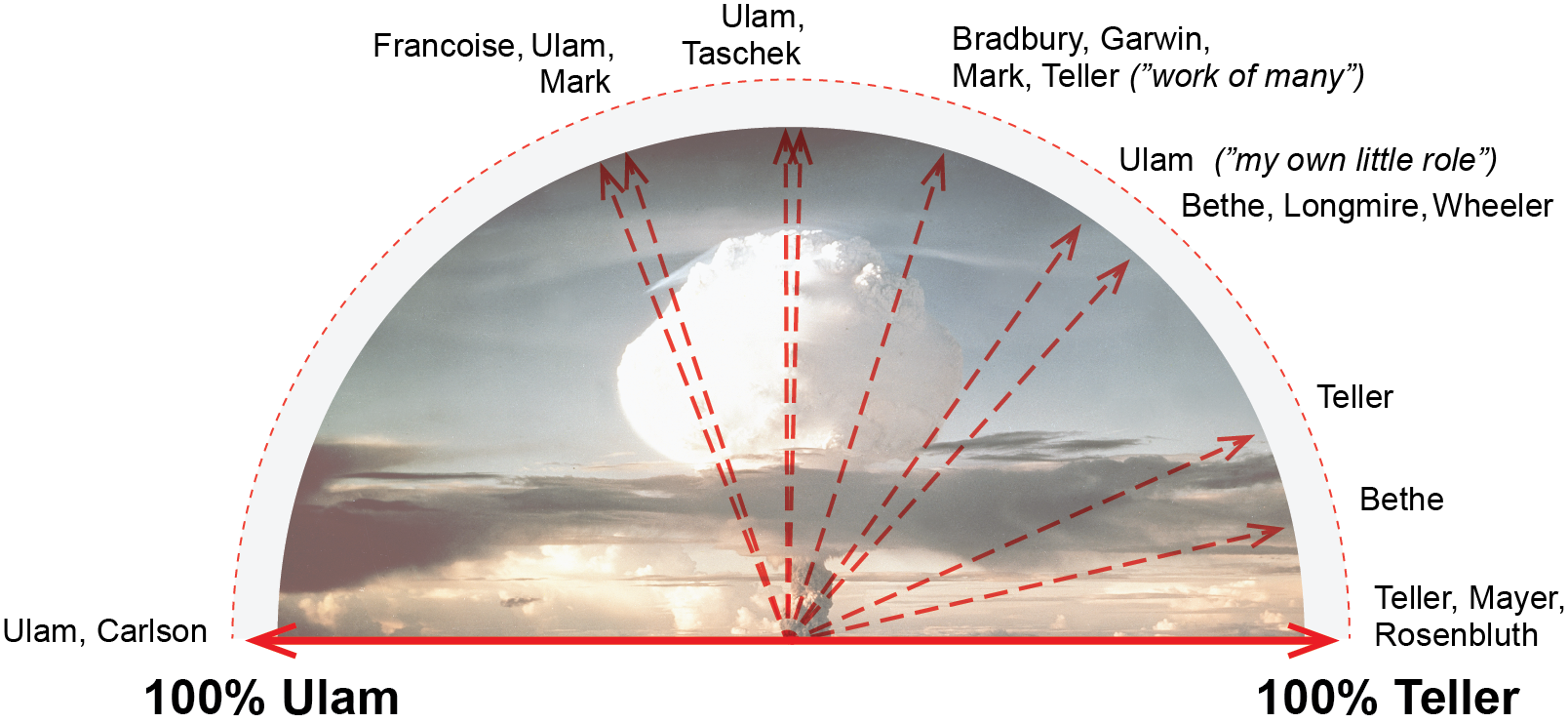
Fig. 1. Teller versus Ulam and the relative credit ascribed, showing the range of opinions, with a backdrop image of the 1952 Ivy Mike test. Where there are multiple values listed for the same person (Teller, Ulam, Bethe, C. Mark) it is because their opinions have varied. Averaging these opinions gives an apportion of credit 64% ± 30% Teller, 36% ± 30% Ulam.
Rivalry and claims
Figure 1 shows the range of opinions, with an image of the Mike test in the background. A longer article in the American Nuclear Society journal Fusion Science and Technology (FST) provides detailed accounts and quotations of the scientists named in Fig. 1 [13]. Teller and Ulam changed their assessments with time, becoming more convinced of their own dominant role as they aged.
Teller’s earliest 1955 writing on the matter, “The Work of Many People” in the journal Science, was quite generous [14]. More bitterness was shown in Teller’s 1979 conversation with Jay Keyworth, President Reagan’s science advisor, where Ulam’s role was minimized. Teller’s Memoirs also lacked generosity when discussing Ulam’s idea to “use a fission explosion to compress the deuterium, and it would burn,” saying, “His suggestion was far from original” [15, p. 316]. Teller said, “Compression had been suggested by various people,” which is partly true, but Teller omits the fact that Ulam was proposing high compression through staging. When discussing the H-bomb breakthrough in his book Better a Shield than a Sword, he does not even mention Ulam.
Ulam’s account in his autobiography Adventures of a Mathematician was balanced [16, p. 219]. But a decade after the invention, Ulam wrote to Atomic Energy Commission chair Glenn Seaborg that Teller was unfairly not giving him adequate credit for “my little role” [17]. Later in life, Los Alamos colleagues noted that Ulam, while chatting at lunch, would recount anecdotes about the lab’s history and imply that Teller’s role was minimal.
The longer paper in FST expands on these protagonists’ perspectives, along with other leading scientists working on the H-bomb project. Director Bradbury [18], Carson Mark (theoretical division leader overseeing the H-bomb design work), and Hans Bethe [12] ascribed the greater credit to Teller while emphasizing the environment of intense discussions between team members. Teller’s Ph.D. students Marshall Rosenbluth and Harris Mayer gave all the credit to Teller; Bengt Carlson, inventor of SN neutron transport, gave all the credit to Ulam! (Their opinions on “%-for-Teller”—and that of others too—are summarized in Fig. 1.) Dick Garwin said it well:
Ulam deserves credit for provoking Teller to do a real calculation. Teller then thought of something everyone should have known.
Legacy and lessons
Averaging the views of scientists directly involved in the H-bomb effort in Fig. 1 yields two-thirds of the credit to Teller and one-third to Ulam. Jonathan Katz recently argued that Emil Konopinski should be given credit for his paper LA-1149, where some of the ideas in the Teller–Ulam paper find earlier origin [19], calling it the “Konopinski–Teller invention.” In “Teller–Ulam at 75: Disputed Credit for the H-Bomb Breakthrough that Changed the World,” I argue that the credit for the key insight should be broadened to Teller, Ulam, Fermi, Konopinski, and Hoffmann [13]. All were American, but only one (Konopinski) was American born. The earlier Los Alamos A-bomb core implosion patent was also by foreign-born scientists Robert Christy and Rudolf Peierls [20].
In 2004, Lawrence Livermore National Laboratory Directors Harold Brown and Michael May offered this balanced assessment:
His principal technical contribution to nuclear weaponry was the final insight, reached in 1951 at Los Alamos, that made thermonuclear weapons possible. Although Teller alone was not responsible for that insight, his persistent pursuit of a solution since 1944 and his successful approach, following many false starts, justify his identification as “father of the H-bomb,” a title with which he was neither altogether happy nor unhappy. [21]
Retired Los Alamos director Sig Hecker told me:
My answer as to who should get most of the credit is—Los Alamos. As Bradbury said, these kinds of ideas are typically the work of many. It was the collection of people and the environment at Los Alamos that made the Teller–Ulam collaboration (as much as one could call it a collaboration) successful.
This article has focused narrowly on the Teller–Ulam innovation (Fig. 2). The broader question of who deserves most credit for the H-bomb is answered best in the words of Brown and May: Teller, its “father,” for his decade-long persistence. The question of who designed Mike, however, points to others: Mark, Longmire, Rosenbluth, Garwin—as well as Teller. And when asking who most effectively brought the 1952 Mike device into existence, the answer is Norris Bradbury, through his disciplined Los Alamos leadership, and Marshall Holloway, who led the engineering and manufacturing of Mike.
The Teller–Ulam innovation set the template for subsequent thermonuclear designs, pioneering the path to compact, powerful weapons that have played a pivotal role in strategic deterrence from the Cold War to today. Whether or not one views this development as key to having ensured 75 years without a world war (the Strategic Air Command’s motto was “Peace is our Profession”—see the 1964 Stanley Kubrick film Dr. Strangelove), one cannot doubt its transformational impact on our society. It is also worth noting that research and development in nuclear and plasma science for thermonuclear defense programs has had substantial benefits for astrophysics research and for the subsequent 75-year-long quest to harness fusion energy for peaceful purposes [22–28].
Mark B. Chadwick is the associate laboratory director for simulation, computing, and theory at Los Alamos National Laboratory.
This paper was released as Los Alamos report LA-UR-25-28578. ChatGPT was used in its preparation.
Footnotes
a. In the afterword of Istvan Hargittai’s book Judging Edward Teller (Prometheus, 2010), Dick Garwin said, “Had he remained involved, it would surely have taken longer to the first test, because Teller could not restrain himself from having additional ideas and putting them forcefully so as to make an engineering program almost impossible to complete.”
b. No professional historian would be so foolish as to attempt to quantify opinions with percentages.
References
- E. Teller and S. Ulam, “On Heterocatalytic Detonations I: Hydrodynamic Lenses and Radiation Mirrors,” LAMS-1225 (1951).
- S. B. Libby and K. A. van Bibber, eds., Edward Teller Centennial Symposium. Modern Physics and the Scientific Legacy of Edward Teller, World Scientific Publishing Company (2009).
- N. Cooper, ed., “Special Issue on Stanislaw Ulam,” Los Alamos Science 15 (1987).
- B. C. Reed, “The Frisch-Peierls Memorandum: A Seminal Document of Nuclear History,” Nuclear News, July 2025, p. 84.
- B. C. Reed, “Revisiting the Frisch-Peierls Memorandum,” European Physical JournalH 49 (2024); doi.org/10.1140/epjh/s13129-024-00070-x.
- M. B. Chadwick, “Rudolf Peierls’s Atomic Bomb and New College,” New College Record, University of Oxford (2024), p. 89.
- S. Hecker, “Reflections on Hiroshima and Nagasaki 80 Years on,” Bulletin of the Atomic Scientists, Aug. 6, 2025; thebulletin.org/2025/ 08/reflections-on-hiroshima-and-nagasaki -80-years-on/#post-heading.
- T. E. Mason, “Thoughts on the H-Bomb Decision, Oppenheimer’s Loyalty/Security Hearing, and Vacating of the AEC Decision,” Fusion Science and Technology 80 (2024): S1; doi.org/ 10.1080/15361055.2023.2268405.
- M. B. Chadwick and B. C. Reed, “Introduction to Special Issue on the Early History of Nuclear Fusion,” Fusion Science and Technology 80 (2024): iii; doi.org/10.1080/15361055.2024 .2346868.
- M. B. Chadwick et al., “Early Nuclear Fusion Cross-Section Advances 1934–1952 and Comparison to Today’s ENDF Data,” Fusion Science and Technology 80 (2024): S9; doi.org/10.1080/15361055.2023.2297128.
- J. E. Morgan, “The Untold Story of Building the First Megaton Thermonuclear Fusion Device: The Simple Element and IVY Mike,” Fusion Science and Technology (2025); doi.org/ 10.1080/15361055.2025.2503035.
- H. Bethe, “Comments on the History of the H-Bomb,” 1954; repr. (unclassified) in Los Alamos Science 6 (Fall 1982), p. 43.
- M. B. Chadwick, “Teller–Ulam at 75: Disputed Credit for the H-Bomb Breakthrough that Changed the World,” Fusion Science and Technology (accepted for publication); doi.org/10.1080/15361055.2025.2602412.
- E. Teller, “The Work of Many People,” Science, Feb. 25, 1955, p. 267; science.org/doi/10.1126/science.121.3139.267.
- E. Teller, Memoirs: A Twentieth-Century Journey in Science and Politics, Perseus Publishing (2001).
- S. Ulam, Adventures of a Mathematician, Charles Scribner’s Sons (1976).
- S. Ulam, letter to G. Seaborg, 1962 (see LA-UR-21-27517); nsarchive2.gwu.edu/nukevault/ebb507/docs/doc%208%2062.03.16%20Ulam%20to%20Seaborg.pdf.
- N. Bradbury, press conference, Sept. 24, 1954, LASL 54-39, in R. Meade, “Norris Bradbury and Edward Teller: A Fission-Fusion Reaction,”LA-UR-18-21047, Feb. 12, 2018; osti.gov/servlets/purl/1422914.
- J. Katz, “The Konopinski-Teller-Ulam invention,” report LA-CP-22-10795, Los Alamos National Laboratory (2022).
- T. A. Chadwick and M. B. Chadwick, “Who Invented the Trinity Nuclear Test’s Christy Gadget? Patents and Evidence from the Archives,” Nuclear Technology 207, S1 (2021): S356; doi.org/10.1080/00295450.2021.1903300.
- H. Brown and M. May, “Edward Teller in the Public Arena,” Physics Today 57 (2004): 51; doi.org/10.1063/1.1801868.
- K. Schoenberg, “A Historical Perspective of Controlled Thermonuclear Research at Los Alamos: 1946–1990,” Fusion Science and Technology 80, S1 (2024): S192; doi.org/10.1080/ 15361055.2024.2352662.
- K. Boyer, W. C. Elmore, E. M. Little, W. E. Quinn, and J. L. Tuck, “Studies of Plasma Heated in a Fast-Rising Axial Magnetic Field (Scylla),” Physical Review 119 (1960): 831; doi.org/10.1103/PhysRev.119.831.
- M. N. Rosenbluth, R. D. Hazeltine, and F. L. Hinton, “Plasma Transport in Toroidal Confinement Systems,” Physics of Fluids, 15 (1972): 116; doi.org/10.1063/1.1693728.
- A. D. Sakharov, “Theory of Magnetic Thermonuclear Reactor, Part 2: Plasma Physics and the Problem of Controlled Thermonuclear Reactions” (translated from Russian), Pergamon (1958), pp. 20–30.
- P. C. Thonemann et al., “Controlled Release of Thermonuclear Energy: Production of High Temperatures and Nuclear Reactions in a Gas Discharge,” Nature 181 (1958): 217; doi .org/10.1038/181217a0.
- R. S. Pease and P. C. Thonemann, “Neutron Production in the ZETA Experiment: A Re- examination,” Nature 181 (1958): 1664.
- J. B. Taylor, “Rotation and Instability of Plasma in Fast Bz Compression Experiments,” Journal of Nuclear EnergyPart C, Plasma Physics, Accelerators, Thermonuclear Research 4 (1962): 401; doi.org/10.1088/0368-3281/4/6/304.