
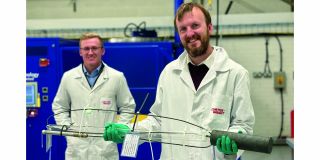
-3 2x1.jpg)
Thompson Igunma’s UF-INL research is creating unique models for molten salt reactors

Igunma
American Nuclear Society member Thompson Odion Igunma is a doctoral candidate in materials science and engineering at the University of Florida (UF) conducting research in collaboration with the Computational Mechanics and Materials Group at Idaho National Laboratory. His work focuses on advanced modeling of the complex interplay between molten salt corrosion, irradiation, and changes in alloy microstructure.
“I see molten salt reactors as a pivotal part of the next generation of nuclear energy,” Igunma said. “Their unique combination of safety, efficiency, and fuel flexibility makes them ideally suited to complement renewables in a low-carbon energy mix.”
He added, “The future of nuclear, in my view, will be shaped by advanced designs—including molten salt, sodium fast, and small modular reactors—all underpinned by innovations in materials science and engineering. My own contribution, through advanced computational modeling of corrosion, is one piece of this larger vision. By filling a critical gap in materials and nuclear engineering, this work helps ensure that the structural alloys in MSRs will perform reliably over decades of operation.”
In that sense, Igunma explained, “The future of nuclear energy will not only depend on visionary designs but also on rigorous, predictive science that gives policymakers, industry, and the public confidence in their deployment.”
The journey
Igunma began his career in Nigeria, receiving his bachelor’s degree in mechanical engineering in 2010 from Ambrose Alli University, located in the city of Ekpoma. He then spent more than a decade gaining industrial experience in manufacturing engineering, including in leadership roles, at GZ Manufacturing Industries and Guinness Nigeria. He said that this experience has allowed him to “effectively bridge computational modeling with real-world engineering practice.”
Igunma next came to the United States to pursue his higher education at UF, obtaining a master’s degree in materials science and engineering in 2024 with a concentration on computational modeling and extreme environments. He is now completing his Ph.D. and working as a research assistant at UF.
Why MSRs?
Igunma’s interest in the engineering of advanced nuclear reactors originated with his interest in materials engineering and computational materials. He said, “As a researcher in computational materials engineering, I was drawn to the technical complexity of understanding how structural alloys interact with molten salts, coupled with other phenomena, including irradiation and stress. These are not just academic questions, because they directly affect the reliability and longevity of next-generation reactors. MSRs provide a fertile ground for innovation in materials design, corrosion modeling, and multiphysics simulation—areas where my work has focused on advancing predictive phase-field methods.”
He was also drawn to study MSRs because they represent a paradigm shift in nuclear technology, offering intrinsic safety features such as low operating pressures and passive decay-heat removal, which reduce the risks associated with accidents. “Their ability to operate at high temperatures also improves thermal efficiency and enables broader applications, such as hydrogen production and process heat for industrial use,” he added, while emphasizing their contribution to sustainability. MSRs can use thorium or reprocessed nuclear waste as fuel, helping close the nuclear fuel cycle and reduce long-lived radioactive waste. “In the context of global decarbonization, they provide a reliable, low-carbon, baseload energy source that complements renewables,” he said.
INL collaboration

From left: Daniel Schwen, Chaitanya Bhave, and Parikshit Bajpai, researchers in the Computational Mechanics and Materials Group at INL. (Photos: INL)
Igunma’s research is funded by the Department of Energy under the Nuclear Energy Advanced Modeling and Simulation (NEAMS) program and is being conducted through a UF-INL collaboration. At INL, Igunma works closely with Daniel Schwen, a distinguished physicist in the Computational Mechanics and Materials Group, as well as with Chaitanya Bhave and Parikshit Bajpai, both computational scientists in the same group. Together, they developed the first phase of a fast Fourier transform (FFT) CALPHAD-informed model to simulate the corrosion of iron-nickel-chromium ternary alloys in molten salt environments. CALPHAD (Computer Coupling of Phase Diagrams and Thermochemistry) is a computational framework for predicting phase diagrams and thermodynamic properties.
Igunma explained, “The FFT-based framework represents a major advancement because it enables the simulation of very large microstructural domains with high computational efficiency. This provides a pathway to realistically model alloy degradation under corrosive and irradiated conditions—something traditional small-domain models could not achieve. Collaborating with such distinguished scientists at INL has been invaluable, as it integrates INL’s expertise in computational mechanics with my focus on corrosion modeling, ensuring that our work directly addresses the critical materials challenges facing next-generation molten salt reactors.”
More broadly, he added, the FFT approach “enables breakthroughs in predictive modeling. It allows us to test the performance of new alloys, radiation effects, or salt chemistries by solving their governing equations numerically, providing insights that guide experiments and accelerate the development of safer, more durable materials for next-generation nuclear reactors. It is a clear example of how advanced materials computation can drive real-world engineering progress.”
Yellow Jacket
The work is part of the NEAMS Yellow Jacket Project, which focuses on understanding and predicting how materials degrade when exposed to molten salts under extreme conditions. According to Igunma, Yellow Jacket involves four main components. The first is multiscale/multiphysics modeling, involving operation “at a mesoscale level to explicitly represent the microstructure of structural materials—for example, grains, grain boundaries, or pores,” he said. “This allows the modeling to capture how microstructural features accelerate or influence corrosion and material depletion when in contact with molten salts.”
Another component involves coupling with other software codes.
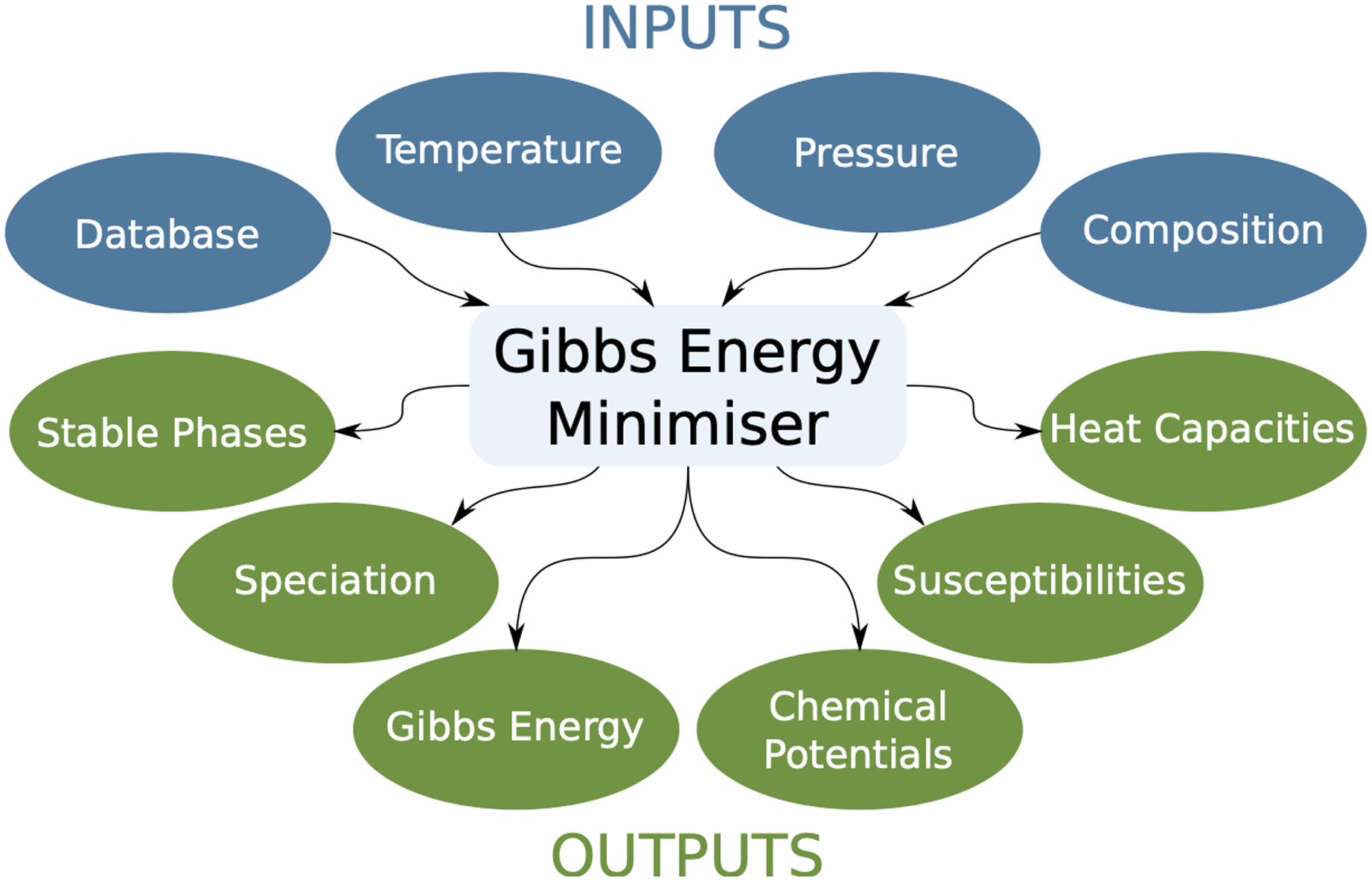
A diagram illustrating the role of a Gibbs energy minimizer in modeling molten salt chemistry and predicting corrosion-relevant conditions. The GEM computes the most stable chemical configuration by applying the fundamental thermodynamic principle of free energy minimization. (Image: Igunma)
A third component has to do with the Gibbs energy minimizer (GEM) and thermochemical equilibrium computational methods. “To drive its modeling, Yellow Jacket uses a thermochemical framework (a GEM) to compute chemical potentials, phase equilibria, and driving forces for corrosion—revealing, for example, which elements tend to leach out into the salt and where voids form,” Igunma explained. “This component allows for better integration with thermodynamic databases, like the Molten Salt Thermodynamic Database.”
A fourth component concerns validation with experiments. “The project isn’t just theory or simulation,” Igunma said. “It incorporates experimental data to validate the model predictions. This is especially relevant for salt-facing structural materials, like the . . . stainless steel that is under stress or irradiation in molten salt conditions.”
According to Igunma, the goal of his Yellow Jacket Project research is to enhance predictive capabilities for corrosion and material degradation in MSRs, as well as in related advanced reactor designs, thereby informing design, material selection, maintenance schedules, and safety margins for the reactors.
MOOSE framework
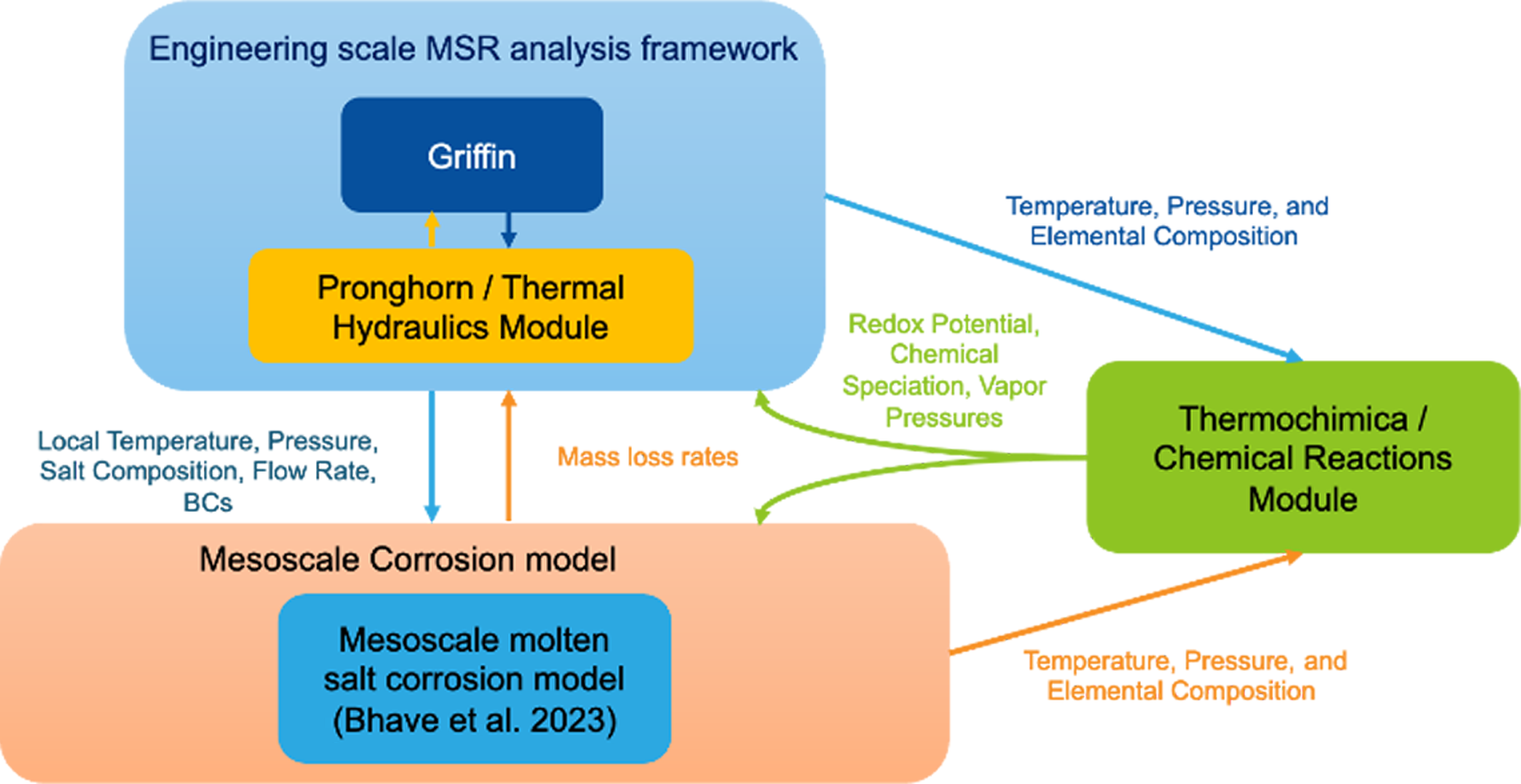
A schematic highlighting how corrosion modeling is integrated into the broader engineering-scale analysis of MSRs. By bridging engineering-scale reactor physics with mesoscale corrosion science, researchers can more reliably predict structural alloy lifetime, safety margins, and performance under realistic MSR conditions. (Image: Igunma)
Igunma’s development of a phase-field model to simulate the effects of irradiation and corrosion in MSRs relies on INL’s MOOSE (Multiphysics Object-Oriented Simulation Environment) computational framework, “which was designed for solving multiphysics problems, in which multiple processes or physics events interact at once. In my research, chemical reactions, diffusion, mechanical stress, radiation effects, and heat transfer all operate simultaneously. MOOSE provides the scalable, high-performance computing infrastructure that makes it possible to couple these complex physics problems and solve them efficiently.”
According to Igunma, the result of integration of advanced phase-field modeling within the MOOSE framework will be greater confidence in next-generation nuclear reactors like MSRs.
Only a few researchers worldwide are using MOOSE as a computational modeling approach to study the corrosion and irradiation of structural alloys in MSRs. As Igunma explained, “Molten salt reactors expose structural alloys to some of the harshest conditions imaginable, as the corrosive molten salts are combined with irradiation from high-energy fluxes. Experimentally studying these combined effects is not only expensive but also limited in scope, as it requires specialized facilities and long-term testing under extreme conditions. For that reason, most research groups choose to study corrosion or irradiation separately, avoiding the added complexity of modeling both together.”
A combined approach
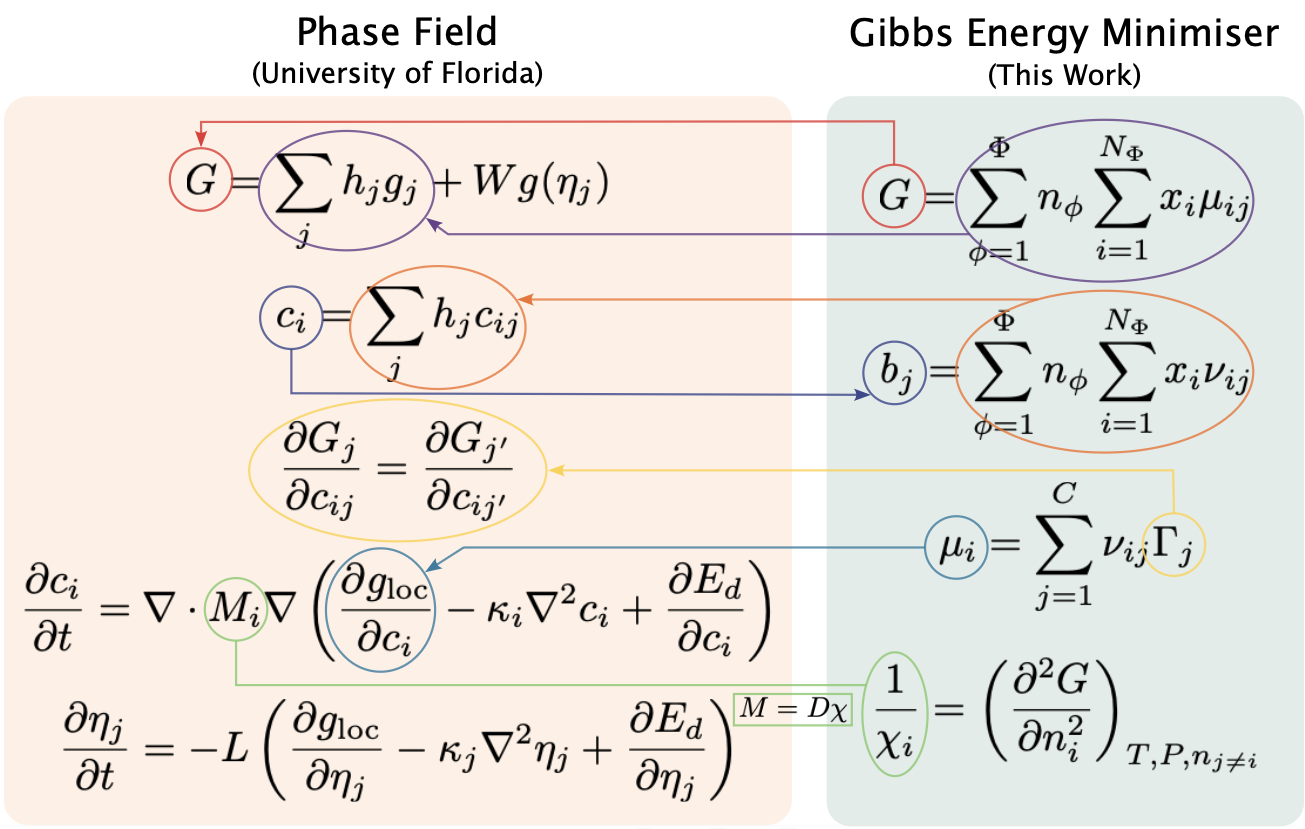
A diagram illustrating the coupling of phase-field modeling with Gibbs energy minimization in the MOOSE computational framework, enabling predictive simulations of corrosion processes in MSRs. This integration enables researchers to move beyond empirical correlations and toward physics- and thermodynamics-informed predictions of alloy degradation in MSRs. (Image: Igunma)
Igunma said that he is developing a computational phase-field framework “that directly or simultaneously couples corrosion and irradiation effects. To the best of current knowledge, no other research group has attempted to integrate these two phenomena into a single predictive model. This is important because radiation fundamentally alters how materials degrade; it produces defects, enhances atomic transport, and accelerates grain boundary weakening. Corrosion, in turn, interacts with those radiation-induced changes. If these processes are treated separately, the real mechanisms driving material failure in molten salt reactors remain hidden.”
By revealing the actual synergistic effects of corrosion and irradiation, Igunma’s work is providing insights about MSRs that do not exist in any other research, he said. He added that the findings of his research will “deliver a practical tool for predicting how reactor alloys will perform over decades of operation, directly supporting safer, more efficient, and longer-lasting nuclear energy systems.”
This integrated approach has applications for as diverse sectors of the nuclear materials community as academia, industry, and government. Igunma notes that for academia, the “first-of-its-kind coupled model [creates] new opportunities for multiscale theory experiments and the training of students in state-of-the-art computational methods.” For industry, his approach allows for a “virtual laboratory to screen alloys, forecast degradation locations/timelines, and de-risking materials selection before building costly prototypes,” thereby shortening design cycles for MSR components. For government agencies and national labs, Igunma notes that his findings are providing “science-based evidence to inform licensing, safety margins, and long-term reliability—aligning with clean-energy deployment goals while reducing reliance on slow, expensive, high-temperature irradiation test campaigns.”
Igunma said that the next phase of his career is to join the Computational Mechanics and Materials Group at INL to continue his work in corrosion and MSRs.