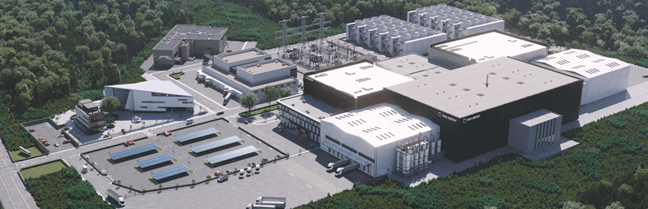
Formerly Princeton Stellarators, Thea Energy is a spin-out of the Princeton Plasma Physics Laboratory and Princeton University and was one of eight companies selected in 2023 for the Department of Energy’s Milestone-Based Fusion Development Program. According to the company, the completion of the preconceptual Helios design meets the last major milestone in the initial phase of the DOE’s public-private program to develop fusion pilot plant designs and resolve related scientific and technological challenges.
Paper reactor: Thea Energy has released an unpublished paper, “Overview of the Helios Design: A Practical Planar Coil Stellarator Fusion Power Plant,” that details the Helios design. According to the company, the system combines software-controlled magnet coils that are adaptable to real-world conditions, a stellarator divertor exhaust system capable of fusion power operations, and a sector-based maintenance scheme enabling long-term plant viability.
Based on a planar coil stellarator architecture, Helios has a thermal power output of 1.1 GW, with the capability of producing 390 MW of net electric power. The electromagnetic coil set is high-temperature superconducting and consists of 12 large, plasma-encircling coils, like the toroidal field coils of a tokamak, and 324 smaller, field-shaping coils. The coils have a maximum magnetic field strength of 20 tesla.
With a major radius of 8 meters, Helios is the most compact optimized stellarator power plant architecture, according to the company.
Next steps: In the next few years, Thea Energy plans to verify and de-risk the operation of the plasma and subsystems in its large-scale demonstration facility, Eos, which is scheduled to be operational by 2030.
Thea Energy said it is currently in conversations with five states for the siting of Eos and expects to select and announce a location for the integrated system in 2026. The company added that it is on track to operate Helios in the 2030s.
Quotables: “Helios does not rely on future scientific breakthroughs,” said David Gates, cofounder and chief technology officer of Thea Energy. “Helios is designed to combine the inherent benefits of the stellarator—steady-state operation, no risk of damaging disruptions, and high efficiency—with programmable, planar magnets. This is the evolution of the stellarator for commercialization. Our proprietary architecture can individually control hundreds of magnets using a software stack to configure stellarator magnetic fields, while accounting for manufacturing and assembly errors as well as system wear and tear over its operational lifetime.”
Carlos Paz-Soldan, associate professor of applied physics and applied mathematics at Columbia University, added, “Thea Energy’s design presents several significant innovations on the conventional approach to build stellarators. The planar coils are easier to manufacture and promise to reduce overall system complexity. They also provide new flexibility to the concept and facilitate plant maintenance. Other innovations include the power handling scheme, where a topology closely related to the conventional tokamak solution has been found for the first time in a stellarator power plant design.”