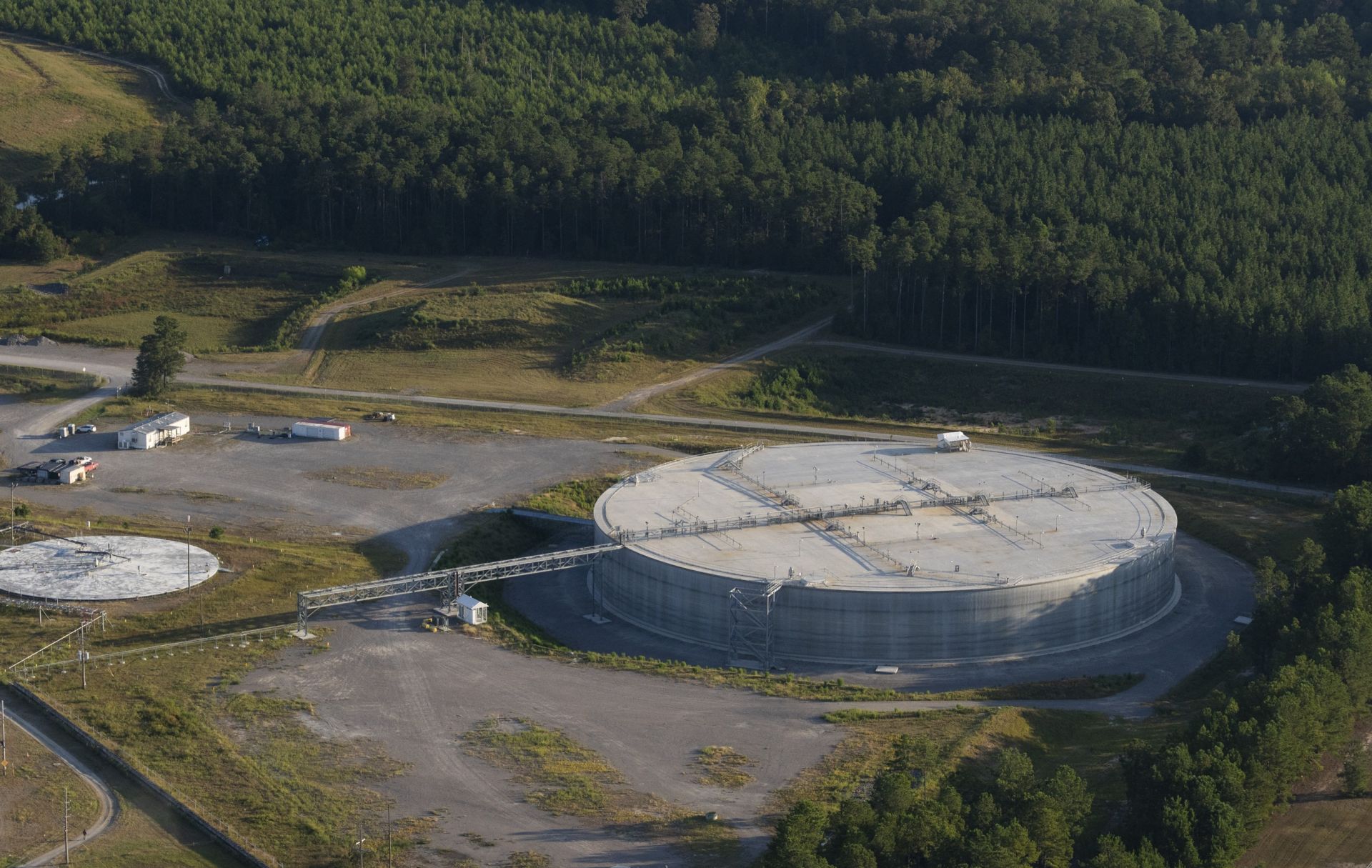
SDU 10, the fifth megavolume Saltstone Disposal Unit at SRS, is the target of an upcoming leak-tightness test. (Photo DOE)
The Savannah River Site in South Carolina will begin a leak-tightness test to qualify the megavolume Saltstone Disposal Unit (SDU) 10 to store up to 33 million gallons of solidified, decontaminated salt solution produced at the site.
Coming soon: Beginning October 27, 2025, Savannah River Mission Completion, the Department of Energy’s liquid waste contractor at SRS, will begin filling SDU 10 with water to check for signs of visible leakage on the exterior. It will take three to four weeks to fill the unit with approximately 33 million gallons—equivalent to the amount of water that would fill approximately 55 Olympic-sized swimming pools, according to the DOE.
Once the unit is filled up to the four-foot level, about 400 gallons of a fluorescent yellow-green dye will be added. The dye is certified by NSF International, an independent public health and safety organization, for use in drinking water and is commonly used in tracer tests. According to the DOE, the dye is being introduced to confirm leak-tightness and assist in leak detection.
The test is expected to take six to eight weeks to complete. Afterward, SDU 10 will be drained, and the dyed water will be discharged to on-site drainage basins for a controlled release into the environment. “When discharged, the water will traverse over land and will empty into an on-site tributary to the Savannah River. Because this dye is safe for the environment, there are no health, safety, or environmental concerns with discharging this water in the SRS ecosystem or the Savannah River,” the DOE noted.
The SDUs are an important part of the liquid waste system because they act as permanent disposal units that will hold solidified, decontaminated salt solution at SRS.
Past work: SDU 10 is the fifth megavolume SDU at SRS: SDUs 6 and 7 are in operation, while SDUs 8 and 9 have been approved for operation.
Leak-tightness tests were previously performed on SDUs 6, 7, 8, and 9 using the same method as for the SDU 10 test.

-3 2x1.jpg)