-3 2x1.jpg)
DOE publishes 26 Genesis Mission AI challenges for energy and national security
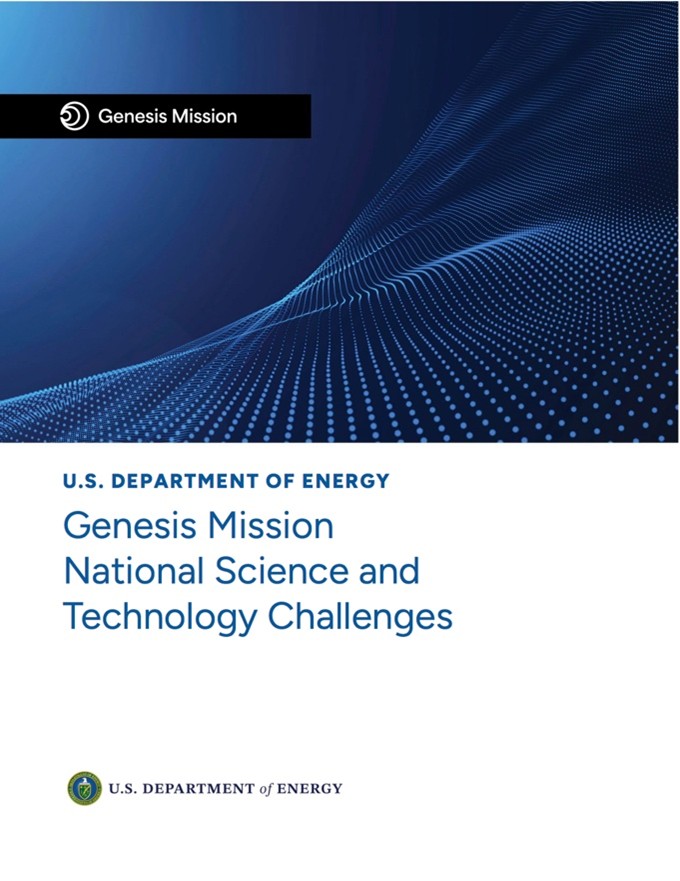 The Department of Energy’s newly published Genesis Mission National Science and Technology Challenges describes 26 challenges and corresponding AI solutions designed to advance the artificial intelligence–focused Genesis Mission, which was established by presidential executive order last November to develop an “integrated platform that connects the world’s supercomputers, experimental facilities, AI systems, and unique datasets across every major scientific domain to double the productivity and impact of American research and innovation within a decade.”
Accelerated technological development: The 26 challenges and solutions were selected by the DOE to “deliver measurable benefits for the American people” through accelerated technological developments related to energy and national security. DOE Under Secretary for Science and Genesis Mission lead Darío Gil explained, “These challenges represent a bold step toward a future where science moves at the speed of imagination because of AI. It’s a game-changer for science, energy, and national security. By uniting the U.S. government’s unparalleled data resources and DOE’s experimental facilities with cutting-edge AI, we can unlock discoveries that will power the economy, secure our energy future, and keep America at the forefront of global innovation.”
Among the nuclear energy–related challenges described in the Genesis Mission report are “Delivering Nuclear Energy that is Faster, Safer, Cheaper”; “Accelerating Delivery of Fusion Energy”; “Harnessing America’s Historic Nuclear Data and Research”; “Increasing Experimental Capacity at Nuclear Research Facilities”; and “Streamlining Production, Removing Red Tape, and Ensuring Safety in the Nuclear Enterprise.”
Faster, safer, cheaper: The DOE report noted that nuclear power plants have historically been challenged by long development timelines and high costs, while demand continues to grow, including from AI data centers.
To meet this challenge, the DOE proposed the use of AI to design, license, manufacture, construct, and operate nuclear reactors “with human-in-the-loop workflows, enabling at least 2x schedule acceleration and greater than 50 percent operational cost reductions.” These goals are being addressed by the DOE through research into such AI technologies as surrogate models, agentic workflows, autonomous labs, and digitals twins.
Accelerating fusion energy: Getting fusion energy on the grid will require coordinated progress in six interdependent challenge areas previously defined in the DOE’s Fusion Science and Technology Roadmap: structural materials, plasma-facing components and plasma-material interactions, confinement approaches, the fuel cycle, blankets, and fusion plant engineering and system integration.
The AI solution for this challenge involves digital twins that integrate plasma, nuclear, materials, and system behavior within a “unified predictive framework, allowing performance and engineering trade-offs, failure modes, and design margins to be evaluated consistently in simulation and experiment.” An “AI-Fusion Digital Convergence Platform (DCP)” is proposed to “integrate novel algorithms in [high-performance computing] codes, foundation models for plasma and materials science, physics- and chemistry-informed neural networks, surrogate models, and digital twins,” thereby providing real-time control across the six Roadmap challenge areas.
Harnessing historic data and research: Much of the United States’ historical and archival information about nuclear science exists only in written notes, printed materials, or photographs, hindering its accessibility and usability for research, design, and production.
The DOE’s proposed AI solution is to build an AI digitization-and-reconstruction pipeline “that converts analog reports, imagery, and drawings into searchable, simulation-ready datasets, including automated meshing and cross-referencing to historic test outcomes.” This pipeline will include a “secure centralized archive with durable metadata/ontology standards, triage workflows that prioritize the highest-value records, and end-to-end access controls and quality assurance processes.”
Increasing experimental capacity: According to the Genesis Mission report, the National Nuclear Security Administration is facing increasing demand for optimized experiments while dealing with current processes to design, document, and analyze such experiments that are slow and inefficient.
To address this problem, an AI “facility operating system” is needed. This system will use “agentic workflows to plan/schedule experiments, steer execution in real time, and fuse live diagnostics with multifidelity simulation so each shot/test yields maximum information with minimal turnaround.” Part of this solution will involve “interoperable facility digital twins and streaming data/provenance standards, plus transparent approval gates, audit logs, and uncertainty-aware analytics that operators can trust in high-consequence environments.”
Streamlining production and ensuring safety: Current nuclear regulatory processes can be slow and fragmented, leading to inefficiencies that can compromise safety and operational effectiveness. According to the DOE, this challenge “is significant as it directly impacts the ability to respond to nuclear threats as well as to maintain safety standards efficiently.”
The recommended AI solution is to “deploy auditable, policy-grounded AI (large language models + agents) that can digest safety-basis requirements, automate safety analyses and documentation, and continuously generate risk-aware work plans while autonomously configuring and running large simulation campaigns.” This solution will require the development of a “trusted digital regulatory corpus with provenance,” as well as “verification and testing harnesses for AI outputs,” and “facility/operations data systems with robust access controls and end-to-end audit logs.”
Other challenges: The Genesis Mission report goes into similar detail for the other science, energy, and security challenges it identifies. Examples include “Scaling the Grid to Power the American Economy,” “Enhancing Particle Accelerators for Discovery,” “Designing Materials with Predictable Functionality,” “Unleashing Subsurface Strategic Energy Assets,” “Achieving AI-Driven Autonomous Laboratories,” “Reenvisioning Advanced Manufacturing and Industrial Productivity,” “Discovering Quantum Algorithms with AI,” and “Recentering Microelectronics in America.”