
Nuclear power’s new rule book: Managing uncertainty in efficiency, safety, and independence
The U.S. nuclear industry is standing at its most volatile regulatory moment yet—one that will shape the trajectory and safety of the industry for decades to come. Recent judicial, legislative, and executive actions have converged to rewrite the rules governing the licensing and regulation of nuclear power reactors. Although these changes are intended to promote and accelerate the deployment of new nuclear energy technologies, the collision of multiple legal shifts—occurring simultaneously and intersecting with profound technological uncertainties—is overwhelming the Nuclear Regulatory Commission and threatening to destabilize investor and industry expectations.
Although many questions and concerns remain unsettled, three questions in particular stand out as both urgent and confusing:
1. Legally, nuclear regulation and licensing must now be “efficient.” What does “efficient” mean, and what happens if the NRC fails to be efficient?
2. The NRC has developed both deterministic and probabilistic safety-centric methods, including probabilistic risk assessment (PRA) under the risk-informed, performance-based (RIPB) regulation. Will these current safety-centric methods remain applicable under the new regulatory regime?
3. What is the role of regulatory independence in ensuring nuclear safety?
This article briefly analyzes each of these questions and offers recommendations for the community to act on immediately. Acting now can transform today’s legal and technological uncertainties into opportunities for a safer, more efficient, and resilient nuclear future. These actions will help the NRC navigate legal scrutiny while reassuring investors, policymakers, and the public. In this sense, the “new rulebook” offered in this article is not just about compliance—it is about securing nuclear power’s promise as a cornerstone of a clean energy future.
For a full discussion of the three key questions and the authors’ recommendations, see the longer version of this article on ANS’s Nuclear Newswire.a
Question 1: Legally, nuclear regulation and licensing must now be “efficient.” What does “efficient” mean, and what happens if the NRC fails to be efficient?
On July 9, 2024, the Accelerating Deployment of Versatile, Advanced Nuclear for Clean Energy (ADVANCE) Act became law. It included a fundamental change in how the NRC regulates and licenses: For the first time since its establishment in 1974, the NRC’s mission was expanded beyond public health and safety to explicitly include efficiency. More specifically, the NRC is now required to license and regulate “in a manner that is efficient and does not unnecessarily limit – (1) the civilian use of radioactive materials and deployment of nuclear energy; or (2) the benefits of civilian use of radioactive materials and nuclear energy technology to society.”
The NRC initially responded to the change in mission by arguing that “efficiency” in the ADVANCE Act was no different from “efficiency” as the commission defined the term in its Principles of Good Regulation (which were adopted in 1991, more than 30 years before the passage of the ADVANCE Act and at a time when the agency had no statutory obligations related to efficiency).
Can the NRC’s old definition of “efficiency” be used to interpret its new statutory directives under the ADVANCE Act? Almost certainly not, given another landmark legal event that occurred on June 28, 2024. After Congress passed the ADVANCE Act but before it was signed into law by President Biden, the Supreme Court decided Loper Bright v. Raimondo. This transformational case upended decades of legal precedent and changed how much power agencies across the government have when interpreting laws. Before this decision, under the so-called Chevron doctrine, courts would defer to the NRC’s reasonable interpretations of ambiguous terms. Previously, the NRC’s interpretations of “efficient,” as included in its Principles of Good Regulation, might have survived legal review. Loper Bright v. Raimondo changed that equilibrium. Now, to define legal terms, judges can use their own “independent judgment”—even on highly technical matters where agencies once held presumptive authority.
The relationship between the ADVANCE Act and the Loper Bright decision is critical and has been missed by key stakeholders. The act mandates the NRC to license and regulate in an “efficient” manner. After Loper Bright, what “efficient” means will be judged by courts—not the commission. This means that the NRC must now design rules and make licensing decisions that a court sees as efficient. Merely referring to its own preferred view of “efficiency” will no longer suffice. Ignoring this sea change in the law leaves the NRC vulnerable to judicial reversal. Furthermore, any apparent progress it makes by interpreting the law in a way later rejected by the courts is vulnerable to reversal as well.
Therefore, much rests on the NRC changing its approach to align with what courts will require. Unfortunately, predicting how a court will interpret statutory meaning is complex. For those who specialize in such matters, however, there are clues to look for—especially regarding language on efficiency, which courts generally interpret to require a cost-benefit analysis (e.g., the 2011 case Business Roundtable v. SEC). Under this interpretation of efficiency (the most likely to be applied), any NRC rulemaking or licensing action needs to be benefit-justified, and the fact that benefits justify costs must be established by a cost-benefit analysis.
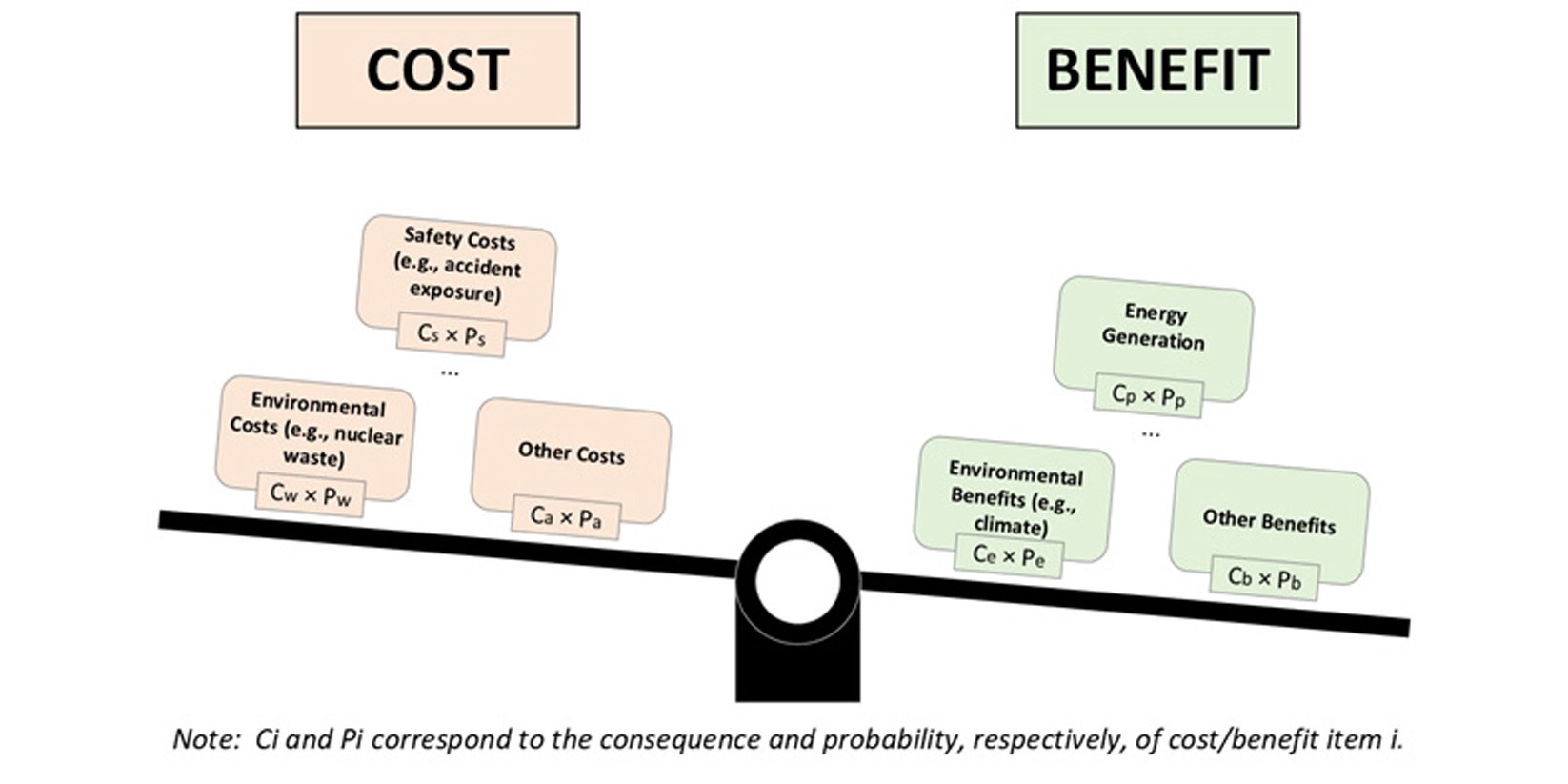
To support efficient regulation and withstand legal scrutiny, the NRC should dedicate resources to developing a robust, transparent, and defensible cost-benefit analysis framework (see Fig. 1 for a conceptualization). This effort could build on existing cost-benefit practices in use, such as those that have been traditionally used in backfitting analysis, while drawing lessons and best practices from other agencies like the Environmental Protection Agency, which has decades of cost-benefit analysis experience.
While this recommendation would require a substantial realignment for the NRC, it is also the most reliable route forward to ensure that the commission does not waste more resources or generate greater uncertainty by having impermissible actions or licensing decisions overturned by courts. Otherwise, many stakeholders—including members of the public, small nuclear startups, or representatives from competing energy industries—will be able to challenge NRC decisions.
Question 2: The NRC has developed both deterministic and probabilistic safety-centric methods, including PRA under the RIPB regulation. Will these current safety-centric methods remain applicable under the new regulatory regime?
The NRC’s traditional interpretation of RIPB regulation—defined as the integration of risk insights, engineering judgment (particularly the principle of defense-in-depth and the incorporation of safety margins), and performance history to achieve safety—is in partial tension with “efficiency,” as discussed above. Defense-in-depth and safety margins by design impose extra layers of conservatism. In many cases, this conservatism dictates inefficient requirements where the marginal increase in benefits does not outweigh the expected marginal increase in costs. In a world where the commission’s only goal is safety, adding safety margins may make sense; but in a world where it must also act efficiently, extra margins may not be justified. The NRC should refine its RIPB framework to eliminate internal contradictions (i.e., defense-in-depth and safety margins) and ensure alignment with efficiency principles.
The risk (or safety risk) insights of the RIPB approach, as currently informed by PRA and its foundational “risk triplet”—what can go wrong, how likely it is to happen, and what are the consequences—are well aligned with cost-benefit analysis in support of efficiency. Safety risk assessment for nuclear accidents, which is fundamental to RIPB regulation at the NRC, is also crucial for estimating the safety cost input in cost-benefit analysis for efficient licensing (Fig. 1). PRA can quantify both the probability and consequences of a light water reactor nuclear accident, which is well-suited for determining the expected value of safety cost (Cs × Ps in Fig. 1) in cost-benefit analysis.
However, due to limited experiential data for advanced reactors, the classical PRA methods (relying on LWR operational data) are not adequate for advanced reactors. Advancing probabilistic safety risk assessment methods is therefore essential to address this limitation. For instance, these advancements encompass the incorporation of modeling and simulation of underlying phenomena into PRA and broader adoption of probabilistic physics‑of‑failure methods to generate simulation data and address limited experiential data, the use of AI techniques to accelerate simulation data analysis and improve computational efficiency, and enhanced methods for uncertainty quantification and validation. These advancements would also allow probabilistic methods to provide credible inputs to cost-benefit analyses, ensuring that efficiency requirements can be satisfied without compromising safety.
Some stakeholders have proposed deterministic safety assessments, such as the maximum hypothetical accident (MHA), as alternatives for new reactors. While deterministic approaches may serve as a potential starting point, methods like the existing MHAs are ill-suited for efficiency-driven cost-benefit analysis because they lack the essential probability component needed to estimate the expected value of safety cost (Cs × Ps in Fig. 1). There may be ways to adjust current deterministic methods to align with efficiency objectives, but this would require further methodological developments that are not yet in use. For example, one possible way is to use only two elements of the risk triplet—accident scenarios and their consequences—while assuming a probability of 1 for the worst-case accident, thus avoiding the need to estimate probabilities altogether. This would allow deterministic safety assessments to be used in cost-benefit analysis (though in a highly conservative manner). For such an approach to be theoretically sound and legally justifiable, the worst-case scenario must assume simultaneous failure of all safety protection systems—both active and passive—within the plant, along with the failure of all external emergency response systems, resulting in maximum possible consequences, which the current MHA approach does not capture. In practice, other high-consequence industries rarely rely solely on deterministic safety assessments when regulatory efficiency is a goal, because credible and legally defensible worst-case scenarios often lead to cost estimates too inflated for meaningful cost-benefit analysis.
Furthermore, the transition from strictly worst-case assumptions to probabilistic safety methods can be carried out gradually. Initially, strictly conservative worst-case assumptions may be used. If the design fails to meet cost-benefit criteria under these assumptions, more refined probabilistic methods should be introduced. For components lacking sufficient data, some can be assessed using advanced modeling and simulation, while others may still be conservatively treated as guaranteed failures.
Given the challenges associated with worst-case-based methods and the fact that not all designs are benefit-justified under such an approach, there is a need to invest in advancing PRA methods for new reactors. Figure 1 makes clear these risk methods should also extend beyond safety risk. Efficiency-driven cost-benefit analyses require probabilistic inputs for multiple domains, for example, nuclear waste risk, climate risk, and even security-related risks. Failing to develop probabilistic methods for these domains may leave NRC decisions inefficient, incomplete, and vulnerable to legal reversal.
Question 3: What is the role of regulatory independence in ensuring nuclear safety?
History suggests that nuclear regulation can be vulnerable to political and industry capture. Yet nuclear safety is inherently multifaceted, relying on strong institutional and agency safeguards as well as other aspects of socio-technical systems. As such, stakeholders should approach nuclear safety holistically.
Neglecting the multifaceted nature of nuclear safety has led to two extreme views within the nuclear community. One view assumes that the loss of independence will inevitably lead to accidents; the other promotes next-generation nuclear power plants by highlighting the strong safety record of existing reactors and emphasizing the enhanced safety features in advanced reactor designs. Both views are flawed.
The first—that weakening the NRC’s independence will inevitably compromise safety—overstates the role of independence in ensuring safe operations. Regulatory independence can be an important safeguard, but it is not the sole determinant of safety. Independence does not guarantee a safe or effective regulator, nor does dependence imply that an agency subverts its safety mission. Some executive agencies, which have always been accountable directly to the president, have a strong history of promoting safety. The EPA, for example, lacks the structural independence granted to the NRC, but it has saved many lives while under the direct control of presidents concerned with safety. Simultaneously, independent agencies (e.g., the U.S. Consumer Product Safety Commission) can also fail at securing safety.
The second view is likewise flawed. A safety record is the result of multiple factors, including current regulatory frameworks and established reactor technologies—both of which are changing for advanced reactors. Regarding regulation, the oversight of advanced reactors will differ from how existing plants were regulated in the past, regardless of the NRC’s independence, due to developments in the ADVANCE Act and the Loper Bright decision. With respect to technology, advanced reactors lack proven operational experience and employ designs that diverge substantially from today’s fleet.
By embracing shared ownership of safety, all stakeholders in the nuclear community can together engage and ensure that important aspects of safety are effectively maintained, regardless of how the courts ultimately define the NRC’s independence.
Footnotes
a. George Joslin et al., “Nuclear power’s new rule book: Managing uncertainty in efficiency, safety, and independence,” Nuclear Newswire, Nov. 21, 2025; https://www.ans.org/news/2025-11-21/article-7572/.
George Joslin is a graduate research assistant and Ph.D. student in the Nuclear, Plasma, and Radiological Engineering Department’s Socio-Technical Risk Analysis (SoTeRiA) Research Laboratory at the University of Illinois–Urbana-Champaign.
Arden Rowell is a professor in UIUC’s College of Law and a faculty affiliate at the Beckman Institute for Advanced Science and Technology.
Ha Bui is a research scientist in the NPRE Department at UIUC and the associate director of research and outreach at the SoTeRiA Research Laboratory.
Justin Valentino is a research affiliate at the SoTeRiA Research Laboratory and the director of the Organizational Informatics consulting company.
Ziwei Che is a J.D. student at UIUC’s College of Law.
Seyed Reihani is a senior research scientist in the NPRE Department at UIUC and the SoTeRiA Research Laboratory.
Zahra Mohaghegh is a professor and Donald Biggar Willett faculty scholar in the NPRE Department at UIUC, where she leads the SoTeRiA Research Laboratory, and is a faculty affiliate of the Beckman Institute for Advanced Science and Technology.