
-3 2x1.jpg)
Jeff Place on INPO’s strategy for industry growth
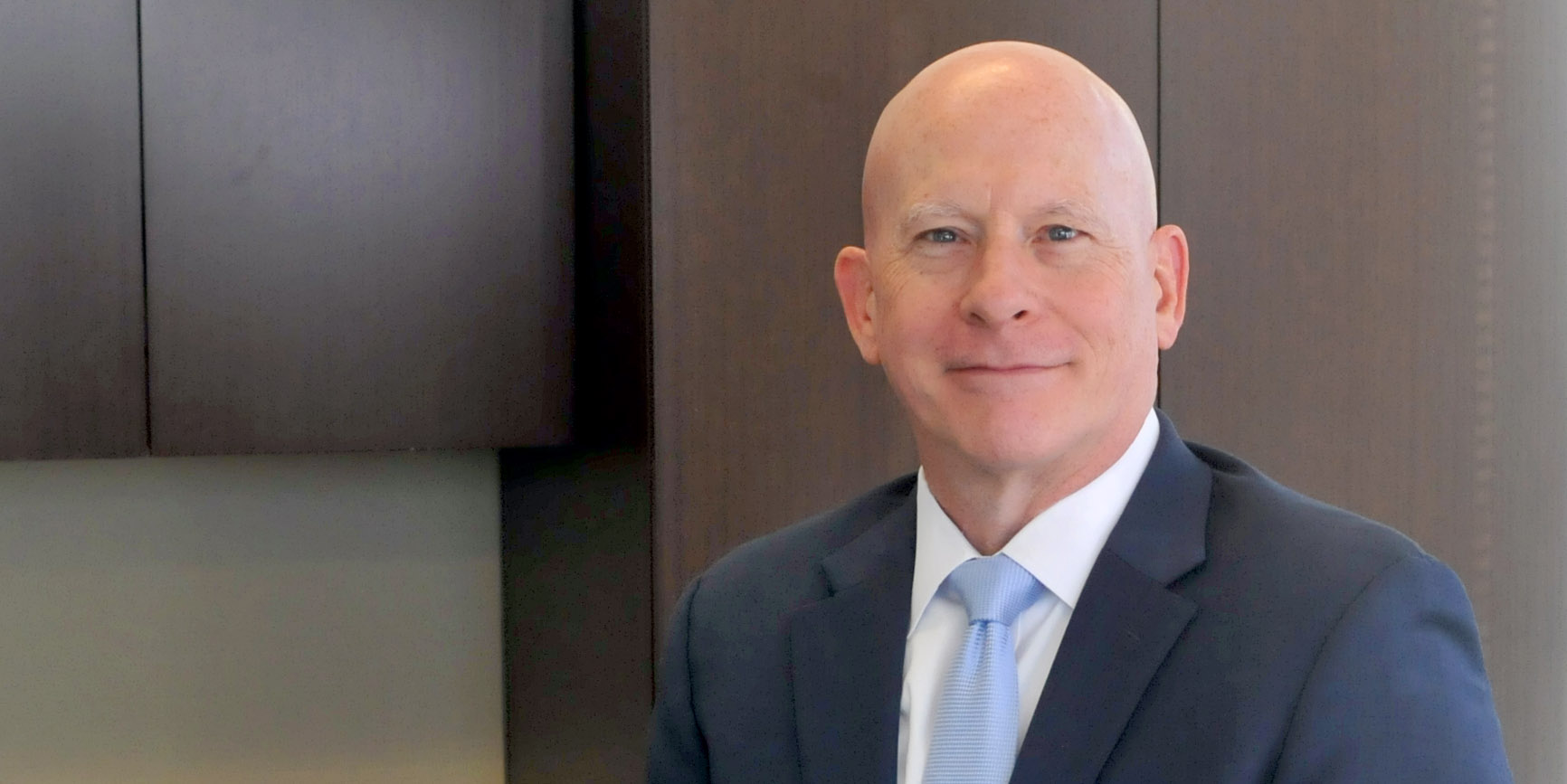
As executive vice president for industry strategy at the Institute of Nuclear Power Operations, Jeff Place leads INPO’s industry-facing work, engaging directly with chief nuclear officers.
From INPO headquarters in Atlanta, Ga., INPO and the World Association of Nuclear Operators’ Atlanta Center engage with nuclear power plants in the U.S., Canada, Mexico, Romania, South Africa, and the United Arab Emirates, as well as some plants in China, and all are part of Place’s remit. To carry out its work, INPO has 300 people on staff and about 60 additional people on loan from the industry.
Place has held the role for nearly eight years out of his 26 at INPO, where he previously was vice president of operations and technical support. (He also was vice president of nuclear fleet operations at Xcel Energy during a loaned assignment.) Before joining INPO as a senior evaluator, Place worked at four nuclear stations for three utilities in leadership roles, and he dates his start in the nuclear industry to his service as an enlisted machinist mate in the U.S. Navy’s Nuclear Submarine Force 41 years ago.
INPO’s contributions to the industry’s success are sometimes not well understood outside the nuclear utilities it serves. However, as Place explained to Nuclear News editor-in-chief Susan Gallier, the organization is now eager to show how decades of focus on safety and reliability have enabled member utilities—and new entrants to the nuclear industry—to capitalize on today’s growth opportunities.
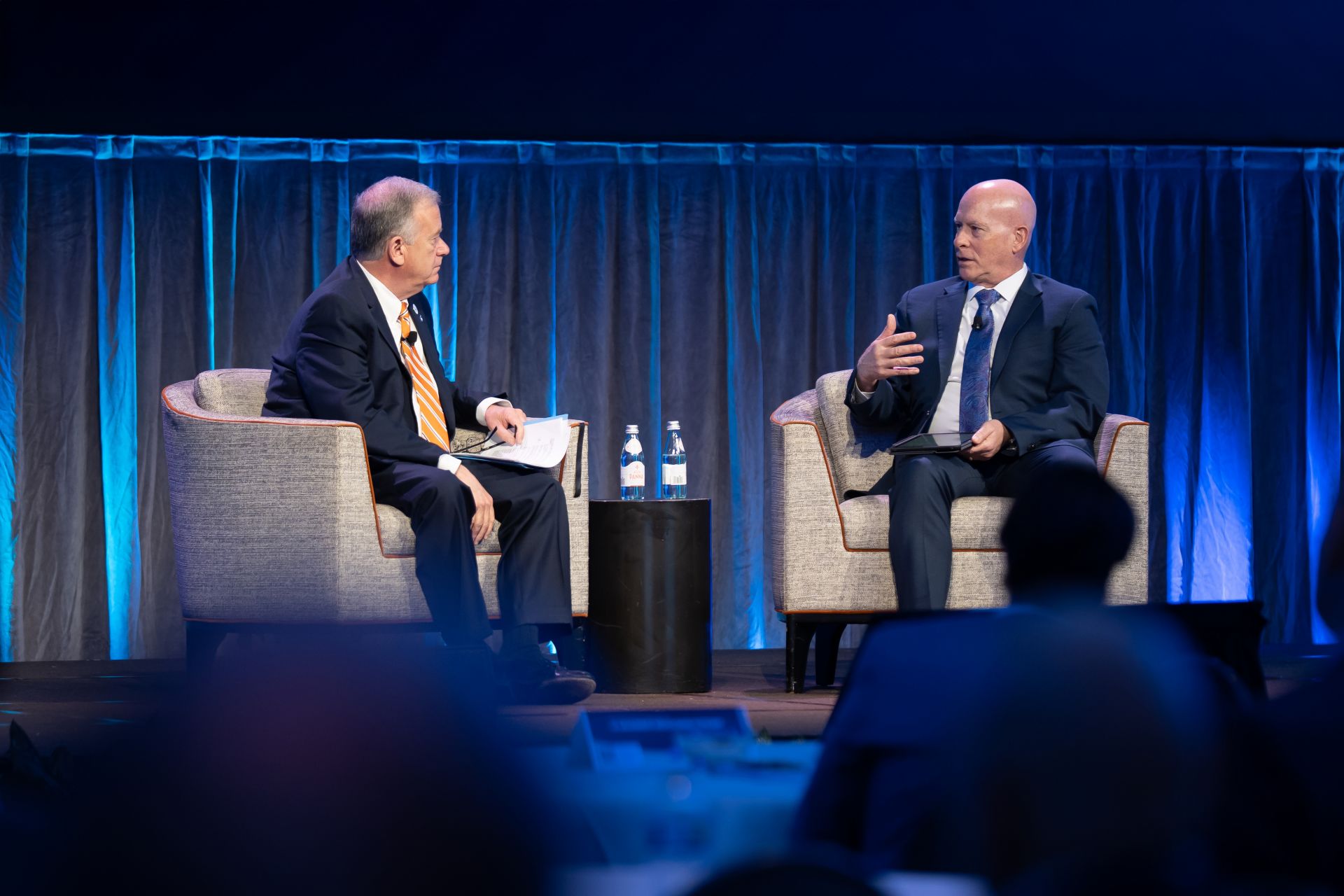
Nuclear Regulatory Commission Chair David Wright (left) joined Place for a fireside chat at the INPO CEO Conference in November 2025. (Photo: INPO)
What is INPO’s value to the nuclear power industry?
INPO has a mission to promote excellence in safety and reliability, and we take that very seriously. It was formed after the accident at Three Mile Island, and WANO was formed after the accident at Chernobyl as a way for the industry to facilitate the sharing of best practices and lessons learned to drive continuous improvement.
Performance improvement in our industry over the last 40 years is pretty remarkable. As an industry, we’re reliable and resilient. And while the utility teams deserve the bulk of the credit for improvement, INPO—along with the Electric Power Research Institute, Nuclear Energy Institute, Nuclear Electric Insurance Limited, and others—is an important part of the fabric of how the industry works.
What is INPO’s industry strategy, and how do you measure its success?
Everything we do, whether it’s in oversight or assistance, is focused on continuously improving the industry. Our industry strategy is fully integrated, meaning what we’re doing at Koeberg in South Africa is exactly what we’re doing at Byron in Illinois.
We have four challenge areas that we are working toward: industry performance, industry sustainability, teaching and learning, and data science and analytics. We implement that work through our operating model that includes our continuous monitoring program, accreditation activities, and various courses and seminars.
We collect a tremendous amount of data from our members. As of about three years ago, all of our stations, including the international stations that we’re responsible for at WANO–Atlanta Center, began reporting the same data. That apples-to-apples comparison has been incredibly important for us to demonstrate progress and identify where we still have work to do.
We have four separate categories of continuous monitoring. We are trying to get 90 percent of our stations into our “monitoring” category—the lowest level of engagement—by 2030. Today, just shy of about 70 percent of our stations are in that category.
In our 10-year strategy, launched in 2020, we’re trying to reduce consequential events—which we consider to be precursors to more significant events—at stations by half, and we’re making very good progress. In fact, the industry has beaten our annual targets in this area every year.
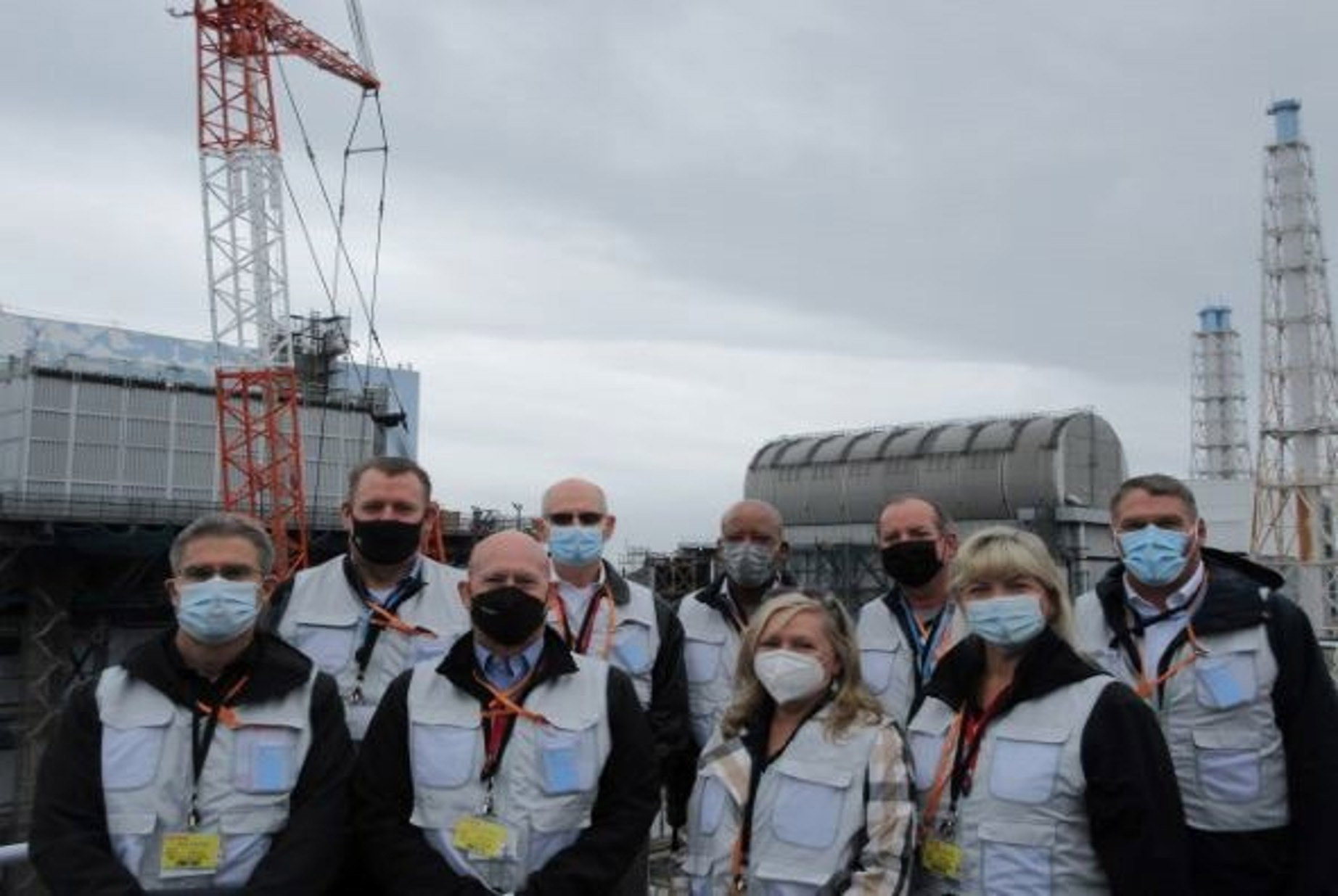
U.S. and Canadian chief nuclear officers visited Fukushima Daiichi in 2022 as part of an INPO-Japan Nuclear Safety Institute (JANSI) CNO Forum. (Photo: Tokyo Electric Power Company Holdings, Inc.)
INPO is relatively unknown outside existing utilities. How are you communicating with nuclear newcomers who may not understand INPO’s role?
A fair number of the new entrants are actually in our supplier program. There are a number of others that are not, but we are still engaging with them. Our New Plant Advisory Committee is there to listen to new nuclear entrants’ concerns and needs, and how we might modify what we’ve done in the past to support them. There is a subset of new reactor vendors that we haven’t really had much communication with, and many of those are in the microreactor realm.
We believe it is important for new nuclear entrants to understand the social license that each of our utilities has to run these plants and that if something significant happens at any nuclear plant—new entrants included—it creates challenges for the entire industry. The public perception of a nuclear power plant, compared with other industries, must be taken into account.
As a not-for-profit, we serve our members and look at how we can support the collective industry to maintain its high level of safety and reliability. If new entrants are going down the path of getting their design approved and constructed, we want to do what we can to help them see that plant built and operated successfully and safely.
What kind of data does INPO collect from its member utilities?
We work with the industry to identify the most relevant data to collect—anything from the performance of individual components and systems to a plant’s power history over the month to the number of events that have happened. We create various indicators, indexes, and models, some of which are focused on specific areas like operations and maintenance.
A station like Oconee that has three units can look at its station-level data through INPOrtal, our digital platform, but they can also look at it to see how Units 1, 2, and 3 compare. The people in the corporate office can see their fleet through that same set of indicators, as well as compare performance across the entire industry through the Plant Information Center.
When an issue is identified at a plant, what does INPO do?
If we see sufficient gaps when we do our peer review or continuous monitoring processes, we’ll write what we call an “area for improvement,” with formal documentation of the gap and its causes. We will work with the station to make sure that the right actions are being taken to close that gap.
We also write reports on events—whether it’s a single event at a station or events that happened across the industry—to share trends or alert stations to common operational drivers. We also include recommendations for stations to act on. The intent is to prevent future events across the industry or at a utility.
The Nuclear Regulatory Commission also tracks reactor performance. How would you differentiate INPO’s role from that of the NRC?
As a self-regulator, we have an independent but somewhat collaborative relationship with the NRC. We also are able to work in areas that the NRC doesn’t typically get into, such as corporate performance.
The role of INPO is to help industry meet standards of performance excellence that it has set for itself, with the goal of improving performance beyond what laws or regulations require. We provide support for that effort as a not-for-profit membership company. Utilities pay for our services, and our board is made up of utility CEOs who expect us to be demanding of their performance.
How does collaboration between INPO and WANO impact the nuclear industry in the United States and around the world?
INPO’s International Division, managed by Steve Meng, focuses outward on what we are doing to help WANO and the global industry improve their performance. We do that in large part to de-risk any poor performance around the globe that could impact any other station—in particular, the stations we’re responsible for here at WANO–Atlanta Center.
INPO is at the forefront of a lot of the things that get done in WANO. We were formed 10 years prior to WANO, so our operating model and capabilities have matured at a different rate. We are also staffed and resourced differently, which provides additional capabilities. For example, I mentioned before that through continuous monitoring of each of the stations in the Atlanta Center, stations can see through objective measures that performance has improved. Over the last few years, we’ve been helping WANO adopt something similar that they call “enhanced performance monitoring.”
We’ve got people out supporting plants around the globe. For example, we have multiple people right now in the WANO–London Office running certain programs for WANO, and we have individuals assisting WANO–Paris Center, which took on a lot of new plants when several utilities that were with the WANO–Moscow Center realigned with the Paris Center because of the Russia-Ukraine war. A new WANO regional center is currently being developed in Shanghai, and we have somebody assigned there.
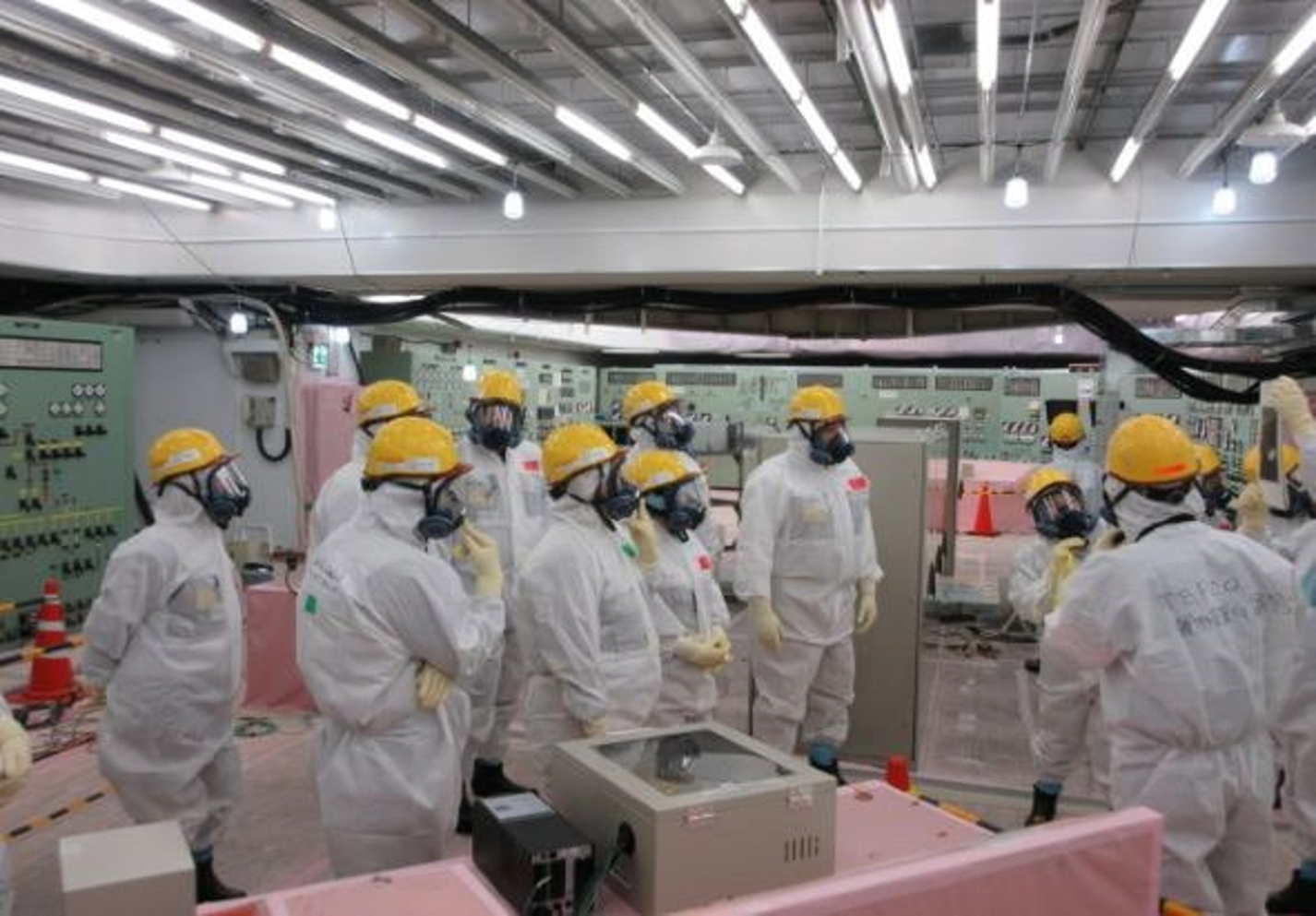
A visit to the control room of Unit 1 at the Fukushima Daiichi plant in 2022, as part of an INPO-JANSI CNO Forum. (Photo: Tokyo Electric Power Company Holdings, Inc.)
What do you see as the biggest challenges facing the fleet today?
First, I would say there are a lot of opportunities facing the fleet. Some of those opportunities also present challenges. Growth is an opportunity; but it is also creating challenges because we need more workers, both at our existing plants and the new reactor vendors. New construction is going to require a highly qualified set of workers across the whole spectrum—craft workers, pipefitters, electricians, engineers, operators.
Between extending the life of our current set of plants and building new plants, the industry expects a significant increase in the need for capable employees. Additionally, we’re expecting a lot of new capital projects, which adds another layer of risk of distraction to the leadership teams. If we don’t handle them well, these opportunities have the potential to challenge existing high levels of performance.
That growth is attracting new nuclear entrants to the industry. How is INPO responding?
The most important thing we did was recognize this growth a few years back. We’ve been involved in new nuclear for quite a while. We were engaged from construction through the transition to operation with all four of the units at Barakah in the UAE, with Vogtle-3 and -4, and with some plants in China.
We recently established a New Nuclear Growth Strategy at INPO, led by Bob Gambrill, with work split into two main areas: one focused on the new entrants and how we’re engaging and supporting them, and one around major capital projects for the current fleet, including extended power uprates, license renewal, operating cycle duration changes, and the construction of new nuclear.
How is INPO working with industry stakeholders to address workforce readiness and support growth?
Through INPO’s National Academy for Nuclear Training, we are preparing the industry’s workforce and leaders to have the right culture, skills, and behaviors. Our Academy Council, chaired by Rick Libra, CNO at Southern Nuclear, is made up of industry training leaders and executives, suppliers, and leaders from EPRI and NEI.
We have seen tremendous demand for the leadership courses we’ve been teaching for years for first-line supervisors, middle-level managers, senior nuclear managers, and senior executives. We partner with the Massachusetts Institute of Technology to teach a four-week intensive reactor technology course for nonnuclear utility executives. We also teach members of corporate boards of directors through Emory University’s Goizueta Business School. So, we touch pretty much everyone from first-line workers all the way to directors, helping to shape and influence the leaders running our industry.
We’ve also partnered with NEI and the industry to reinvigorate the Nuclear Uniform Curriculum program that we started with the industry several years ago. While NEI leads that effort now, we maintain the academy document that establishes the standard in that area. That allows utilities to work directly with community colleges and universities to help shape course curricula. Individuals coming out of a community college, for example, can get a certification that might allow them to go straight into a radiation protection job at a utility.
How does INPO accredit training programs?
Accreditation is the one thing we do at INPO that is directly tied to NRC regulation. Decades ago, through INPO, the industry took on that responsibility. The NRC provides annual oversight to affirm that the process meets the intent of the training rule.
The National Nuclear Accrediting Board comprises 16–24 representatives from the nuclear industry, academia, nonnuclear industrial training, and individuals nominated by the NRC. For each board, five members, including three members who are not from a nuclear utility, are selected to make independent decisions about renewing accreditation for utility training programs on a six-year frequency.
Accreditation is one area we’ve engaged with our new nuclear entrants on quite a bit, because many of them—depending on how they’re going to license their plant—will have to meet the training rule. Any new nuclear entrant that’s going to use 10 CFR Part 50 or Part 52 regulation will be required to meet the training rule. We are working with them to adjust the accreditation process to meet their needs while staying consistent with the training rule.
How did the four nuclear executive orders of May 2025 change INPO’s work and outlook?
Our executive team went back and looked at our strategy after the executive orders (EOs) came out, and we didn’t think that there was a large change in direction for us. I think the EOs have added energy around the pace at which changes are coming.
Many of our key stakeholders see a need to highlight the importance of what we do, given the potential for disruption and distraction. They are asking us to continue focusing on anything that could challenge the fresh opportunity we have to recapitalize our industry. If anything, the EOs probably elevated the importance of what we do on a daily basis.
Has INPO’s collaboration with the NRC changed in the wake of the EOs?
It has not changed. We communicate regularly with the NRC’s executive teams and have ongoing dialogue with their executive director for operations. INPO President and CEO Bob Willard and I periodically engage with the commissioners. I don’t see that changing, though some of the individuals that we’re working with now are different.
When the NRC understands that INPO is engaged with the industry in a particular area and can identify performance trends, that helps give the regulator confidence that the right things are going to be done.
INPO has long tracked radiation exposures at nuclear plants. The EOs pressed for a reassessment of the ALARA principle of keeping dose as low as reasonably achievable, and INL released a report proposing higher dose limits in July 2025. What is INPO’s role?
First and foremost, I’d say we’re not involved in policymaking. We need to let the prevailing scientific and industry policy experts inform us in this area.
In the current industry, meeting the established dose limits is not a problem. The radiological aspects of nuclear are the reason why we have so many rules and regulations to begin with. The typical nuclear station releases incredibly low levels of radiation, compared with what the actual standard allows. Individual exposures are very low, collective radiation exposures are low, so this isn’t something that the industry is currently having trouble meeting.
If any new standards are developed that may change the way ALARA is evaluated or developed, we’ll take a look at how we can assist the industry in supporting the new standards.
Do you see ALARA serving as an analog to safety and reliability at power plants?
Based on what science tells us, radiation is a hazard at certain levels, and we don’t operate our plants or put our people in situations where the hazard is acute.
Radiation is the one aspect of nuclear generation—the business of putting electricity on the grid or producing heat—that is different from all other generation sources, so it needs to be taken into consideration. You want to have some level of control over that from a safety standpoint just like you would other hazards. That level can be debated, and I believe that is what the current review of ALARA is about.
Plants are typically designed to meet a certain radiation standard for the public and workers. Vendors are going to want to sell their designs widely, so I’m not sure we’re going to get too far away from the rest of the world in this space because it may be counterproductive.

INPO headquarters in Atlanta, Ga. (Photo: INPO)
You touched on utilities’ plans to get more power from their existing reactors through uprates. How is INPO involved?
The industry has been through periods of power uprates in the past, and we have a lot of data and best practices from past projects that we share with our utility and supplier members to make sure that these projects will be successful. Our large supplier program includes most of the major suppliers that will support this work in design, construction, and execution.
Our division director over the new nuclear projects group recently supported a group at INL on one of the EOs that called for 5 GW of new electricity from the existing fleet by 2030. We’re working with them to understand how we can help make that goal in a safe and reliable way.
How is INPO helping utilities balance tech-enabled efficiency gains with the core goals of safety and reliability?
Our utility members see it as nonnegotiable: safety and reliability are paramount. They’re not going to do anything that’s going to impede safety as they innovate by, for example, bringing in drones to do inspections or coming up with new ways to use AI. We don’t step in and say, “You can’t do that.” We want to share those innovations through benchmarking to get good information out in front of the rest of the utilities so we can all gain from it.
In the next few years, the work management process is going to be AI-enabled—obviously with a human involved—and using the reams of data every utility has about what needs to get done whenever you take a feedwater pump out of service, for example.
AI is also being used in the corrective action programs (CAPs) that all utilities are required to have to analyze off-normal events. CAP analyzers are now being used to identify things that people may not be able to see if they’re hunting and pecking through data.
Is INPO using AI and machine learning tools?
We have a data science road map as part of our strategy and are beginning to use AI in several ways. For example, when an event comes in from a utility, whether it’s an equipment failure or human error, AI assigns individual tags based on keywords associated with the events to help us track and report on trends.
We are working with EPRI and NEI to stand up a nuclear industry large language model. It will take the 40-plus years of data at INPO—as well as research and information from EPRI and NEI, and NRC data from ADAMS. The vision is to roll that out to the entire U.S. industry and then also to the Atlanta Center. We believe it is going to be a potential game-changer that will help support knowledge transfer and performance improvement.
INPO and U.S. nuclear utilities are experts in light water reactor operations. Will that prove relevant to new reactor types and sizes?
Yes, because some of the designs that are being looked at and considered—take Ontario Power Generation and the Tennessee Valley Authority with the BWRX-300, for example—are LWRs.
For any nuclear reactor that comes on line, there are things we learned in operating our plants from a nuclear safety culture standpoint that new entrants would benefit from. Any plant will have people involved, and people have the potential to make errors, if you will. So I think most of the operational aspects will continue to be relevant.
Another area that we see as largely common is the secondary side of the new plants. While the reactors may be different, often the components and systems on the secondary side are very similar. We have lots of experience with helping the industry improve the reliability of those systems and components.
Our new nuclear strategy has us developing INPO’s staff on all the new technologies that we support. We have already put that into practice multiple times. For example, through the Atlanta Center, we have experience with a high-temperature gas reactor—the pebble bed reactors at China’s Shidao Bay. We are on that site multiple times a year with people who have experience in operations, maintenance, engineering, and organizational effectiveness, and helped transition that plant from construction to operation.
Some reactor developers are opting for DOE authorization under the Reactor Pilot Program. A subset of those reactors may be deployed at military facilities. What is INPO’s role?
Right now, it’s less clear what we’re going to do in that space. While we have relationships with some Department of Energy sites, we have historically not been deeply involved with the design and operation of reactors at their facilities.
We are having conversations internally and with the national labs. The authorizations are part of a pilot. At some point they would go commercial, and we would then have additional conversations with the owners and operators. We haven’t settled on an operating model or any specific support that we’re going to provide, but we will stay engaged.
The U.S. Navy reached out to us for some ideas in one specific area. From what we understand now—and again this may change because this is a fast-changing area—the military is not looking to operate the reactors being deployed on military bases that have come to our attention. They’re looking for other operators, which may include some of our utility members. If so, INPO intends to be engaged and that would be another way we could help support our utility members and new entrants.
Is competition between reactor developers—and the investors providing capital—complicating new entrant collaboration with INPO?
There’s a lot of intellectual property to consider. It’s understandable that they want to protect their intellectual property—they have a specific design they believe is going to meet a need. We are developing nondisclosure agreements with some of these developers so we can have conversations with them.
I think industry success comes from sharing operational best practices and challenges to make sure that all plants operate at the highest levels. We are continuing the dialogue with new entrants on the benefits of sharing operating and construction experience as they progress through their design, construction, and into the operational phases of their projects. Our goal is to get to the right level of sharing to support the continued safe operation of the larger nuclear industry.
How do you see INPO’s role evolving over the next few years?
We serve to benefit the industry, so as its needs change, we need to stay engaged and intellectually curious to understand what individual companies and utilities are doing and how things are going to evolve. We need to be flexible enough and adaptable enough to continue to meet the needs of the entire industry.