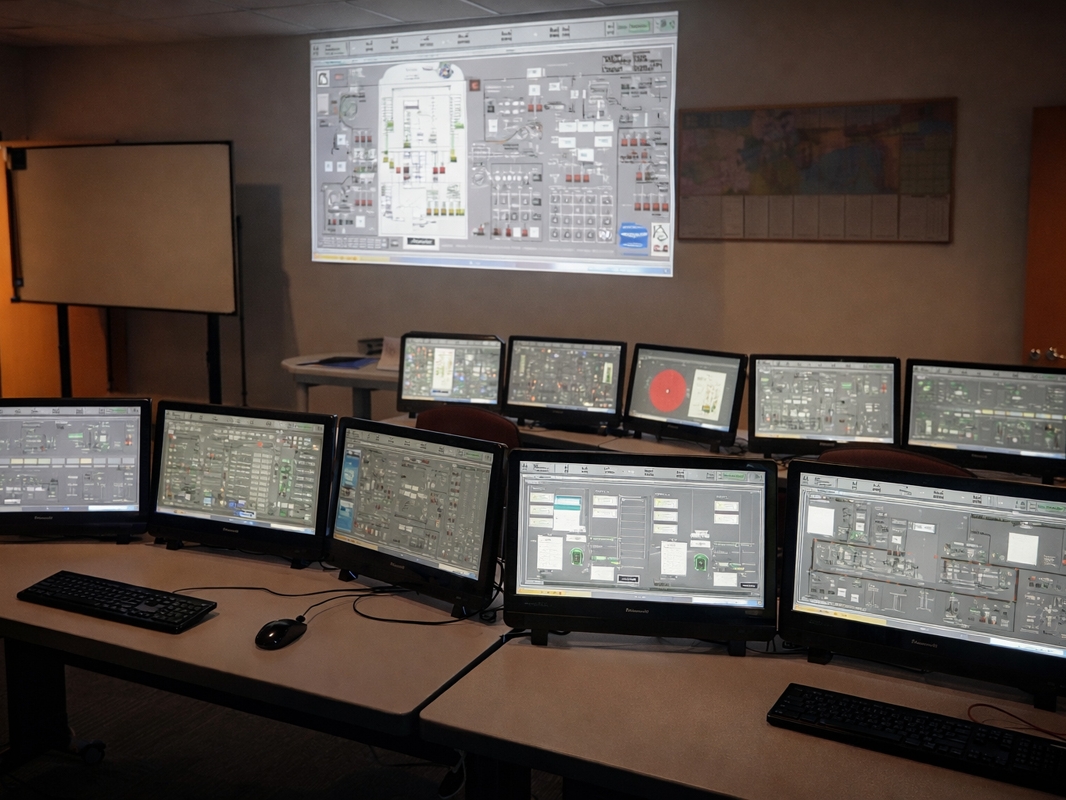
A nuclear reactor simulator made by WSC Inc. (Photo: WSC Inc.)
The United States Embassy and Consulate in Kazakhstan announced in December that the two countries are expanding their partnership in civil nuclear energy with a new educational initiative about small modular reactors.
The Department of State’s Foundational Infrastructure for Responsible Use of Small Modular Reactor Technology (FIRST) program will provide the Kazakhstan Institute of Nuclear Physics with an SMR classroom simulator. The simulator will be produced by Florida-based energy technology company Holtec International and WSC Inc., a Maryland-based developer of simulation technology that is a subsidiary of Curtiss-Wright.
Regional training hub: The SMR classroom simulator, which will be located in Almaty, Kazakhstan’s largest city, will serve as a regional training hub designed to facilitate the safe and secure deployment of SMRs in Kazakhstan and throughout Central Asia. According to the embassy announcement, “This new facility is a critical step in developing the workforce to expedite U.S. SMR deployment with trustworthy vendors who meet the highest nuclear security, safety, and nonproliferation standards.”
Feasibility study: In a second SMR initiative, the FIRST program, in partnership with Chicago-based energy architecture-engineering firm Sargent & Lundy, has launched an SMR feasibility study in Kazakhstan. The goal of the study is to “identify a shortlist of U.S. SMR options suitable for deployment at potential sites in Kazakhstan.”
According to the embassy, Kazakhstan is the first Central Asian partner for the FIRST program, began in 2021.
Closer look: The Kazakh government currently has agreements with Russia and China to build large nuclear reactors, which are scheduled for completion in the mid-2030s, and the government previously had not indicated an interest in constructing SMRs. However, SMRs could help fulfill President Kassym-Jomart Tokayev’s plans to bring AI data centers and greater electricity-generating capacity to the country.
Kazakhstan’s new SMR initiatives with the United States may reflect doubts within the Kazakh government that Russia’s Rosatom will be able to meet the projected timeline to build the large VVER-1000 reactors.

-3 2x1.jpg)
.png)