
-3 2x1.jpg)
High-Temperature neutron flux detectors for Generation IV reactors and SMRs
Curtiss-Wright’s new 800°C fission chamber could reshape instrumentation layouts in next-generation systems
-3 2x1.jpg)
Curtiss-Wright has successfully tested several full prototypes of a new high temperature neutron flux detector that we have developed to operate at up to 800°C, a necessary feature for many new reactor types. The new detectors are fission ionization chambers and the prototypes were constructed in our own facilities, which we use to manufacture our mature detector designs that operate at up to 600°C in the UK’s AGR fleet. Curtiss-Wright has a comprehensive suite of reactor protection electronics and the new detector is designed to complement our Guardline™ reactor protection system.
Gen IV reactor conditions
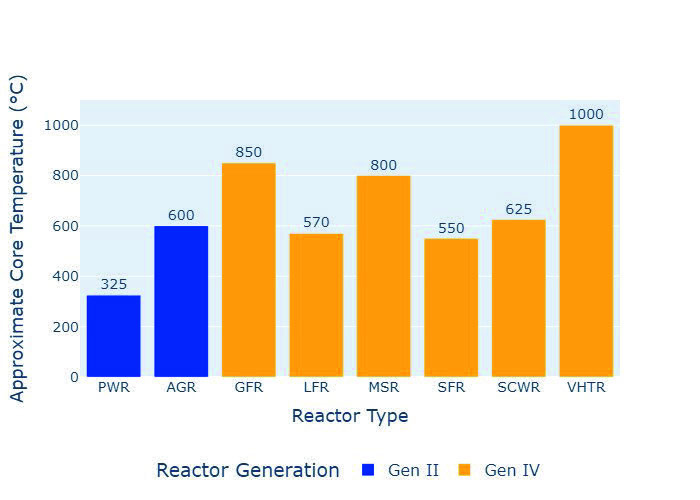 Generation IV and small modular reactors (SMRs) aim to be cheaper, safer and more efficient. However, many designs will operate at higher temperatures than earlier designs, use more compact cores and integrate systems that pose operational challenges for traditional instrumentation. These advances demand new solutions for neutron flux monitoring, the fundamental measure of reactor power and safety.
Why neutron flux matters
Neutron flux is the prime indication of power level that informs safety systems, and guides startup, shutdown and transient control. Neutrons don’t travel far outside the core necessitating neutron flux instruments to be close to the hot core regions. Commercial pressurized water reactor (PWR) instruments typically operate below 300°C. AGR detectors extend that range up to a maximum of 600°C, but future reactor concepts such as hightemperature gas reactors and molten-salt designs will expose sensors to much hotter conditions.
Engineering for extreme heat
At such high temperatures, materials behave in ways that challenge conventional detector designs. Thermal expansion, distortion and material outgassing can change the detector’s structure, gas composition, ionization behavior, and even coat insulators, increasing leakage currents and noise.
The detector’s body is made from a nickel alloy, chosen for its excellent creep and corrosion resistance at 800 °C. Ceramic components of alumina (Al₂O₃) and magnesium oxide (MgO) provide electrical isolation, and carefully matched materials prevent stress from thermal expansion.
To handle the delicate signal path, the team used a proprietary triaxial mineral-insulated (MI) cable capable of operating at 800°C - copper conductors embedded in MgO and housed within a stainlesssteel sheath. This configuration maintains insulation and shielding integrity even in harsh radiation and temperature environments.
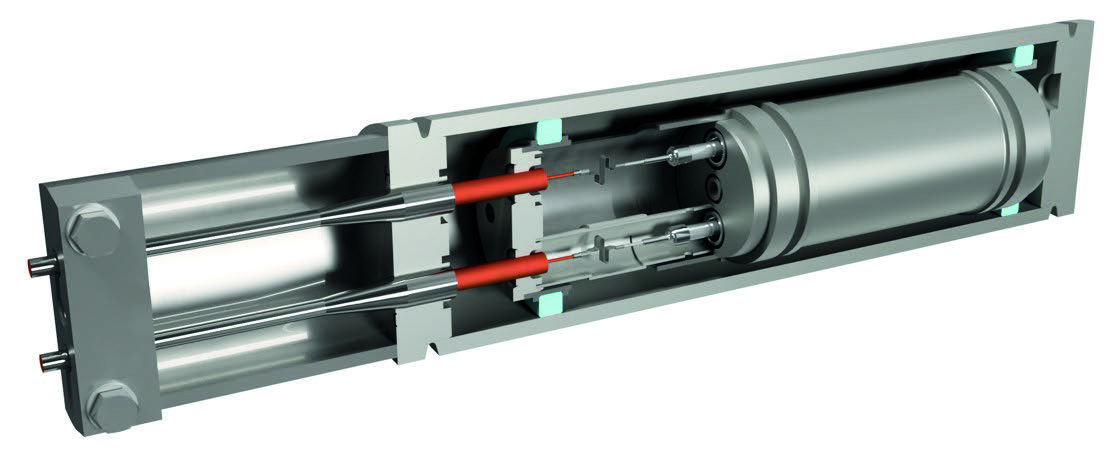
CAD model of our high temperature detector design
By simplifying assembly, the design reduces potential failure modes and supports consistent, repeatable manufacturing. The detector uses a U- 235 coating as its neutron-sensitive layer, operating in pulse, Campbell (mean-square voltage), and DC modes - allowing a single device to measure over ten decades of neutron flux providing a signal for a reactor core from start-up to full power.
Tested in the lab and test reactor
Several complete prototypes were built and evaluated through a combined laboratory and reactor test program at Curtiss-Wright’s Wimborne site and at a third party research reactor to validate performance under reactor conditions and reactor neutron flux levels.
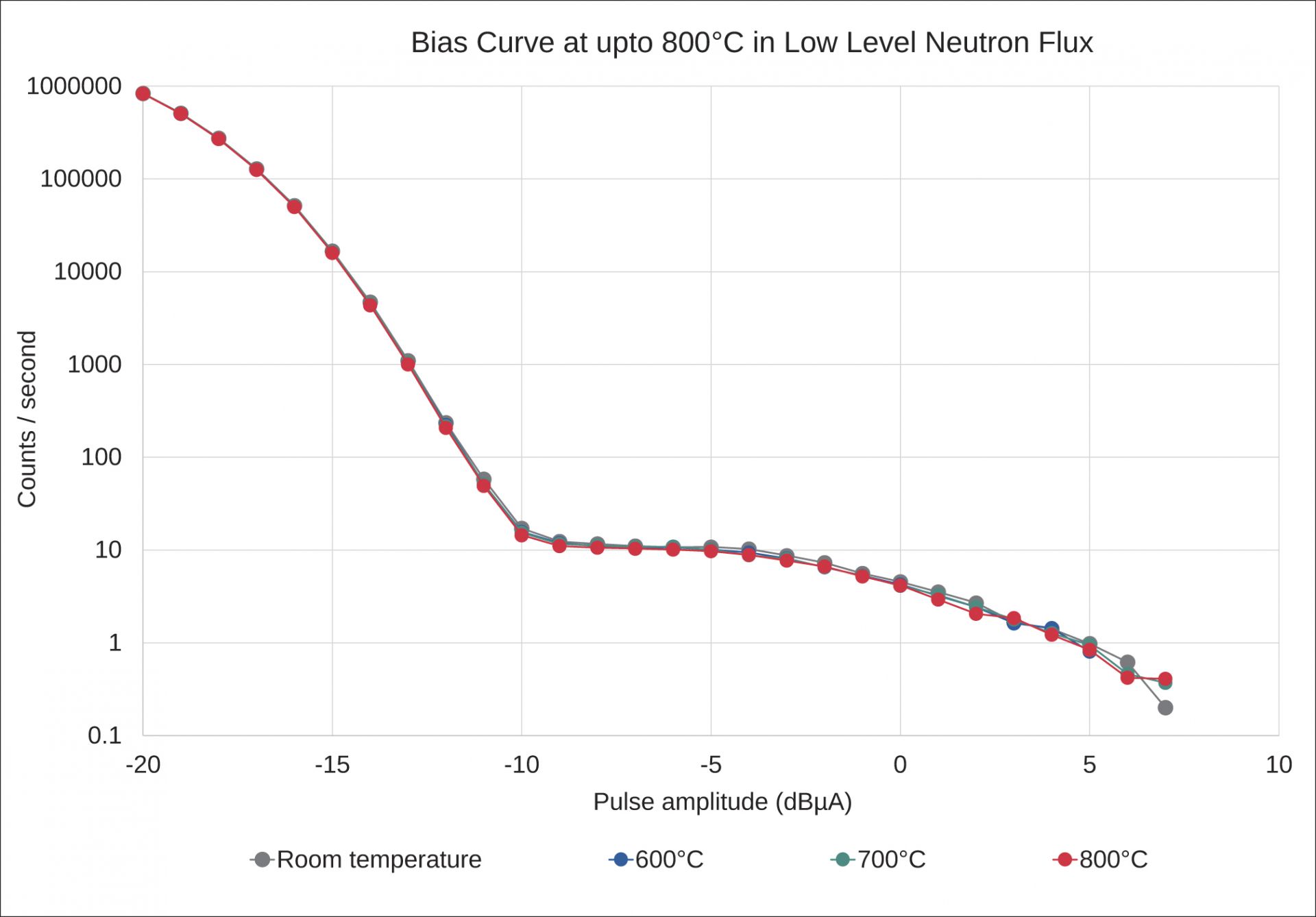
A subset of test data is shown below confirming stable behavior, stable signal-to-noise characteristics, and linear response to neutron flux when operating at up to 800°C. The first plot shows a bias curve in a fixed low level neutron flux (consistent with reactor start-up) at various temperatures with consistent results.
 Results below show stable output and linear response up to flux levels of about 5 × 10¹¹ nv when recording a DC signal current consistent with neutron flux and signals for a reactor that is at (or approaching) full power.
 These outcomes demonstrate practical readiness for further qualification and eventual use in advanced reactor systems.
Implications for future reactor designs
Reliable neutron monitoring at 800°C could transform how instrumentation is integrated into Gen-IV reactors and SMRs. High-temperature-capable detectors and cabling allow sensors to be positioned closer to the core, improving accuracy and reducing the need for complex cooling or signal-conditioning arrangements.
A single, wide-range detector that spans pulse, Campbell, and DC operation also simplifies system design by reducing the number of discrete detectors needed. Together, these advances could cut instrumentation complexity, enhance reliability, and lower plant cost.
Next steps
As advanced reactor programs pursue higher thermal efficiency and more compact configurations, instrumentation capable of keeping pace will be critical. High-temperature neutron flux detectors like these represent a practical, near-term step toward that future.
Curtiss-Wright is now conducting additional reactor tests and long-duration trials to establish lifetime and stability data. Our aim is to supply this detector as part of a complete reactor protection system which can be tailored to customer needs.
 Curtiss-Wright maintains one of the most comprehensive and diverse portfolios of high-performance components, advanced technologies, and critical services to support the global nuclear power industry.
For over 65 years, our customers have relied upon our expertise and innovative solutions to enhance the safety, reliability, and performance of nuclear plants and facilities.