Savannah River Mission Completion, the SRS liquid waste contractor for the DOE’s Office of Environmental Management, is responsible for the treating and disposing of the millions of gallons of waste remaining in underground tanks at the site, as well as closing the tanks.
Before an emptied waste tank can be filled with grout—deeming it operationally closed—SRMC cleans the tank and collects samples of residual material left in the unit. Sampling helps confirm that the cleaning process has been effective and that the tank no longer contains significant residues of high-level radioactive waste.
Old way, new way: Traditionally, residual waste inside the tank had to dry through evaporation before a remote crawler could be inserted into the tank to obtain the samples—a waiting period that could take six months or more before sampling could move forward.
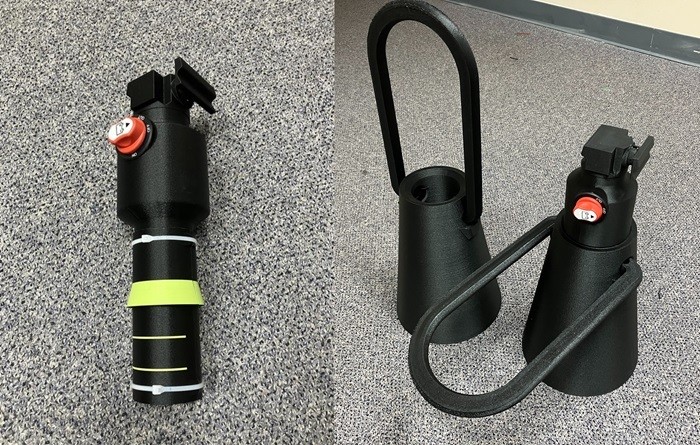
The new sampling tool, however, eliminates the need for evaporation by way of a centrifuge. According to the DOE, SRMC engineers designed, refined, and developed a centrifugal sampling tool using parts manufactured with a 3D printer, resulting in a cost-effective and efficient solution. The centrifugal tool allows sampling to occur much sooner, thus achieving operational closure sooner, which reduces risk to the environment.
The DOE said the new tool recently proved successful in SRS's Tank 9 and will reduce the sampling schedule by eliminating the need for the waste tank to be dry before sample collection.
How it works: The sampling tool is lowered into the waste tank through an access port, called a riser, along with a transport basket, which was also 3D printed. A remote crawler picks up the transport basket with the sampling tool inside, drives it to the sample location, and then picks up the sampling tool and activates it.
“This team thought outside the box and gave us an innovative way to make a significant leap forward in the tank closure process,” SRMC president and program manager Thomas Burns Jr. said.
Tony Robinson, DOE–Savannah River acting assistant manager for waste disposition, added, “This new sampling tool and the preliminary cease waste removal [PCWR] milestones will significantly advance the SRS liquid waste program safely and efficiently."
Noted: PCWR is a regulatory milestone for old-style tanks that designates agreement between DOE-EM, the U.S. Environmental Protection Agency, and the South Carolina Department of Environmental Services that there is reasonable assurance that performance objectives for tank closure will be met.
PCWR approval means that work can begin on the sampling and analysis phase of the tank closure process. SRMC recently completed PCWR for seven old-style tanks years ahead of the SRS Federal Facility Agreement schedule.

-3 2x1.jpg)